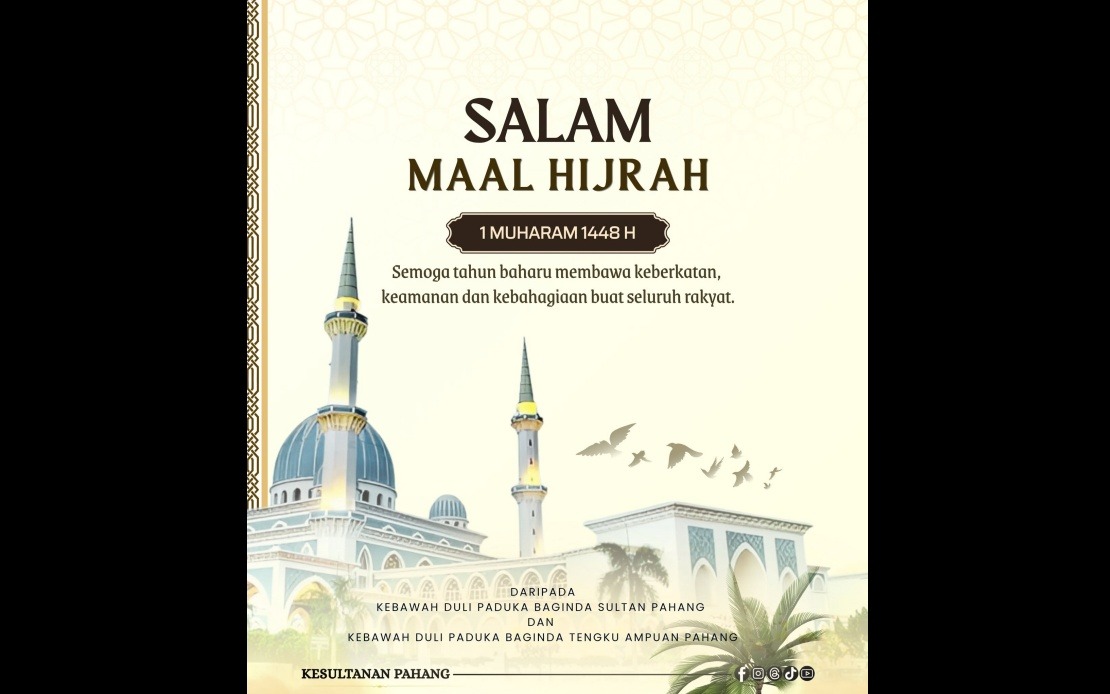
The Sultan of Pahang, Al-Sultan Abdullah Ri'ayatuddin Al-Mustafa Billah Shah, and the Tengku Ampuan of Pahang, Tunku Azizah Aminah Maimunah Iskandariah, have issued Maal Hijrah 1448H greetings to the Muslim community across the state, marking the beginning of the Islamic new year with messages of hope and spiritual renewal.
Through a statement posted on the official Facebook page of Kesultanan Pahang, the royal couple extended their warm wishes to residents, expressing confidence that the new Islamic year would usher in an abundance of blessings, tranquility, and contentment for all citizens. The gesture reflects the traditional role of Malaysian monarchs in providing spiritual guidance during significant Islamic occasions, reinforcing the constitutional position of sultans as custodians of Islam in their respective states.
Pahang Menteri Besar Datuk Seri Wan Rosdy Wan Ismail amplified these sentiments through his own message, positioning the Islamic new year as an opportune moment for Muslims to reassess their personal commitments and deepen their religious observance. His statement underscored the significance of Maal Hijrah not merely as a calendar milestone, but as a catalyst for meaningful introspection and spiritual progression within the Muslim population.
The Menteri Besar's remarks carry particular weight in the Malaysian context, where state leaders often align public discourse around Islamic occasions with broader developmental and social agendas. By invoking the spirit of Prophet Muhammad's Hijrah—the foundational migration narrative in Islam—Wan Rosdy connected individual spiritual renewal to collective responsibility, encouraging citizens to channel their faith into tangible improvements in governance, integrity, and social cohesion.
In his statement, the Menteri Besar articulated a comprehensive vision encompassing several interconnected themes. He called upon residents to harness the symbolic power of the new Islamic year to initiate personal transformations while simultaneously strengthening the bonds of unity within Pahang's diverse communities. The emphasis on integrity and ethical conduct reflects a recurring message in official Malaysian discourse, particularly relevant given ongoing discussions about governance standards and public trust in institutions.
Wan Rosdy's invocation of enhanced charitable works carries significance beyond religious observance, tapping into Islamic principles that emphasize social responsibility and communal welfare. In a state like Pahang, where economic disparities and development challenges persist alongside wealth from natural resources, such messages from state leadership serve to reinforce expectations that religious commitment should translate into practical support for vulnerable populations.
The connection drawn between personal faith renewal and state development is noteworthy, as it reflects how Malaysian political and religious leadership frequently interweaves spiritual narratives with administrative objectives. By framing the Islamic new year as an opportunity to strengthen commitment to developing Pahang and improving citizen welfare, the Menteri Besar positioned religious observance as complementary to economic and social policy rather than separate from governance concerns.
The dual leadership message—from both royal and executive authority—demonstrates the coordinated approach that characterizes religious communication in Malaysian sultanates. Such synchronization reinforces official narratives and ensures consistency in messaging, while also reflecting the hierarchical relationship between the Sultan's spiritual authority and the Menteri Besar's administrative responsibility within the state structure.
For Malaysian Muslims generally, and Pahang residents specifically, these messages serve multiple functions beyond ceremonial greeting. They affirm the state's recognition of Islamic occasions as moments worthy of collective pause and reflection, validate the integration of religious values into public discourse, and implicitly encourage citizens to align personal aspirations with officially endorsed frameworks of integrity, unity, and community service.
The timing and content of these statements also provide insight into how Malaysian state governments utilize religious observances strategically. By issuing Maal Hijrah messages that connect spiritual renewal to development and governance improvement, leaders effectively position the Islamic calendar as a resource for promoting their policy priorities. This approach has become standard practice across Malaysia's sultanates, where Islamic occasions function simultaneously as religious milestones and platforms for reinforcing state narratives about progress and national values.

%22%2F%3E%3C%2Fpattern%3E%3C%2Fdefs%3E%3Crect%20width%3D%22100%25%22%20height%3D%22100%25%22%20fill%3D%22url(%23ph40buhg)%22%2F%3E%3Crect%20width%3D%22100%25%22%20height%3D%22100%25%22%20fill%3D%22url(%23ph40buhp)%22%2F%3E%3Ctext%20x%3D%2250%25%22%20y%3D%2250%25%22%20text-anchor%3D%22middle%22%20dominant-baseline%3D%22central%22%20fill%3D%22rgba(255%2C255%2C255%2C0.95)%22%20font-family%3D%22Georgia%2C%20'Times%20New%20Roman'%2C%20serif%22%20font-weight%3D%22700%22%20font-size%3D%22320%22%20letter-spacing%3D%22-0.02em%22%3EGRS%3C%2Ftext%3E%3C%2Fsvg%3E)