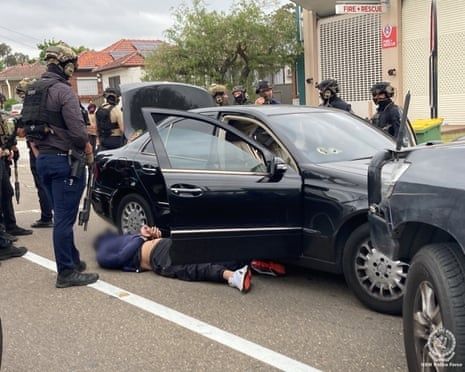
New South Wales police have intensified their crackdown on violent and sexual crime affecting public transport users, announcing the arrest of 356 individuals during the sixth phase of Operation Waratah. The three-day enforcement blitz, conducted from Thursday to Saturday of last week, deployed more than 400 officers daily across trains, buses, light rail trams and ferries throughout the state, reflecting the scale of resources now directed at tackling transit-related offences.
The operation, which was initiated in 2024 specifically to combat violence and sexual assault on public transport, has reached a cumulative milestone of over 1,800 arrests since its inception. This escalating enforcement activity underscores the NSW Police Force's commitment to creating safer commuting environments as cities across Australia grapple with rising concerns over anti-social behaviour on transit networks. The progression from earlier phases to the current sixth iteration suggests both an expansion in police strategy and an apparent persistence of the underlying problem.
During the three-day operation, police recorded 645 combined offences across the 356 arrests, indicating that many detainees faced multiple charges. Officers also confiscated 28 knives and other weapons and logged 137 separate drug-related detections, suggesting that the violence and sexual assault issues on public transport are frequently intertwined with substance abuse and weapons possession. These figures reveal the complexity of transit crime and the range of criminal activities officers encounter when patrolling commuter networks.
The scale of the operation's footprint across NSW's public transport infrastructure was substantial. Patrols covered 539 trains, 127 buses and 29 light rail trams during the three-day window alone, demonstrating the concentration of police presence required to provide visible deterrence across such dispersed networks. This granular deployment approach contrasts with traditional broader policing and reflects evidence-based targeting of high-risk times and locations where passengers are most vulnerable.
For Malaysian readers, the Operation Waratah model offers relevant lessons as Southeast Asian cities including Kuala Lumpur continue to expand rapid transit systems. Public transport safety has emerged as a critical concern in Malaysia's own development of integrated light rail and bus networks. The NSW initiative reveals both the potential effectiveness of concentrated law enforcement operations and the underlying challenge of sustaining safety improvements once police resources are redeployed elsewhere.
The weapons seizures during the operation highlight a concerning dimension of transit crime. The confiscation of 28 knives and other implements in just three days suggests that a significant proportion of public transport users carrying weapons may not be engaged in active violence at the time of arrest, but rather represent a persistent risk factor that armed presence can inflame into actual harm. This reality complicates police response strategies, which must balance deterrence, de-escalation and prevention.
The drug detections documented across the enforcement phase indicate that substance abuse frequently accompanies transit crime. The 137 drug-related incidents recorded during Operation Waratah's latest iteration suggest that addressing public transport violence may require coordinated responses spanning law enforcement, health services and addiction support. Many perpetrators arrested may cycle through justice systems without access to rehabilitation pathways that could interrupt patterns of offending behaviour.
Operation Waratah's continuation into successive phases signals that one-off enforcement campaigns have proven insufficient to permanently reduce transit crime. The necessity for a sixth phase after less than a year of operation suggests that arrests, while important for immediate public safety, do not automatically resolve underlying drivers of violence on public transport. Systemic factors including mental health crises, homelessness, economic disadvantage and substance dependence likely contribute to the persistence of offending despite significant police intervention.
The NSW Police Force's sustained commitment to the operation reflects both community pressure and institutional recognition that public transport is a particular vulnerability point for commuters. Passengers boarding trains and buses have limited ability to avoid situations, cannot easily retreat to safety once assaulted, and often travel during evening hours when visibility and assistance are reduced. These structural vulnerabilities make transit networks attractive environments for offenders seeking victims with few escape options.
Looking forward, the effectiveness of Operation Waratah will depend on whether arrest numbers translate into actual reductions in transit crime victimisation rates. Arrest statistics alone do not capture whether passengers feel safer using public transport, whether crime has simply relocated to non-surveilled areas, or whether the operation's temporary intensity produces lasting behavioural change among would-be offenders. Measuring true impact requires longitudinal data on crime patterns extending well beyond enforcement phases.
The operation also raises questions about resource allocation and sustainability. Deploying over 400 officers daily across an entire state's public transport network requires unprecedented concentration of police capacity. While operationally justified in the short term, such intensive operations cannot reasonably be sustained indefinitely without compromising other policing functions. This constraint suggests that ongoing transit safety ultimately requires complementary strategies beyond enforcement, including better environmental design, integrated security technology, and community-based interventions targeting root causes of violence.

