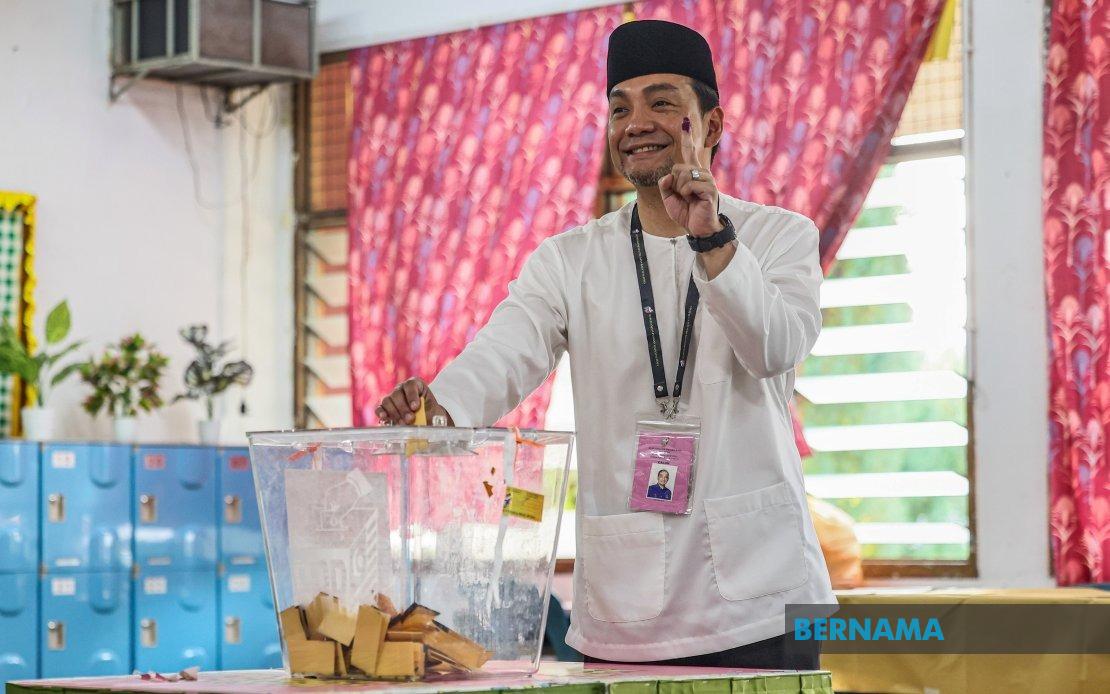
Johor Menteri Besar Datuk Onn Hafiz Ghazi exercised his democratic right on July 11 by casting his ballot at Sekolah Kebangsaan Simpang Renggam at 8.33 am during the 16th Johor state election. The senior politician, who also chairs the Johor Barisan Nasional coalition, demonstrated the common practice among election day candidates by arriving early to vote, setting an example for other eligible citizens to do likewise.
Before proceeding to Stream 4 to deposit his ballot, Onn Hafiz took the opportunity to engage with voters assembled at the polling station. The informal interaction underscored a traditional aspect of Malaysian electoral politics, where candidates and party leaders often use polling day to strengthen grassroots connections and reinforce their accessibility to constituents. His presence at the venue reflected the competitive nature of the contest and the campaign's personal dimension.
Onn Hafiz's candidacy this election cycle represents an attempt to consolidate his grip on the top state office. Facing him in a straight two-way contest is Nur Hafiz Roslan, the Pakatan Harapan challenger who represents the main opposition bloc's challenge to Barisan Nasional's control over Johor's executive branch. This direct confrontation between the two major coalitions underscores the polarisation within Malaysian state politics, where contests frequently boil down to a BN-versus-PH dynamic following the 2018 federal election upheaval.
Speaking to assembled journalists immediately after voting, Onn Hafiz delivered the conventional appeal for public participation in the electoral process. He emphasised the importance of early turnout, framing voter engagement not merely as a political gesture but as a civic obligation rooted in Malaysia's democratic framework. His comments reflected broader concerns about voter fatigue and declining participation rates that election officials frequently encounter during state polls.
Concurrently, Dr Maszlee Malik, the Pakatan Harapan candidate contesting the Puteri Wangsa state seat, arrived at SJK (C) Tuan Poon in the same locality at 8.58 am to cast his ballot. The former federal education minister's participation highlighted the involvement of nationally-recognised political figures in state-level contests, a pattern common in Malaysian elections where federal personalities frequently contest or campaign in state races to bolster their coalitions' electoral prospects.
The Puteri Wangsa contest presented a more fragmented electoral landscape compared to the direct two-way races dominating other constituencies. Dr Maszlee contended against four opponents spanning multiple political entities: Rashifa Aljunied representing the Malaysian United Democratic Alliance, a newer political actor attempting to carve electoral space; Teow Chia Ling standing as the Barisan Nasional standard-bearer; Nicholas Paul Vincent fielding Parti Bersama Malaysia's colours; and independent candidate Wang Wee Siong offering voters a non-partisan option.
This five-way competition reflected wider fragmentation within Malaysia's opposition politics, where Pakatan Harapan's dominance faces increasing pressure from smaller parties and independent candidates. The Malaysian United Democratic Alliance's participation in particular underscores evolving dynamics within the broader anti-establishment political ecosystem, as newer movements attempt to differentiate themselves from established opposition coalitions.
The Johor state election represented a significant electoral moment for the second-largest state in Malaysia by economic output. State elections in major economic centres carry disproportionate weight within national political discourse, influencing perceptions of coalition strength and momentum ahead of potential federal electoral contests. Johor's governance directly impacts the broader Southeast Asian region given its role as a manufacturing hub and strategic border territory with Singapore.
The polling process itself demonstrated Malaysia's established electoral infrastructure, with multiple voting streams organised to manage voter flow efficiently. The deployment of Stream 4 and other designated voting channels reflected standard operational procedures developed through decades of electoral administration experience. These procedural mechanisms, while routine, remain essential to maintaining electoral credibility and public confidence in democratic processes.
Voter participation patterns on election day typically signal broader engagement levels within constituencies, with early morning turnout often correlating with overall election intensity. The appearance of prominent political figures like Onn Hafiz and Dr Maszlee at polling stations during morning hours frequently receives media attention, generating news cycles that potentially influence subsequent voter behaviour and participation through the day.

