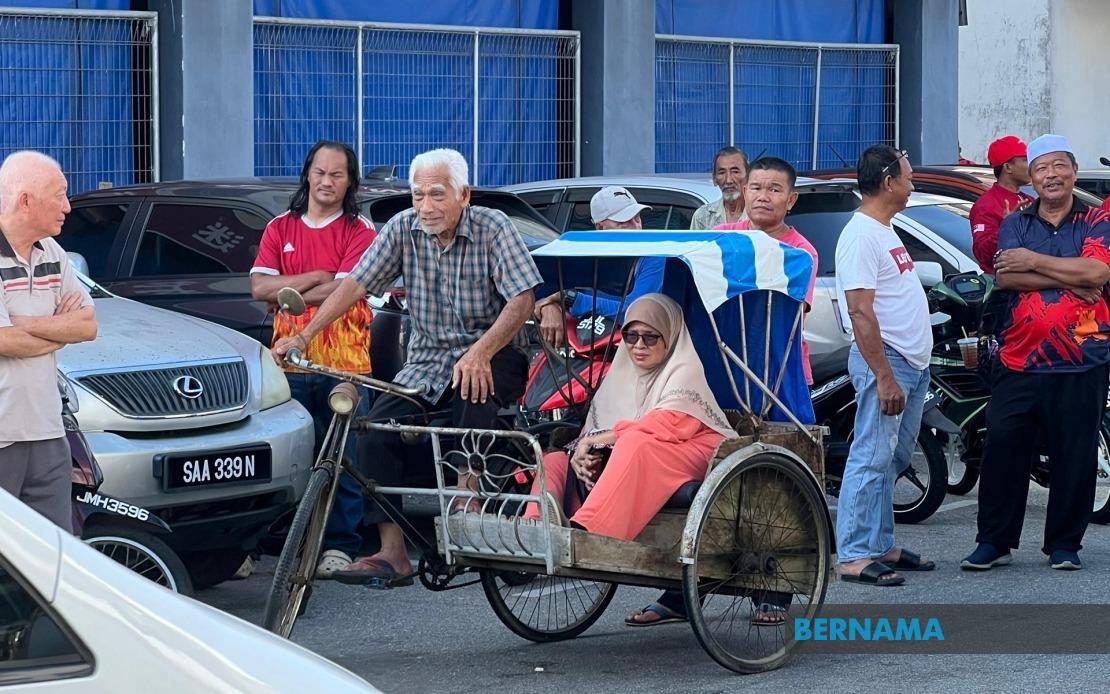
The intense heat of a Johor afternoon proved no obstacle for Abdul Razak Pelangga, an 86-year-old trishaw operator, who pedalled his traditional three-wheeled vehicle nearly a kilometre through the streets of Batu Pahat to realise his wife's long-held wish of seeing Prime Minister Datuk Seri Anwar Ibrahim in person. The journey from their home in Kampung Parit Bugis to Kedai Kopi Hailam Sri Medan in Senggarang, undertaken on July 5, captured the kind of grassroots political engagement that occasionally surfaces during election campaigns, offering a snapshot of how even the oldest segments of Malaysian society remain invested in national leadership.
Abdul Razak, accompanied by his wife Jamilah Samsudin, 64, had learned the previous day that the Prime Minister would be making a breakfast stop at the coffee shop during a campaign swing through the constituency. Rather than driving a car or riding a motorcycle, he made the deliberate choice to pedal his trishaw, a decision rooted not in romance or symbolism but in practical pragmatism—he sought to avoid the complications of finding a parking space in the busy town. This detail underscores how even in moments of political significance, Malaysian citizens navigate the quotidian realities of urban congestion and spatial constraints.
The Imam's personal history with Anwar Ibrahim added another dimension to his motivation. Many years before the current Prime Minister ascended to the nation's highest office, he had visited the Masjid Raudhatul Jannah Parit Bugis to perform prayers, where Abdul Razak led the congregational service. The encounter left an impression—he remembered Anwar as friendly and approachable, an interaction that Abdul Razak had recounted to his wife multiple times over the intervening years. For the elderly imam, the opportunity to bring his wife to witness the same man, now holding the top position in government, represented a chance to bridge personal memory with national significance.
When Abdul Razak arrived at the coffee shop with his wife, the gathering had grown substantial enough that a direct, face-to-face meeting with the Prime Minister proved impossible. Nevertheless, the couple managed to observe Anwar from a reasonable distance as he spent approximately fifty minutes at Kedai Kopi Hailam Sri Medan, mingling with local residents as part of the PMX Meet-and-Greet Programme. For Abdul Razak and Jamilah, having seen the Prime Minister in the flesh, rather than only through the mediated lens of television screens, sufficed to fulfill the intention behind their morning expedition. This distinction—between witnessing a political figure directly versus through broadcast media—held genuine meaning for people who had spent most of their lives in an era when such direct observation required deliberate effort.
The visit to Senggarang formed part of Anwar's broader campaign engagement with the Johor state election, with Communications Minister Datuk Fahmi Fadzil, who also serves as Pakatan Harapan Communications Director, accompanying the Prime Minister during the event. The meet-and-greet format, increasingly common in Malaysian electoral politics, attempts to create informal spaces where citizens and political leaders can interact without the formality of structured political rallies or speeches, though circumstances often prevent the intimacy such formats theoretically promise.
Beyond the immediate pleasure of seeing the Prime Minister, Abdul Razak viewed his forthcoming participation in the election itself as personally significant. Polling for the 16th Johor state election was scheduled for July 11, a date that coincided with his 87th birthday. Although he had exercised his voting rights on numerous previous occasions throughout his long life, this particular election held special meaning because he would be fulfilling his civic duty on the anniversary of his birth. He articulated this connection not as whimsy but as a genuine source of satisfaction, suggesting how individual life milestones can intersect with broader civic participation.
The early voting period for the election was set for July 7, providing voters with an alternative to the main polling date two days later. The scheduling reflected standard election administration practice designed to accommodate those who might face challenges voting on the principal election day. For Abdul Razak, the symbolism of voting on his birthday appeared to matter more than the practical flexibility the early voting option provided.
This incident, while seemingly modest in scope, illuminates several dimensions of Malaysian political engagement. The willingness of an octogenarian to undertake physical exertion in unfavourable weather conditions to witness a political leader demonstrates that enthusiasm for political participation transcends age cohorts, even if such enthusiasm occasionally manifests in unexpected ways. The trishaw ride itself, a quintessentially Malaysian mode of transport increasingly rare in urban areas, carried implicit commentary on continuity and change—an elderly man using traditional transportation to observe a contemporary political moment.
Moreover, the couple's journey reflects the persistent gap between mediated and direct political experience. Despite Malaysia's advanced media infrastructure and the ubiquity of political coverage through television and digital platforms, the prospect of seeing a national leader in person retained sufficient appeal to motivate a couple to travel through oppressive heat. This hunger for direct observation, even when such observation remains largely passive and distant, suggests that political engagement encompasses dimensions beyond information consumption or rational policy evaluation.
The broader context of Johor's state election also merits consideration. As one of Malaysia's most politically competitive states, Johor elections typically generate considerable campaign activity and voter interest. The Prime Minister's personal engagement in campaigning, participating in community-level meet-and-greet sessions rather than confining himself to major rallies, reflects the competitive intensity that state elections in Johor command. For Pakatan Harapan, such grassroots engagement represents an attempt to maintain momentum and demonstrate continued connection with the electorate between major electoral events.
Abdul Razak's narrative also touches upon the relationship between individual memory and political leadership. His recollection of Anwar's earlier visit to his mosque, and his desire to share that memory with his wife by observing him again in his current capacity, exemplifies how political figures accumulate personal histories with citizens across the years. These accumulated interactions, while seemingly inconsequential from a governance perspective, contribute to the texture of political legitimacy and public connection that sustains electoral systems.
For Malaysia's electoral observers, the story of an elderly man pedalling his trishaw through the Johor heat serves as a reminder that political engagement manifests across diverse registers and motivations. Not all participation emerges from sophisticated policy analysis or ideological conviction; sometimes it stems from the desire to witness significant figures in one's community, to share experiences with loved ones, or to mark personal milestones through civic participation. Understanding these varied dimensions of engagement provides fuller appreciation of how electoral democracies function beyond the quantifiable metrics of campaign spending or voter turnout percentages.

