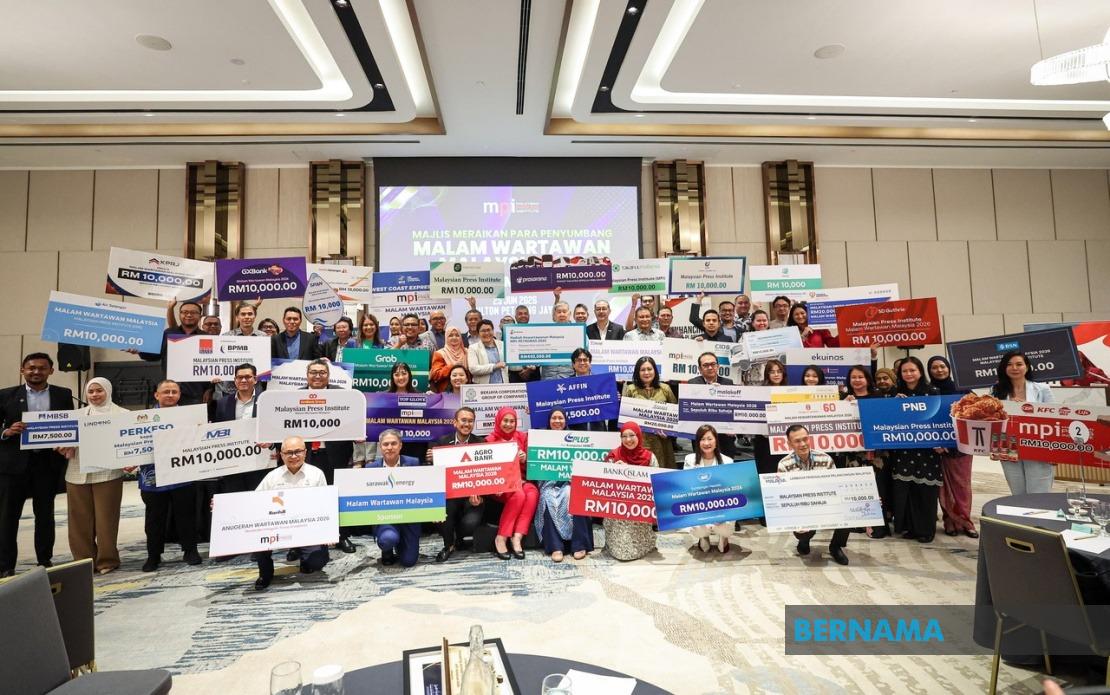
The Malaysian Press Institute (MPI) has successfully secured RM1.037 million in financial backing for the upcoming Malaysia Press Night (MWM) 2026, scheduled to take place next month in Kuala Lumpur. The announcement was made at a Contributors' Appreciation Ceremony held today, highlighting the strong institutional and corporate support for an event that has become a cornerstone of Malaysia's media calendar. This year's edition carries particular significance with confirmation that Prime Minister Datuk Seri Anwar Ibrahim will attend the July 17 ceremony, underscoring the government's continued commitment to recognising the role of journalism in national development.
The funding package comprises two distinct revenue streams, each reflecting different stakeholder engagement with the initiative. Organisational contributions totalling RM587,000 came from 60 different entities across the corporate, government and media sectors, demonstrating broad-based confidence in the event's mission and impact. Complementing this grassroots support is a substantial RM450,000 sponsorship commitment from PETRONAS, the national petroleum corporation, which has maintained a continuous partnership with MPI for journalism excellence since 1994. This three-decade association represents one of the longest-running corporate commitments to media awards in Southeast Asia, reflecting the energy giant's recognition that quality journalism serves the broader interests of economic stability and informed public discourse.
Dr Ainol Amriz Ismail, chief executive officer of MPI, articulated the deeper significance of this financial mobilisation beyond mere event logistics. In remarks delivered at the ceremony, he characterised the contributions as manifestations of a shared institutional philosophy prioritising professional standards, ethical conduct and trustworthiness in news gathering and reporting. This framing is particularly relevant in Malaysia's current media landscape, where concerns about misinformation, partisan reporting and declining public trust in news institutions have intensified. By positioning Malaysia Press Night as a celebration of rigorous journalism rather than merely a social gathering, MPI is attempting to reinvigorate professional identity among practitioners and reinforce public perception of media's essential democratic function.
The governance and institutional leadership present at the ceremony underscored the event's establishment status within Malaysian media circles. MPI President Datuk Yong Soo Heong, alongside deputy president Farrah Naz Abd Karim, represented the institute's elected leadership. Datin Paduka Nur-ul Afida Kamaludin, a governing council member and chief executive of Bernama (Malaysia's national news agency), brought the perspective of state media infrastructure. PETRONAS's Jalina Joheng, general manager for Strategic Communications, Channels and Media Relations, embodied corporate sector engagement. This constellation of senior figures demonstrates that Malaysia Press Night operates within formally established networks of institutional power and coordination, distinguishing it from peer recognition events that might lack such embedded authority structures.
Prime Minister Anwar Ibrahim's scheduled attendance carries implications extending beyond ceremonial protocol. His presence signals governmental endorsement of journalism as a profession worthy of state-level recognition, a positioning that becomes increasingly important as global pressures on press freedom intensify. For Malaysian journalists operating in an environment marked by varied regulatory constraints and occasional political tensions with news organisations, the attending of a sitting prime minister at a celebration of their profession represents substantive, if symbolic, affirmation of journalism's legitimacy within the national institutional order. The choice of July 17 for this year's ceremony suggests careful scheduling around parliamentary and governmental calendars.
The MPI-PETRONAS Malaysian Journalism Awards, for which PETRONAS provides cash prizes, have emerged as the region's most established journalism competition, with roots extending back to 1994. This continuity across three decades reflects the award programme's success in maintaining professional credibility and participant engagement despite Malaysia's evolving media landscape, including the transition from print-dominated to digital-centric news ecosystems. The longevity of PETRONAS's partnership suggests that corporate sponsorship of journalism awards serves functions beyond public relations, including stakeholder investment in maintaining professional standards within an industry that shapes public understanding of corporate and governmental performance.
Dr Ainol's remarks emphasised MPI's implementation of professional development programmes, industry training and initiatives benefiting Malaysia's broader media community. These functions have grown increasingly important as news organisations grapple with technological disruption, economic pressures on advertising-dependent business models, and shifting audience consumption patterns. MPI's positioning as an institutional provider of training and professional development responds to market failures whereby individual news organisations lack resources for comprehensive staff development, particularly in emerging areas like digital journalism, data literacy and multimedia production. The securing of RM1 million in contributions provides the financial foundation for scaling these services across the Malaysian media sector.
This year's Malaysia Press Night programme featured a forum format bringing together prominent figures across Malaysia's media ecosystem. Malaysian Journalism Icon Datuk A. Kadir Jasin, representing the elder statesman tradition of investigative journalism, shared the panel with Firdaus Hussamuddin of Karangkraf Group, one of Malaysia's largest magazine and publishing operations. TV AlHijrah's chief executive officer Namanzee Harris brought representation from Malaysia's Islamic-focused broadcaster, while Thiaga Rajan Muthusamy of Vanakkam Malaysia represented minority-language and community journalism segments. This deliberate diversity of panel voices suggests MPI's intention to position Malaysia Press Night as inclusive of Malaysia's heterogeneous media landscape, acknowledging that journalism in Malaysia operates across multiple linguistic, religious and community contexts.
The moderator selection of Ally Iskandar, an established broadcast personality and journalist, further underscored the professional calibre of the forum's orchestration. Such careful attention to panel composition and facilitation reflects institutional understanding that media industry events function as spaces where professional norms are constructed and reinforced. By assembling panellists spanning different media segments and professional traditions, MPI facilitated conversation likely addressing tensions and synergies across Malaysia's fragmented media sector. The forum format permitted substantive discussion rather than ceremonial pronouncements, consistent with MPI's articulated mission of strengthening professional standards and ethical practice.
The financial achievement represented by the RM1.037 million raise positions Malaysia Press Night 2026 as a well-resourced institutional event capable of delivering meaningful programming and meaningful recognition. For Malaysian journalists, particularly those in provincial newsrooms or smaller news organisations operating with limited resources, the existence of a well-funded, professionally managed annual ceremony honouring journalism excellence provides important psychological and professional validation. The event serves as annual confirmation that journalism remains valued within Malaysian institutional and corporate circles, a message with particular resonance in an era when news industry economics have deteriorated and journalists' professional standing has faced periodic political criticism.
The breadth of organisational support, with 60 contributing entities, suggests that Malaysia Press Night has achieved institutional embeddedness across business, government and media circles. This wide participation base creates resilience, reducing dependence on any single sponsor and distributing investment across the media ecosystem. For Malaysian businesses and government agencies, participation in MPI events and journalism award programmes represents investment in media infrastructure that serves broader informational and reputational interests. The demonstrated willingness of corporate Malaysia to fund journalism recognition events suggests that sectoral recognition of media's importance to business operating environments remains robust, even amid periodic controversies surrounding specific journalistic investigations or editorials.

