Prime Minister Datuk Seri Anwar Ibrahim has underscored how Malaysia's carefully calibrated approach to international relations—maintaining independence while building bridges across competing geopolitical spheres—is translating into tangible commercial gains and bolstering global confidence in the nation's investment climate.
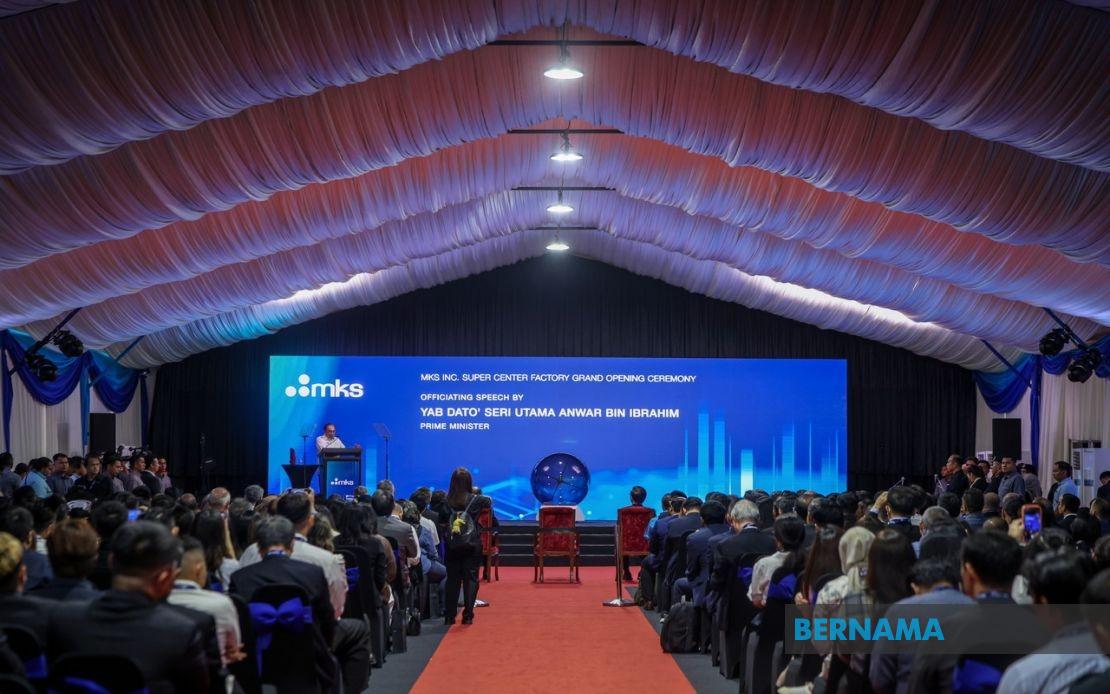
Speaking at the opening of the MKS Super Centre factory in Bandar Cassia Technology Park in Batu Kawan on June 20, Anwar highlighted the strategic dividends of Malaysia's refusal to align exclusively with any single power bloc. This diplomatic posture, he argued, has positioned the country as a trusted partner capable of fostering substantive economic cooperation with nations that might otherwise view engagement through zero-sum competition.
The Prime Minister cited Malaysia's recent dealings with major global actors as evidence of this balanced approach yielding results. His references spanned the spectrum of international relations: high-profile engagement with United States President Donald Trump during his previous administration, concurrent strengthening of ties with China and India, and more recent diplomatic initiatives with Russia. Rather than viewing these connections as contradictory, Anwar framed them as complementary expressions of Malaysia's central position in global affairs.
This framework has manifested in concrete commercial successes. Most notably, Petronas, Malaysia's national oil and gas company, has secured a significant agreement in Turkmenistan—a partnership that exemplifies how non-aligned positioning can unlock resource-rich collaborations beyond Malaysia's traditional sphere. Such agreements demonstrate that countries increasingly value Malaysian partnerships precisely because they see the nation as a neutral actor capable of serving as a reliable counterparty without entangling them in broader geopolitical disputes.
The logic underpinning Anwar's approach reflects a sophisticated understanding of contemporary global economics. As major powers engage in strategic competition across sectors from technology to energy, nations that credibly maintain independence become valuable partners. They offer markets without political strings, investment without hegemonic expectations, and trade relationships uncomplicated by loyalty tests. For Malaysia, a nation dependent on global trade flows and foreign direct investment, this positioning is economically rational.
However, executing such a strategy requires careful diplomatic messaging. Anwar acknowledged that Malaysia does not remain silent on contentious international issues—the nation articulates positions on matters affecting global peace and stability. Yet this willingness to engage substantively does not translate into exclusive allegiances. Instead, Malaysia invites participation from all countries and perspectives, creating space for economic cooperation even amid political disagreements.
The Prime Minister's remarks, delivered alongside Penang Chief Minister Chow Kon Yeow and Deputy Minister of Investment, Trade and Industry Sim Tze Tzin, emphasise that neutrality and independence strengthen rather than weaken Malaysia's hand in negotiations. When a nation is perceived as genuinely non-aligned, it gains negotiating leverage with multiple partners. This proves particularly valuable in sectors like energy, infrastructure, and technology where competition between major powers creates opportunities for countries willing to engage pragmatically.
For Malaysian readers and businesses, this strategic orientation has immediate implications. Companies seeking to expand internationally benefit from operating within a nation viewed as a balanced partner by major global actors. Trade relationships often flow more smoothly when the home country maintains strong bilateral relations without requiring partners to choose sides in larger geopolitical contests. Malaysian firms positioning themselves as suppliers or partners to global enterprises gain advantages when their home nation is seen as reliably neutral.
The factory opening at Bandar Cassia Technology Park itself serves as a microcosm of Malaysia's economic strategy. Such facilities, supported by government policies emphasising balanced engagement and investment openness, attract both domestic and international capital. The presence of Penang's chief minister underscores how state-level administrations align with federal foreign policy objectives to create integrated promotional frameworks.
Anwar's articulation of Malaysia's international posture also addresses potential regional concerns about ASEAN coherence. As a leading ASEAN economy and current or recent chair of regional forums, Malaysia's independent stance does not undermine Southeast Asian solidarity; rather, it reflects ASEAN's founding principle of non-interference and respect for sovereignty. By practising what ASEAN preaches, Malaysia reinforces the region's relevance as a genuinely non-aligned bloc capable of cooperating with all major powers.
Looking forward, the sustainability of Malaysia's approach depends on consistent diplomatic execution and demonstrated economic benefits. If partnerships negotiated through this neutral framework deliver jobs, technology transfer, and revenue, public and international support will strengthen. Conversely, perceived inconsistencies or abandonment of stated neutrality would erode the trust that makes the strategy effective.
The convergence of strategic positioning and economic opportunity illustrated in Anwar's remarks suggests that Malaysia intends to deepen this approach. By explicitly linking neutrality to prosperity, the Prime Minister invites both foreign partners and domestic stakeholders to view non-alignment not as passive fence-sitting but as active positioning that serves national interests. In an increasingly multipolar world fractured by great-power competition, such strategic clarity may prove Malaysia's most valuable economic asset.