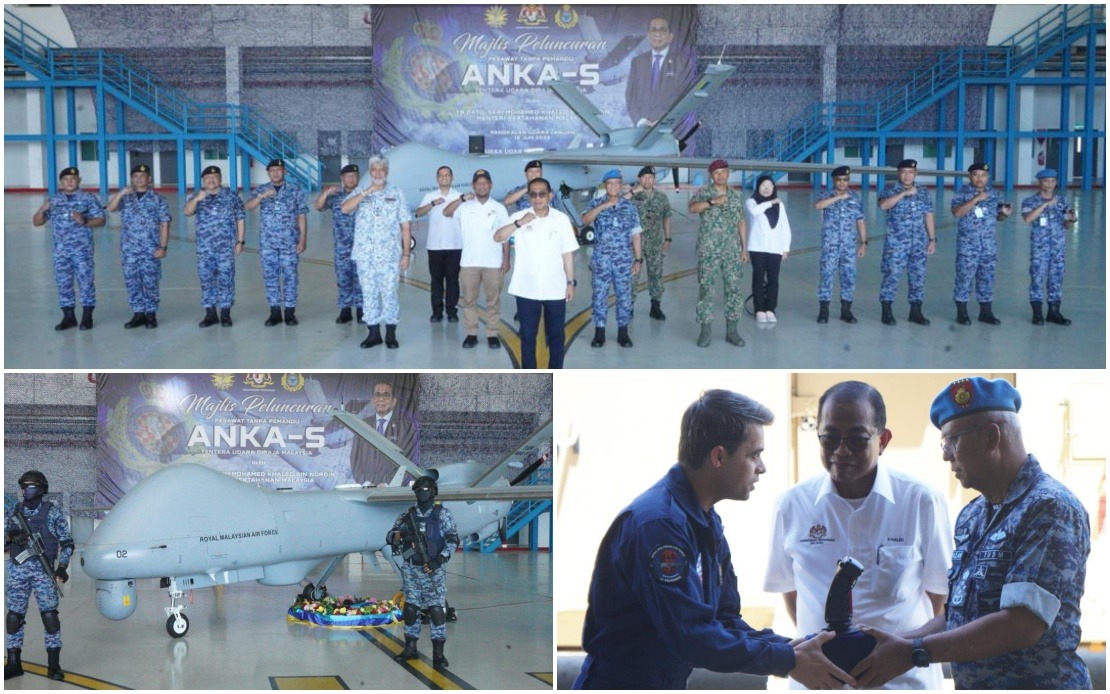
Malaysia has taken a significant step in modernizing its defence infrastructure with the operational deployment of the ANKA-S Unmanned Aircraft System by the Royal Malaysian Air Force, marking what Defence Minister Datuk Seri Mohamed Khaled Nordin describes as a transformative advancement in the country's surveillance and security posture. The system, officially launched at RMAF Labuan Air Base on June 16, introduces technological capabilities previously unavailable to Malaysian defence forces, particularly regarding maritime monitoring in one of the world's most strategically contested regions.
The acquisition represents an investment of RM423.8 million for three aircraft, encompassing ground control infrastructure and comprehensive two-year personnel training programs. This substantial expenditure underscores the government's commitment to enhancing national sovereignty protection across Malaysia's extensive maritime zones, where strategic interests intersect with those of multiple regional and global actors. The platform's deployment to Labuan positions it strategically for operations across the South China Sea, a waterway through which vast quantities of global trade transit and where competing territorial claims frequently generate diplomatic tensions.
The ANKA-S platform, classified as a Medium Altitude Long Endurance system, delivers operational specifications tailored to Malaysia's geographic and security requirements. Aircraft can maintain continuous flight operations exceeding 24 hours while maintaining altitudes reaching 30,000 feet, enabling persistent observation across extensive oceanic expanses. This endurance capacity fundamentally changes Malaysia's surveillance approach, replacing reactive patrols with proactive, sustained monitoring that covers previously blind spots in maritime domain awareness.
Beyond raw technical specifications, the system's intelligence-gathering capabilities provide Malaysia with enhanced situational awareness critical for informed policymaking. The platform can accurately identify and classify vessel profiles, enabling defence planners to distinguish between commercial traffic and potential security threats. This discriminatory capacity allows the RMAF to concentrate response resources where genuine threats materialize rather than dispersing assets across unfocused patrols, thereby improving both operational effectiveness and resource allocation efficiency.
The economic advantages of this technological shift merit particular attention for Malaysian defence planning. Operating unmanned aircraft for maritime surveillance generates substantially lower costs than deploying crewed fighter jets or dedicated maritime patrol vessels for comparable coverage. This cost-effectiveness proves especially valuable for middle-income nations managing constrained defence budgets while facing extensive maritime responsibilities. The surveillance-to-expenditure ratio substantially improves when these platforms replace traditional approaches, creating fiscal space for other critical defence priorities.
Perhaps equally significant as the technical capabilities is Malaysia's deliberate decision to maintain the ANKA-S in an unarmed configuration despite the platform's engineering capacity to carry weaponry. Defence Minister Mohamed Khaled explicitly framed this choice as a communications strategy, signaling to regional and international audiences that Malaysia's defence orientation remains defensive rather than provocative. This restraint carries particular weight given regional sensitivities surrounding military modernization and the ongoing dynamics of the South China Sea disputes, where perceptions of escalation can themselves fuel tensions.
The government's announced consideration of acquiring three additional ANKA-S aircraft under a second phase indicates confidence in the platform's operational value and suggests plans for expanded surveillance coverage. Such expansion would enable simultaneous operations across multiple strategic areas, potentially covering contested waters with greater density and reducing response times to detected anomalies. The proposal's advancement through Malaysia's national development planning framework suggests serious budgetary commitment beyond the initial deployment.
From a broader strategic perspective, the ANKA-S deployment reflects Malaysia's positioning within evolving regional security architectures. As established maritime powers modernize surveillance and enforcement capabilities, middle-income nations with substantial maritime zones require equivalent technological advancement to maintain effective sovereignty exercise. Malaysia's situation resembles that of other Southeast Asian nations balancing legitimate resource protection and security interests against the complex geopolitical sensitivities characterizing contemporary Indo-Pacific dynamics.
The launch ceremony, attended by Defence Ministry secretary-general Datuk Lokman Hakim Ali, Navy Chief Admiral Tan Sri Dr Zulhelmy Ithnain, Air Force Chief Gen Tan Sri Muhamad Norazlan Aris, and Joint Forces Commander Lt Gen Datuk Tengku Muhammad Fauzi Tengku Ibrahim, underscored the system's cross-service importance. This representation signals that maritime surveillance transcends individual service priorities, demanding integrated national responses. The live Intelligence, Surveillance and Reconnaissance demonstration at Labuan's Data Exploitation Centre illustrated operational integration, showing how sensor data transforms into actionable intelligence through systematic analysis.
For Malaysian readers and policymakers, the ANKA-S deployment carries implications extending beyond military modernization. Enhanced maritime surveillance strengthens the foundation for fisheries management, environmental monitoring, and exclusive economic zone enforcement—functions with direct consequences for Malaysia's economic interests. Improved awareness of maritime activities supports not only security objectives but also resource stewardship across Malaysia's exclusive maritime domains.
The system's operational availability also influences Malaysia's negotiating position within regional forums addressing maritime governance and security cooperation. Visible capability enhancements may facilitate more credible participation in multilateral maritime exercises and dialogues, potentially amplifying Malaysia's voice in discussions shaping regional norms and arrangements. In this sense, technological acquisition intersects with diplomacy, affecting how regional partners perceive Malaysia's capacity and commitment to maritime stewardship.
Looking forward, the ANKA-S represents a foundational capability upon which Malaysia can build increasingly sophisticated maritime domain awareness architectures. Integration with allied systems, satellite intelligence, and naval assets creates synergistic effects potentially exceeding individual platform contributions. As Malaysia contemplates additional acquisitions and evolving operational concepts, the initial deployment serves as a validation of technological fitness for the nation's specific security environment, establishing baseline from which future refinements and expansions can develop.


%22%2F%3E%3C%2Fpattern%3E%3C%2Fdefs%3E%3Crect%20width%3D%22100%25%22%20height%3D%22100%25%22%20fill%3D%22url(%23ph40buhg)%22%2F%3E%3Crect%20width%3D%22100%25%22%20height%3D%22100%25%22%20fill%3D%22url(%23ph40buhp)%22%2F%3E%3Ctext%20x%3D%2250%25%22%20y%3D%2250%25%22%20text-anchor%3D%22middle%22%20dominant-baseline%3D%22central%22%20fill%3D%22rgba(255%2C255%2C255%2C0.95)%22%20font-family%3D%22Georgia%2C%20'Times%20New%20Roman'%2C%20serif%22%20font-weight%3D%22700%22%20font-size%3D%22320%22%20letter-spacing%3D%22-0.02em%22%3EGRS%3C%2Ftext%3E%3C%2Fsvg%3E)