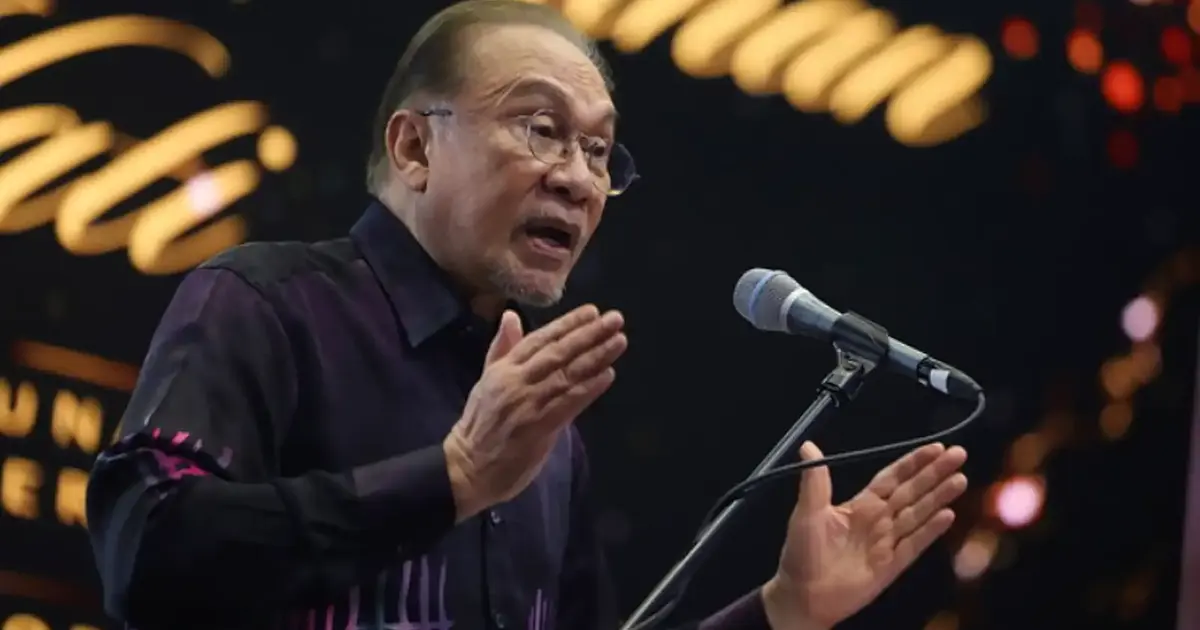
Prime Minister Anwar Ibrahim has urged Malaysians to transcend the inflammatory rhetoric being peddled by certain political leaders, reaffirming his conviction that the nation's ethnic diversity constitutes one of its most valuable assets. The statement, made amid ongoing political tensions, reflects the government's determination to chart a course grounded in unity rather than the sectarian messaging that periodically surfaces in domestic discourse.
The prime minister's remarks underscores a recurring theme in his administration's approach to governance: that Malaysia's multiethnic, multireligious character is not an obstacle to overcome but rather a framework within which national prosperity can flourish. This perspective stands in sharp contrast to the divisive positioning adopted by certain opposition figures and fringe elements within the political landscape who have sought to weaponise identity issues for electoral gain.
Anwar's emphasis on diversity as a national strength carries particular resonance in the Malaysian context, where communal harmony has historically been viewed as foundational to economic stability and social cohesion. The nation's middle-income status and relative regional prominence rest substantially on the ability of its varied populations to coexist and cooperate across ethnic and religious lines, a reality that demographic trends and economic interdependence continue to reinforce.
The warning against hate-mongering rhetoric reflects broader concerns about the corrosive effects of divisive messaging on institutional trust and social fabric. When political actors resort to inflammatory language targeting specific ethnic or religious groups, they risk undermining the constitutional compact that underpins Malaysian democracy and the secular framework within which plural communities negotiate shared citizenship.
International experience demonstrates that societies which attempt to mobilise electoral support through identity-based polarisation often experience diminished institutional capacity, reduced foreign investment confidence, and increased difficulty in addressing substantive policy challenges. The prime minister's advocacy for transcending such rhetoric aligns with empirical evidence suggesting that inclusive governance models tend to deliver superior economic and developmental outcomes, particularly in diverse societies navigating globalisation.
The intervention also signals the government's confidence in its ability to out-compete divisive messaging through affirmative articulation of a unifying vision. Rather than simply condemning hateful rhetoric, Anwar has chosen to reframe the diversity question in explicitly positive terms, casting pluralism as intrinsically connected to Malaysia's capacity to attract talent, investment, and influence in regional and global affairs.
For businesses and investors monitoring Malaysia's political climate, the prime minister's stance provides reassurance about governmental commitment to maintaining the institutional stability and social predictability that underpin market confidence. Periods of intense communal tension have historically corresponded with capital flight and reduced business formation, outcomes that both the government and the private sector have clear incentive to avoid.
The broader geopolitical context amplifies the significance of Anwar's message. In an era where ASEAN nations compete for investment and regional influence, those perceived as ethnically fragmented or internally divided face distinct disadvantages in attracting multinational corporations and skilled migration. Conversely, Malaysia's success in maintaining functioning plural democracy at a time when many emerging markets experience democratic backsliding represents a competitive asset that the government appears determined to preserve and articulate more forcefully.
Yet the persistence of hate-mongering by certain political actors suggests that Anwar's rhetoric of transcendence, while admirable, must be accompanied by concrete institutional mechanisms that penalise divisive communication and reward inclusive political competition. The challenge for Malaysia involves strengthening enforcement of laws against hate speech while simultaneously cultivating a political culture where exploiting ethnic or religious grievance carries genuine electoral cost rather than strategic advantage.
The prime minister's intervention also reflects recognition that demographic change and economic transformation are generating anxiety among certain segments of the Malaysian population, creating openings for divisive messaging. Addressing the substantive concerns underlying reactionary appeals—whether related to economic opportunity, educational access, or representation in state institutions—represents an indispensable complement to rhetorical calls for unity.
Moving forward, the effectiveness of Anwar's vision for a diversity-affirming Malaysia will depend substantially on whether the government can deliver measurable improvements in living standards, employment opportunity, and institutional fairness across all communities. Diversity rhetoric unmoored from material improvement in governance tends to ring hollow, particularly among populations experiencing economic stress or feeling marginalised by state institutions.
The prime minister's remarks represent a clear articulation of governmental values and an implicit challenge to rival political forces to elevate their own discourse. Whether Malaysian voters respond by rewarding inclusive messaging or continue to prove susceptible to divisive appeals will significantly shape the nation's political trajectory and institutional health in coming years.