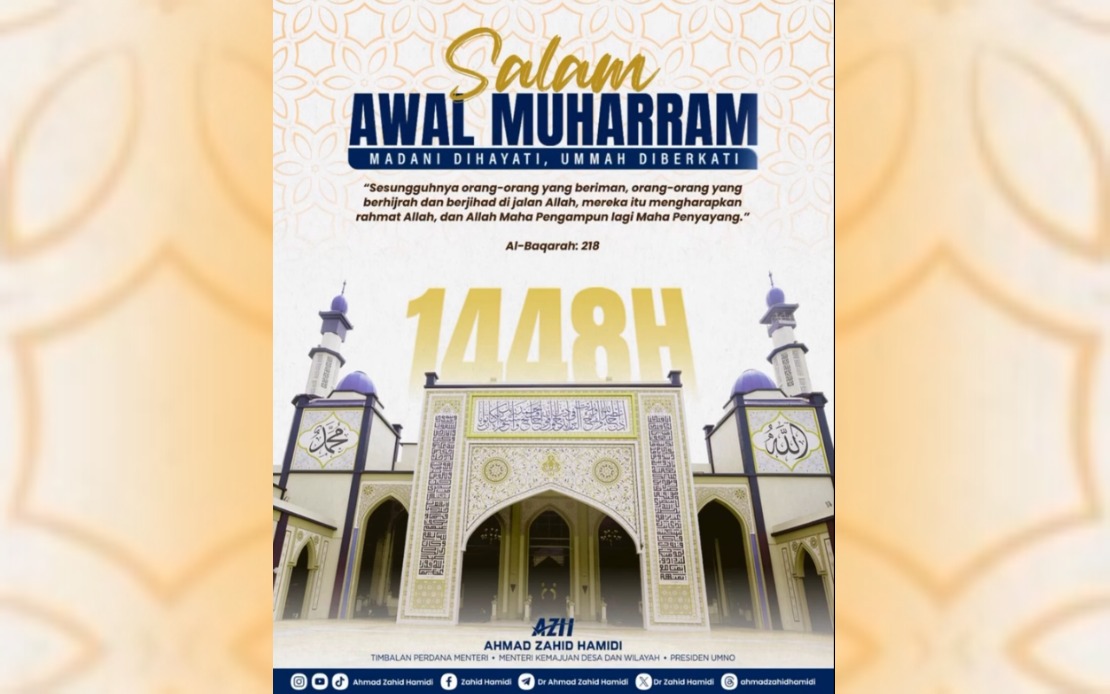
Malaysia's top political leadership has issued a coordinated call for citizens to embrace the spiritual and moral dimensions of Maal Hijrah, the Islamic New Year, positioning the occasion not merely as a calendar milestone but as a moment for genuine national introspection and renewal. The emphasis placed by Deputy Prime Minister Datuk Seri Dr Ahmad Zahid Hamidi and his colleague Datuk Seri Fadillah Yusof, along with a broad cross-section of cabinet ministers, reflects an official vision of Hijrah as a framework for addressing contemporary challenges facing Malaysia—from economic pressures to social cohesion.
Dr Ahmad Zahid framed Hijrah as fundamentally about tangible commitment rather than empty rhetoric. The concept itself, rooted in Prophet Muhammad's migration from Mecca to Medina in 622 CE, carries deep resonance within Islamic tradition as a transformative act requiring sacrifice, planning and moral courage. By invoking this historical precedent, the Deputy Prime Minister drew a direct parallel between the early Muslim community's willingness to uproot themselves for principle and the kind of personal and institutional reform Malaysia must undertake. He stressed that change demands "effort, discipline and determination," language that transcends religious context to speak to broader governance and personal responsibility. This framing positions Hijrah not as escapism or passivity, but as demanding engagement with systemic weakness and the courage to confront shortcomings.
The values Dr Ahmad Zahid identified—sacrifice and perseverance—speak to particular vulnerabilities in contemporary Malaysian society. Economic uncertainties, institutional fragmentation and generational anxiety have created a climate where citizens and officials alike face pressure to question long-held assumptions. By anchoring these necessary adjustments to Islamic principle, the Deputy Prime Minister provided ideological ballast for what might otherwise appear as mere administrative restructuring. His call for Malaysians to be "courageous in embracing reforms" and to "address our weaknesses" carries implicit acknowledgment that the status quo is insufficient, a message that gains force when delivered at the highest levels of government.
Deputy Prime Minister Fadillah Yusof shifted emphasis toward practical implications of the Hijrah spirit, particularly in the context of Malaysia's economic environment. His references to global supply chain disruptions, inflationary pressures and economic uncertainty are not abstract—these conditions have materially affected household budgets, business investment and consumer confidence across the country. By connecting Hijrah to prudent resource management, Fadillah positioned Islamic teaching as directly responsive to contemporary hardship. His emphasis on moderation, avoiding wastefulness and distinguishing between needs and wants addresses a critical pain point for ordinary Malaysians struggling with cost-of-living pressures. The framing suggests that spiritual discipline and economic resilience are not separate domains but intertwined, a message with particular resonance given regional concerns about inflation and financial instability.
Crucially, Fadillah articulated how individual actions aggregate into collective benefit. His observation that "small steps taken collectively can have a significant impact" speaks to a widespread frustration that personal efforts feel insignificant against large structural forces. By validating small-scale behavioral change—reduced electricity consumption, food waste avoidance, prudent spending—while simultaneously connecting these to family and national welfare, he offered a vision of agency that feels both realistic and meaningful. This represents an important rhetorical move in a context where citizens often feel powerless before governmental and global forces beyond their control.
The Deputy Prime Minister also returned explicitly to Malaysia's defining characteristic: ethnic and religious pluralism. His assertion that unity must overcome difference, and that "togetherness, mutual respect and cooperation" require conscious cultivation, acknowledges that such harmony cannot be assumed but must be actively maintained. This message gains particular significance given periodic communal tensions and polarization across the region. By linking national unity to Hijrah values, Fadillah located social cohesion not in abstract multiculturalism but in shared Islamic principle—a grounding that may resonate more powerfully within Malaysia's Muslim-majority context while presumably extending to the broader population.
Communications Minister Datuk Fahmi Fadzil synthesized these themes by emphasizing courage, patience and sincerity as cardinal virtues for navigating contemporary life. His phrasing—that Hijrah "teaches us the courage to change for the better"—echoes Dr Ahmad Zahid's emphasis on agency and reform while adding emotional texture. The invocation of patience particularly speaks to Malaysian conditions, where rapid social and economic change has created generational anxieties about employment, housing and opportunity. A political message emphasizing patience as virtue responds to these tensions by reframing waiting and perseverance as spiritually grounded rather than merely passive.
Minister in the Prime Minister's Department (Religious Affairs) Zulkifli Hasan grounded Hijrah in personal spiritual practice, encouraging Muslims to mark the occasion with specific prayers and family-centered observance. His designation of 1 Muharam as "the best moment for self-reflection and self-improvement" (Islah) provided structured religious guidance while reinforcing the broader message that Hijrah functions as a reset mechanism. The emphasis on family-level observance is significant for a society where collective religious practice remains important but increasingly competes with urbanization, work pressures and individualization.
The breadth of ministerial participation—spanning agriculture, science, education, digital affairs, health and youth portfolios—signals coordination across government and suggests this message represents not isolated rhetoric but an articulated policy orientation. Ministers representing diverse portfolios nevertheless emphasized consistent themes: reform, resilience, unity and personal responsibility. This consistency implies either coordinated messaging from the Prime Minister's office or genuine agreement across leadership about the need for national renewal framed through Islamic principle.
For Malaysian readers and regional observers, these statements reflect a government attempting to mobilize spiritual and cultural resources to address material challenges. Whether such invocations successfully translate into behavioral change or institutional reform remains uncertain—the gap between rhetorical commitment and implementation is substantial in most governance contexts. Nevertheless, the explicit connection of Islamic teaching to contemporary economic and social challenges suggests that Malaysia's leadership recognizes both the legitimacy crisis affecting institutions and the continued salience of religious language and community in addressing public concerns. The Hijrah message, as articulated across multiple ministerial statements, positions reform and resilience not as technical problems requiring only bureaucratic solutions but as moral challenges demanding spiritual renewal.

%22%2F%3E%3C%2Fpattern%3E%3C%2Fdefs%3E%3Crect%20width%3D%22100%25%22%20height%3D%22100%25%22%20fill%3D%22url(%23ph40buhg)%22%2F%3E%3Crect%20width%3D%22100%25%22%20height%3D%22100%25%22%20fill%3D%22url(%23ph40buhp)%22%2F%3E%3Ctext%20x%3D%2250%25%22%20y%3D%2250%25%22%20text-anchor%3D%22middle%22%20dominant-baseline%3D%22central%22%20fill%3D%22rgba(255%2C255%2C255%2C0.95)%22%20font-family%3D%22Georgia%2C%20'Times%20New%20Roman'%2C%20serif%22%20font-weight%3D%22700%22%20font-size%3D%22320%22%20letter-spacing%3D%22-0.02em%22%3EGRS%3C%2Ftext%3E%3C%2Fsvg%3E)