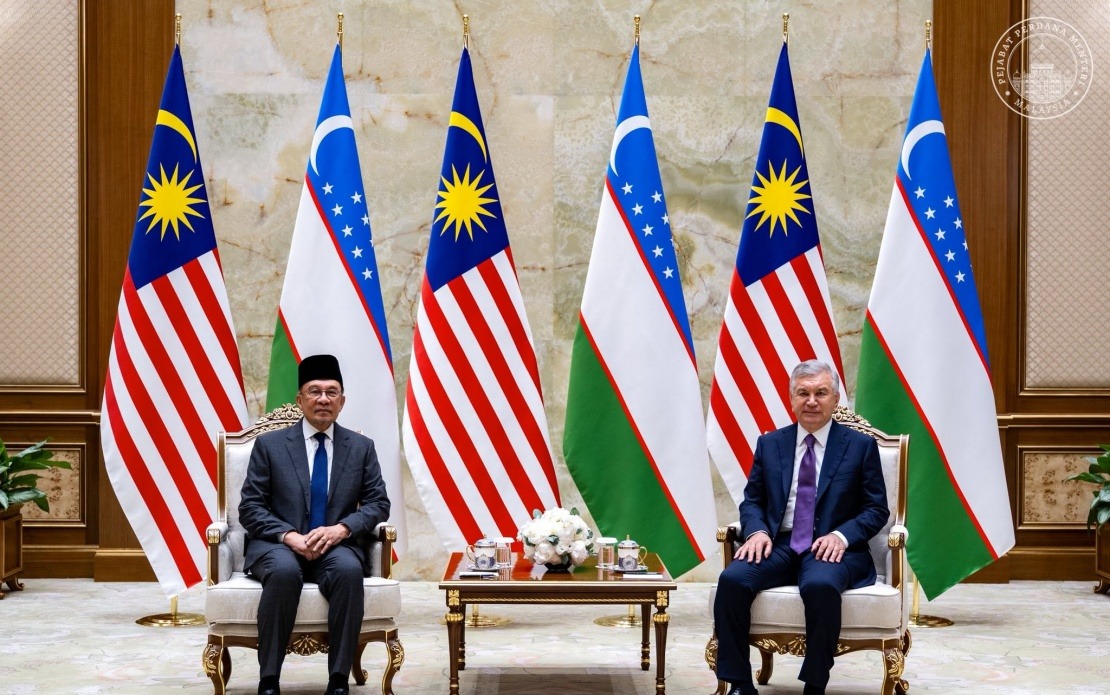
Prime Minister Datuk Seri Anwar Ibrahim has identified substantial scope for Malaysia and Uzbekistan to expand their collaborative efforts across numerous sectors deemed strategically important to both nations, following a high-level meeting with Uzbekistan President Shavkat Mirziyoyev in Tashkent. The encounter took place on June 17 when Anwar's flight made a scheduled stopover in the Central Asian capital while en route to Kazan, Russia, where he would subsequently attend the ASEAN-Russia Commemorative Summit scheduled for June 17-18.
The brief diplomatic engagement proved sufficiently substantive for both leaders to conduct a wide-ranging exchange on the trajectory of bilateral relations, with particular emphasis on potential breakthroughs in what they characterised as strategic spheres of mutual interest. The sectors identified for collaborative expansion span the energy industry—notably natural gas and petroleum extraction and processing—alongside conventional trade and investment channels, with educational partnerships and the burgeoning halal sector flagged as additional avenues for deepening economic ties.
Anwar's remarks, shared through social media channels, highlighted an often-overlooked dimension of the proposed cooperation: the shared commitment of both nations to the preservation and advancement of Islamic civilisational heritage and scholarly traditions. This cultural and intellectual dimension reflects Malaysia's positioning as a significant voice within the Islamic world and underscores how bilateral relationships increasingly encompass not merely transactional economic interests but also the promotion of shared values and knowledge systems. The Prime Minister emphasised that collaboration in these areas would contribute to elevating human dignity and fostering more equitable development models across their respective regions.
The energy sector represents perhaps the most strategically consequential area for potential partnership. Uzbekistan possesses substantial reserves of natural gas and petroleum, resources that hold particular relevance for Malaysia's long-term energy security considerations and industrial expansion objectives. Any deepening of cooperation in this domain carries implications not only for bilateral trade flows but also for broader regional energy dynamics in Central Asia and Southeast Asia. Malaysia's technological expertise and investment capacity could complement Uzbekistan's resource endowments, creating synergies that benefit both economies while contributing to sustainable development imperatives that increasingly drive international energy partnerships.
Beyond energy, the investment and trade relationship warrants expansion given the complementary nature of the two economies and Malaysia's established position as a regional hub for Islamic finance and commerce. The halal industry, a sector where Malaysia enjoys recognised global leadership and certification authority, presents particularly promising prospects. Uzbekistan's geographic position along traditional Silk Road trade routes and its role within Central Asian markets could facilitate Malaysian halal products and services reaching broader Eurasian markets, while Uzbek enterprises might leverage Malaysian expertise and certification frameworks to access Southeast Asian and global halal-certified supply chains.
Educational cooperation offers another layer of institutional deepening. Malaysian universities and vocational institutions have historically attracted Central Asian students, while Malaysian expertise in Islamic education and contemporary technical fields could enhance Uzbekistan's capacity building initiatives. Reciprocal scholarship and faculty exchange programmes would strengthen people-to-people connections and create networks of mutual understanding that typically prove durable foundations for long-term bilateral relationships extending beyond government cycles.
Anwar's acknowledgment of Uzbekistan's increasing importance as a regional actor within Central Asia and its growing engagement with ASEAN reflects Malaysia's broader geopolitical calculations. Central Asia represents a frontier of strategic competition between major powers, and deepening ASEAN engagement with regional actors like Uzbekistan serves Malaysia's interests in promoting a multilateral regional order where Southeast Asian voices maintain meaningful influence. As Uzbekistan itself pursues broader international partnerships under President Mirziyoyev's modernisation agenda, Malaysia positions itself as a reliable partner capable of offering both economic collaboration and mutual respect for diverse governance approaches.
The timing of such diplomatic engagement assumes added significance within Malaysia's broader foreign policy framework. As Anwar navigates the complex geopolitical landscape involving major power competition, regional integration dynamics, and economic interdependence, cultivating partnerships with Central Asian states diversifies Malaysia's engagement portfolio and reduces overdependence on traditional partnerships. The ASEAN-Russia summit that immediately followed provided Anwar an additional platform for advancing Malaysian interests in the broader Eurasian context.
It bears noting that the substance of these discussions extends beyond ceremonial diplomatic pleasantries. Both nations face genuine complementarities: Uzbekistan requires technology transfer, investment capital, and access to sophisticated service sectors where Malaysia possesses comparative advantages; Malaysia conversely seeks reliable energy supplies, access to Central Asian markets, and opportunities to position itself as a gateway between Islamic civilisations and global commerce. These material interests provide concrete foundations for institutional development.
The cultural and civilisational dimension that Anwar emphasised—regarding Islamic heritage, scholarly traditions, and their contributions to human advancement—reflects a distinctive Malaysian approach to international relations. Rather than framing partnerships primarily through commercial or strategic calculus, this framing appeals to shared identity and common purpose in advancing Islamic knowledge and contributions to global civilisation. Such an approach resonates particularly with Central Asian nations that are simultaneously modernising while reasserting connections to Islamic heritage after decades of Soviet suppression.
Moving forward, the challenge lies in translating these broad political commitments into concrete institutional arrangements, regulatory frameworks, and investment flows. Establishing joint commissions, harmonising standards—particularly in the halal sector—and removing barriers to trade and capital mobility would represent logical subsequent steps. Malaysian business chambers and investment promotion agencies would need to actively pursue opportunities identified during such high-level diplomatic encounters to generate tangible economic benefits for both nations' private sectors.
The casual mention of Uzbekistan's football team's preparations for the 2026 FIFA World Cup campaign, with their opening match against Colombia, added a human dimension to the diplomatic engagement. Such moments of informal warmth between leaders often prove surprisingly durable in building the personal relationships that facilitate smoother negotiations and sustained cooperation across institutions. As both nations contemplate deepening their partnership across multiple dimensions, such foundation-building moments assume genuine value in creating the political capital necessary for ambitious bilateral agendas to succeed.

%22%2F%3E%3C%2Fpattern%3E%3C%2Fdefs%3E%3Crect%20width%3D%22100%25%22%20height%3D%22100%25%22%20fill%3D%22url(%23ph40buhg)%22%2F%3E%3Crect%20width%3D%22100%25%22%20height%3D%22100%25%22%20fill%3D%22url(%23ph40buhp)%22%2F%3E%3Ctext%20x%3D%2250%25%22%20y%3D%2250%25%22%20text-anchor%3D%22middle%22%20dominant-baseline%3D%22central%22%20fill%3D%22rgba(255%2C255%2C255%2C0.95)%22%20font-family%3D%22Georgia%2C%20'Times%20New%20Roman'%2C%20serif%22%20font-weight%3D%22700%22%20font-size%3D%22320%22%20letter-spacing%3D%22-0.02em%22%3EGRS%3C%2Ftext%3E%3C%2Fsvg%3E)