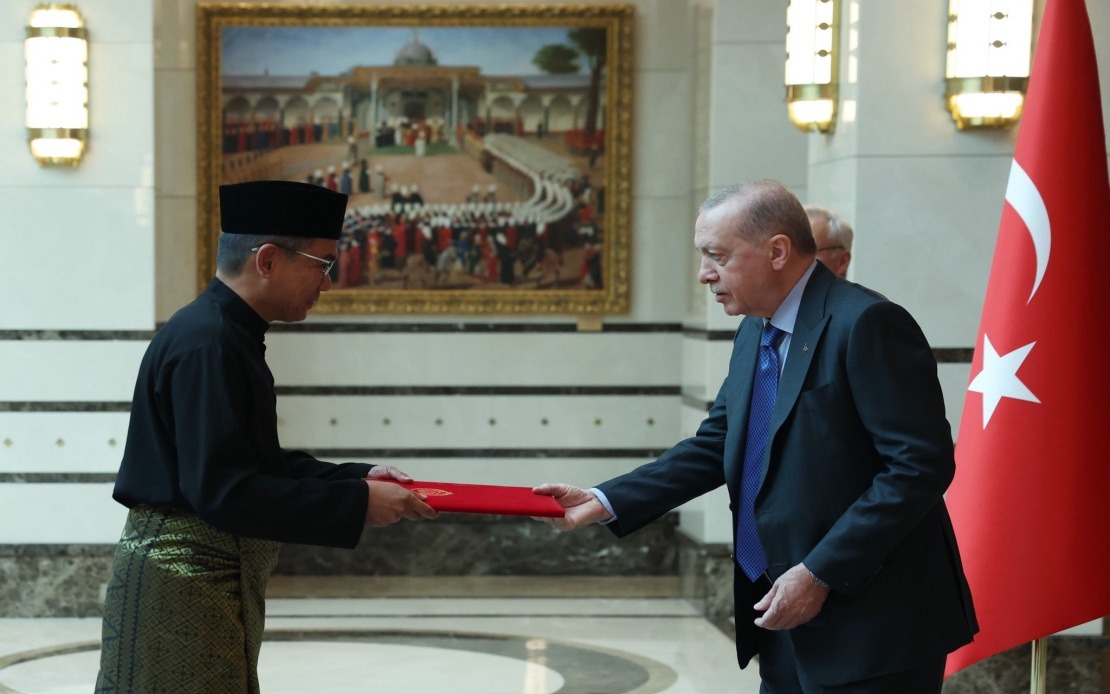
Malaysia has thrown its diplomatic weight behind Türkiye's ambition to secure Dialogue Partner status within the Association of Southeast Asian Nations, marking a significant step in broadening the regional bloc's international engagement framework. The endorsement came during a formal meeting between Malaysian Ambassador to Türkiye Adlan Mohd Shaffieq and Turkish President Recep Tayyip Erdoğan at the Presidential Complex in Ankara on June 17, when the ambassador presented his letters of credence to the Turkish leader.
The timing and substance of this diplomatic overture reflect Malaysia's strategic assessment of Türkiye's growing relevance to Southeast Asia's economic and geopolitical landscape. According to the Malaysian Embassy statement, Ambassador Shaffieq articulated a comprehensive case for Türkiye's deepening role in the region, emphasising how the country has progressively established itself as a consequential partner through multifaceted engagement with ASEAN member states. This positioning goes beyond transactional commerce, extending into strategic thinking and civilian exchanges that build lasting foundations for cooperation.
Türkiye's economic footprint in Southeast Asia has expanded considerably in recent years, though it remains less visible than that of traditional Asian powers. The country's manufacturing capabilities, particularly in sectors such as automotive production and textiles, combined with its positioning as a bridge between European and Asian markets, make it an increasingly attractive partner for regional economies seeking supply chain diversification. The backing from Malaysia, as ASEAN's current or recent chair, carries considerable diplomatic weight in any future formal consideration of Dialogue Partner status within ASEAN's consensus-based decision-making framework.
Particularly noteworthy is the emphasis Ambassador Shaffieq placed on shared values and mutual respect anchoring the Malaysia-Türkiye relationship. The ambassador noted that both nations are bound by commitment to peace, prosperity, and development—language that reflects deeper ideological and civilisational commonalities beyond mere commerce. Both countries share significant Muslim populations and have invested in halal industry development, creating a natural convergence point for economic cooperation that extends into standards-setting and certification frameworks that benefit both sides.
The mention of education and defence cooperation signals the bilateral relationship's institutional depth. Malaysian universities have attracted Turkish students, while defence procurement and military-to-military engagement have grown steadily. These domains are often proxies for the level of trust and strategic alignment between nations, suggesting that Malaysia perceives Türkiye as a reliable long-term partner rather than a transient trading opportunity.
President Erdoğan's reciprocal enthusiasm, particularly his confidence in achieving a US$10 billion bilateral trade target, indicates both leaders share optimism about expanding economic ties. This figure is ambitious given current trade volumes but reflects aspirational planning that might materialise through sectoral diversification and increased investment flows in both directions. For Malaysian businesses, particularly those in manufacturing and halal-related sectors, Turkish market access and investment opportunities represent meaningful commercial possibilities.
The personal rapport between President Erdoğan and Prime Minister Datuk Seri Anwar Ibrahim, explicitly cited by the ambassador, has become a significant asset in Malaysia-Türkiye relations. High-level political alignment facilitates faster decision-making on complex bilateral matters and provides political cover for both governments when advancing contentious regional positions. This personal dimension often proves decisive in Southeast Asian diplomacy, where personal relationships between leaders can accelerate or slow institutional processes considerably.
From an ASEAN perspective, Türkiye's potential elevation to Dialogue Partner status would complement the bloc's existing framework of such partnerships with major powers including the United States, China, India, and Japan. A Dialogue Partner designation typically enables regular consultations on regional matters, participation in certain ASEAN-sponsored forums, and enhanced information-sharing without the binding commitments associated with full membership. For Türkiye, such status would formalise its claim to regional relevance and provide institutional mechanisms for advancing its strategic interests in Southeast Asia.
Malaysia's public support for this application also carries domestic political significance. By championing Türkiye's cause, Malaysia positions itself as a bridge-builder and facilitator of North-South dialogue, roles that enhance its diplomatic prestige within non-aligned forums and among Islamic-majority nations. This aligns with Prime Minister Anwar's broader agenda of reinvigorating Malaysia's multilateral diplomacy and establishing the country as a credible voice for the Global South.
The emphasis on people-to-people ties, mentioned by the ambassador as a pillar of Malaysia-Türkiye relations, points to softer dimensions of engagement often overlooked in transactional diplomacy. Turkish investment in Malaysian real estate, tourism flows in both directions, and cultural exchanges create constituencies within both societies with vested interests in strengthening bilateral relations. These grassroots connections ultimately provide resilience to state-level partnerships.
For other ASEAN members, Malaysia's position effectively initiates conversation about welcoming Türkiye into the regional diplomatic architecture. Consensus-based ASEAN decision-making means that any single member could theoretically block such an application, but Malaysia's move signals that at least this significant player sees strategic benefit in Türkiye's enhanced engagement. Whether other member states, particularly those with different geopolitical priorities or more cautious foreign policies, will align with this position remains to be seen, though Malaysia's advocacy substantially improves Türkiye's prospects.
The broader implications extend to how Southeast Asia calibrates its partnerships amid shifting global alignments. By welcoming non-traditional partners like Türkiye, ASEAN diversifies its diplomatic options and reduces dependence on a narrow band of traditional powers. This approach aligns with the region's long-standing hedging strategy, where economic and diplomatic engagement with multiple powers prevents any single nation from dominating regional affairs. Türkiye's potential role fits this pattern, offering Southeast Asian nations an alternative voice in global forums and potentially new investment and trade pathways.

%22%2F%3E%3C%2Fpattern%3E%3C%2Fdefs%3E%3Crect%20width%3D%22100%25%22%20height%3D%22100%25%22%20fill%3D%22url(%23ph40buhg)%22%2F%3E%3Crect%20width%3D%22100%25%22%20height%3D%22100%25%22%20fill%3D%22url(%23ph40buhp)%22%2F%3E%3Ctext%20x%3D%2250%25%22%20y%3D%2250%25%22%20text-anchor%3D%22middle%22%20dominant-baseline%3D%22central%22%20fill%3D%22rgba(255%2C255%2C255%2C0.95)%22%20font-family%3D%22Georgia%2C%20'Times%20New%20Roman'%2C%20serif%22%20font-weight%3D%22700%22%20font-size%3D%22320%22%20letter-spacing%3D%22-0.02em%22%3EGRS%3C%2Ftext%3E%3C%2Fsvg%3E)