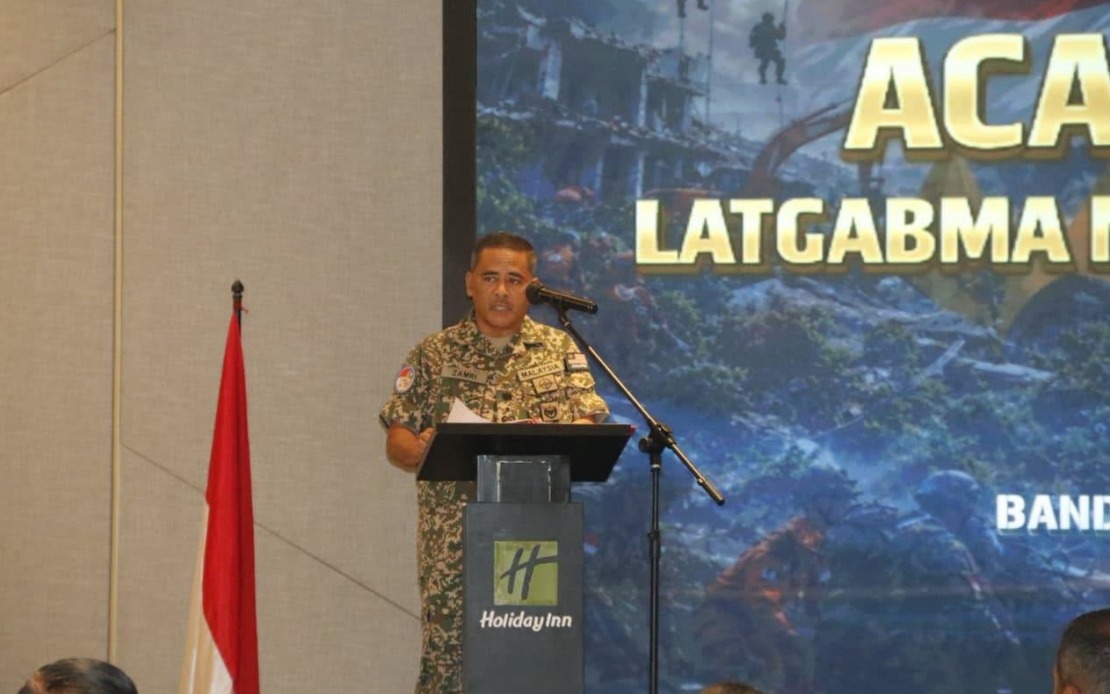
The Malaysian Armed Forces and Indonesia's National Armed Forces have marked a significant step forward in regional military cooperation through their participation in a 13-day combined exercise held in Lampung, Sumatra. Designated LATGABMA MALINDO DARSASA 12AB/2026, the operation brings together 719 personnel from both nations and represents far more than a routine training activity—it embodies the deepening strategic partnership between two neighbouring nations facing shared security challenges across the maritime, terrestrial and airspace domains.
According to Malaysia's Joint Forces Headquarters, the exercise extends beyond traditional military drills to encompass a comprehensive approach to modern defence cooperation. Brigadier General Datuk Zamri Othman, who serves as both Commander of the 1st Infantry Brigade and Chief of the MAF Exercise Planning Group, emphasised that the operation demonstrates a concrete expression of the fraternal relationship and mutual strategic confidence binding Malaysia and Indonesia. This framing is particularly significant, as it positions the exercise within the broader context of long-standing regional partnerships that have weathered various geopolitical shifts and continue to serve as anchors for stability in Southeast Asia.
The contemporary security environment facing both nations has evolved considerably from traditional military threats. Maritime piracy, organised smuggling networks, transnational terrorism, and increasingly sophisticated cyber intrusions now occupy equal priority with conventional defence considerations. Natural disasters, amplified by climate vulnerability and geographic exposure to tectonic activity, further compound the complexity. By addressing these multifaceted challenges through joint training, Malaysia and Indonesia are acknowledging that prosperity and security in the region cannot be achieved through isolated national efforts. This collaborative stance offers important lessons for other Southeast Asian democracies grappling with similar pressures.
The institutional history of these joint exercises extends back four decades to 1984, operating under the framework of the General Border Committee and the Malaysia-Indonesia Joint Training Committee. The three-yearly rotation between the two nations ensures sustained momentum and shared ownership of the training outcomes. The previous iteration, conducted in Pekan, Pahang during 2023, concentrated on counter-terrorism scenarios. This year's shift toward humanitarian and disaster-focused training reflects an adaptive approach to evolving regional threats and vulnerabilities. The selection of Lampung Province as the exercise location was deliberate and analytically sound—the region sits astride three active tectonic plate boundaries, making it a laboratory for realistic disaster simulation that incorporates actual earthquake and tsunami experiences that have devastated southern Sumatra in recent decades.
The exercise architecture comprises two principal components: the Staff Exercise phase and the Field Training Exercise phase. The Staff Exercise, known as STAFFEX, walks senior commanders and planners through ten critical scenarios spanning the entire disaster response lifecycle. These range from initial emergency response through mass casualty management, infrastructure rehabilitation, international coordination, and eventually stabilisation and transition phases. This graduated approach ensures that personnel develop conceptual mastery before moving into practical application, a pedagogically sound methodology that has proven effective in military training contexts across the developed world.
The Field Training Exercise component facilitates direct integration between Malaysian personnel, Indonesian military units, and civilian responder organisations including Indonesia's Search and Rescue Agency, disaster management cadets, the Indonesian Red Cross, and provincial disaster management authorities. Practical activities encompass fundamental rescue techniques such as rope work, rappelling, emergency first aid protocols, and the rapid establishment of field medical facilities. These skill sets directly translate to real-world capacity when earthquakes, floods, or other calamities strike the region with little warning. The inclusion of civilian agencies reflects a sophisticated understanding that modern disaster response is inherently an all-of-society endeavour, requiring seamless coordination between military and civilian institutions.
Beyond immediate life-saving capabilities, the exercise incorporates substantial civil action components that build goodwill and demonstrate military utility beyond combat contexts. Engineering and Civil Action Programme activities involve rehabilitation of uninhabitable housing units and infrastructure construction in participating villages—work that remains after the exercise concludes, providing tangible community benefits. The Medical Civil Action Programme extends free health screening, provision of corrective eyewear, and blood donation activities through local health centres, addressing immediate health equity concerns while building rapport between foreign military personnel and Indonesian communities. These components are particularly valuable for regional security, as they demonstrate to civilian populations that their armed forces serve protective rather than purely coercive functions.
Cyber security represents the exercise's most contemporary dimension and reflects growing recognition that digital infrastructure now constitutes critical national assets warranting defence as seriously as physical territory. The Cyber Exercise component trains participants in reconnaissance techniques, vulnerability enumeration, credential attacks, man-in-the-middle interception, spoofing, and information manipulation—the core technical competencies required to defend government and civilian networks against increasingly sophisticated state and non-state actors. The inclusion of this domain signals that Malaysia and Indonesia recognise cybersecurity as integral to the broader security architecture, not as a separate concern relegated to technology specialists.
The exercise involves 463 Indonesian military personnel, 150 Malaysian service members, representatives from Malaysia's National Disaster Management Agency, members of Indonesia's National Police, and 79 participants from various Indonesian civilian agencies. This composition reflects a deliberate calibration toward realistic disaster response scenarios, which historically activate police forces for crowd control, civilian agencies for coordination and resources, and military assets for logistics, transport, and heavy lifting. The inclusion of Malaysian civilian disaster management representation ensures that lessons learned feed into national preparedness frameworks, multiplying the exercise's value beyond the bilateral military relationship.
For Malaysia and the wider Southeast Asian region, this continued commitment to joint military training carries significant strategic implications. Regional stability depends partly on the capacity of defence establishments to work together effectively, building institutional relationships and common operational procedures that transcend political fluctuations at the highest levels. Malaysia and Indonesia share substantial maritime boundaries and critical sea lanes, making coordination on maritime security indispensable. The exercise's emphasis on disaster response also acknowledges climate realities—the region faces mounting exposure to typhoons, monsoon flooding, and seismic activity, requiring enhanced regional capacity to respond rapidly and effectively. By institutionalising these joint exercises every three years, both nations signal commitment to preparation rather than reactive crisis management.
The timing and content of LATGABMA MALINDO DARSASA 12AB/2026 also reflects broader trends within ASEAN towards deepening defence cooperation without undermining the principle of non-interference. Unlike formal military alliances that can generate regional tension, disaster response and humanitarian assistance exercises build capacity while avoiding zero-sum competitive dynamics. This model has proven sustainable across decades of sometimes-fraught bilateral relations, suggesting its utility for other regional pairs managing complex histories and competing interests. As climate change intensifies disaster frequency and transnational organised crime networks expand their operations, the collaborative frameworks being tested in Lampung will likely prove essential to regional prosperity and stability in the coming years.

%22%2F%3E%3C%2Fpattern%3E%3C%2Fdefs%3E%3Crect%20width%3D%22100%25%22%20height%3D%22100%25%22%20fill%3D%22url(%23ph40buhg)%22%2F%3E%3Crect%20width%3D%22100%25%22%20height%3D%22100%25%22%20fill%3D%22url(%23ph40buhp)%22%2F%3E%3Ctext%20x%3D%2250%25%22%20y%3D%2250%25%22%20text-anchor%3D%22middle%22%20dominant-baseline%3D%22central%22%20fill%3D%22rgba(255%2C255%2C255%2C0.95)%22%20font-family%3D%22Georgia%2C%20'Times%20New%20Roman'%2C%20serif%22%20font-weight%3D%22700%22%20font-size%3D%22320%22%20letter-spacing%3D%22-0.02em%22%3EGRS%3C%2Ftext%3E%3C%2Fsvg%3E)