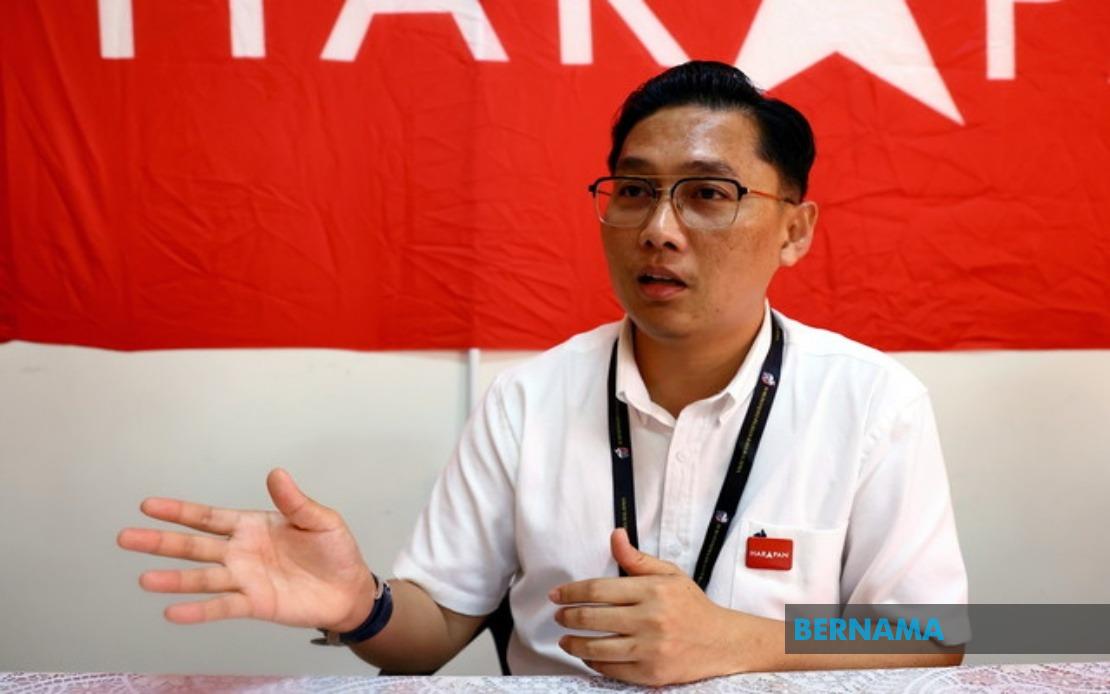
Nur Hafiz Roslan, the Pakatan Harapan candidate contesting the Machap state seat, has declared his readiness to take on the incumbent Johor Menteri Besar Datuk Onn Hafiz Ghazi in the July 11 state election, dismissing concerns about facing an entrenched political heavyweight in what has long been regarded as a Barisan Nasional stronghold. Speaking at the PH operations centre for the N26 Machap constituency in Simpang Renggam, Nur Hafiz conveyed a tone of quiet confidence, grounded in his two decades of experience practising law and a conviction that electoral outcomes are never predetermined.
The challenge before Nur Hafiz is substantial. Onn Hafiz secured the seat in 2022 with a commanding majority of 6,543 votes, reflecting the deep-rooted support for BN in this rural Johor constituency. Yet the PH candidate drew historical parallels to bolster his case, pointing to the electoral defeats suffered by former Johor Menteri Besars Tan Sri Abdul Ghani Othman and Datuk Seri Khaled Nordin despite their prominence and tenure. His framing suggests that even entrenched incumbents are vulnerable when political winds shift, a subtle reminder that Malaysia's voters have repeatedly demonstrated a willingness to punish ruling parties they perceive as complacent or disconnected.
What distinguishes Nur Hafiz's pitch is his explicit rejection of what he terms outdated campaign tactics. Rather than engage in the traditional Malaysian electoral playbook of divisive messaging, he has positioned himself as an advocate for what he calls "mature politics"—an approach that transcends the appeal to race, religion and royalty sentiments, or what he described as the exploitative mobilisation of 3R fears. This framing carries particular resonance in contemporary Malaysian politics, where younger, urban voters and increasingly educated constituencies have grown weary of campaigns built on anxiety and communal divisions. His emphasis on policy substance over emotional agitation represents a deliberate attempt to position PH as the party of forward movement and rational governance.
The legal background Nur Hafiz brings to the contest provides him with a distinct professional positioning. Two decades in the law profession suggests an individual accustomed to evidence-based argument, contractual clarity, and the discipline of presenting cases systematically. In the Malaysian electoral context, where many candidates draw from business, military, or party machinery backgrounds, a lawyer offers voters a different profile—someone trained in due process and the articulation of rights. This professional identity, however, also carries risks; legal professionals can appear detached from ground realities or overly cerebral in their engagement with constituents' immediate concerns about jobs, services, and livelihood.
Nur Hafiz's remarks on the internal strength of the PH campaign machinery carry significance beyond mere morale-boosting. He highlighted that the coalition's election organisation is stable and free from the internal fractures that have plagued opposition coalitions in past contests. Malaysia has witnessed numerous instances where opposition machines have imploded mid-campaign due to personal rivalries, ideological disputes, or resource disputes between parties. A united, disciplined campaign structure is not merely advantageous—it is often decisive in competitive contests. His statement that this stability has been evident since the nomination stage suggests careful party management and possibly strong coordination between PH component parties in the state.
The promised role as a bridge between state and federal government, should he win, touches on a fundamental governance challenge in Malaysia's federal system. Machap constituents have experienced decades of BN state government, and the relationship between a state opposition to a federal government of the same colour creates complex dynamics. Nur Hafiz's undertaking to represent constituency concerns fairly regardless of background suggests an awareness that effective representation transcends partisan loyalty—a message that appeals to pragmatically minded voters who prioritise results over ideology. This positioning also implicitly critiques the incumbent's capacity to deliver benefits from the federal government, should there be misalignment between state and federal power.
The straight fight between Nur Hafiz and Onn Hafiz eliminates potential vote-splitting scenarios that might have complicated the contest. In Malaysian state elections, three-way contests frequently deliver victories to the frontrunner even with fragmented opposition support. The direct bilateral contest sharpens the choice for voters and eliminates the complication of strategic voting calculations. This clarity potentially benefits the challenger, as voters can focus their decision on the two candidates without hedging their bets across multiple options.
Nur Hafiz's campaign messaging reflects broader trends within opposition politics across Southeast Asia, where younger candidates are increasingly emphasising developmental competence and policy delivery over traditional partisan or identity-based appeals. His disavowal of fear-based politics centred on communal anxieties suggests he believes the electoral terrain in Machap—and more broadly in Johor—has shifted sufficiently that such messaging carries declining effectiveness. Whether this reflects genuine demographic and attitudinal change or represents underestimation of such politics' continuing resonance will be tested on polling day.
The scheduling of early voting for July 7, with main polling on July 11, provides a window for last-minute campaign dynamics to shift voter sentiment. Early voting traditionally attracts more committed voters, which could advantage either candidate depending on their respective bases' mobilisation levels. In Machap, where BN's organisational machinery has had decades to embed itself, the turnout calculations may prove decisive. A PH victory would require not merely competitive campaigning but active persuasion of voters accustomed to voting BN, a significantly higher bar than merely motivating core supporters.
For Malaysian politics more broadly, the Machap contest represents a microcosm of larger questions about whether electoral contestation can evolve beyond communal appeals and whether policy-focused messaging resonates with voters in constituencies defined by traditional voting patterns. Nur Hafiz's campaign, should it succeed despite the considerable headwinds, would provide evidence that even deeply entrenched political holdings can shift when challenged by candidates offering substantively different visions and campaign approaches.

