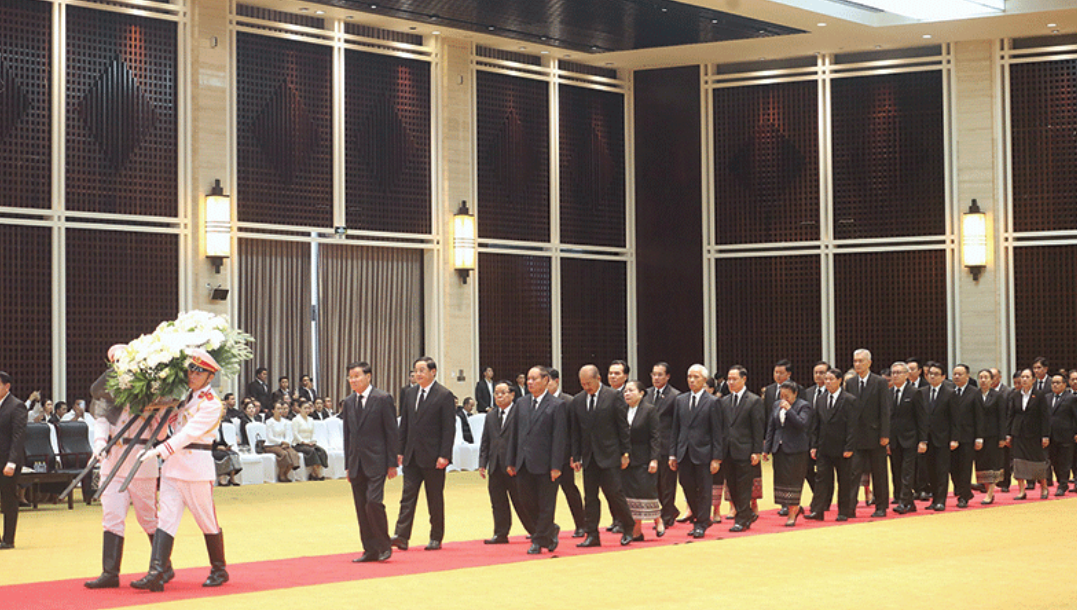
Laos's top political leadership converged at the National Convention Hall to honour National Assembly President Xaysomphone Phomvihane following his death on Saturday, August 9. Party Secretary General and President Thongloun Sisoulith spearheaded the solemn proceedings, which saw dignitaries from across the Lao establishment lay wreaths to commemorate the departed statesman. The ceremony drew senior government officials, National Assembly members, representatives from civic organisations and business leaders, creating an assembly that underscored the late president's stature within Lao political circles.
The loss of Xaysomphone, who held membership in the Politburo of the Lao People's Revolutionary Party Central Committee, represents a watershed moment for the nation's legislative institution and broader political structure. Throughout his career, he devoted himself to advancing the National Assembly's institutional strength and shepherding Laos through critical phases of economic and social development. His leadership extended beyond parliamentary affairs into the country's defence apparatus and strategic governance frameworks, positioning him as an architect of contemporary Lao statecraft.
The wreath-laying ceremony followed a carefully choreographed protocol that reflected hierarchies within the Lao power structure. The Central Committee of the Lao People's Revolutionary Party initiated proceedings under President Thongloun's direction, establishing the ceremonial tone. Successive delegations from the Standing Committee of the National Assembly, led by Vice President Sounthone Xayachack, and the Government, represented by Prime Minister Dr Sonexay Siphandone, honoured the deceased in prescribed sequence. This ordering illuminates how Lao ceremonial practices encode political relationships and institutional standing.
Family delegations accorded prominence in the tributes speak to Xaysomphone's dynastic significance within Laos's ruling elite. Born on December 12, 1956, he was one of six sons of former President Kaysone Phomvihane, himself a foundational figure in the Lao state. His siblings occupy prominent positions within government, with Deputy Prime Minister and Finance Minister Santiphab Phomvihane leading family representation. Such interconnected family networks characterise the concentrated power structures typical of Communist-led states in Southeast Asia.
What distinguished the ceremony was Vietnam's prominent participation, underscoring the two nations' extraordinarily close political and strategic alignment. A delegation from the Vietnamese National Assembly, led by Tran Thanh Man—a senior Communist Party figure—travelled to Vientiane to pay respects, accompanied by representatives from Vietnam's security apparatus. This diplomatic gesture reinforces Hanoi's investment in maintaining strong institutional connections with Vientiane, reflecting how bilateral relations permeate multiple governmental levels rather than remaining confined to executive channels.
International participation extended beyond Vietnam to include foreign diplomatic missions operating from the Lao capital, where envoys visited the National Convention Hall to express condolences. This cosmopolitan dimension of the tributes demonstrates how Xaysomphone's passing transcended domestic significance to register as an event meriting acknowledgment within Laos's broader international engagement patterns. For Malaysian observers, such ceremonies illustrate the ceremonial weight accorded to deceased senior leaders in one-party states, where institutional continuity and symbolic reinforcement of revolutionary legitimacy feature prominently.
Both Laos and Vietnam enacted formal mourning periods honouring Xaysomphone's memory. Vietnam declared two consecutive days of national mourning on August 10 and 11, while the Lao establishment designated five days spanning August 8 through 12 for official mourning across the Party Central Committee, National Assembly, Government and Lao Front for National Development. These synchronized observances illustrate how ceremonial practices synchronise across the Lao-Vietnamese political space, reinforcing ideological and institutional solidarity.
Xaysomphone's life trajectory intertwined intimately with the National Assembly's development and institutional consolidation. His tenure witnessed the legislative body's evolution from revolutionary institution into an ostensibly more deliberative forum, though real power concentration remained centred within Party structures. His contributions to legislative affairs, national defence coordination and socio-economic policymaking positioned him as a bridging figure between revolutionary origins and contemporary state management challenges. His passing therefore creates potential institutional vacuums requiring careful succession planning.
The five-day mourning window, concluding with a state cremation at the That Luang esplanade on August 12 with full ceremonial honours, reflects Lao Buddhist traditions interwoven with Socialist state practices. The timing and location of the cremation—one of Buddhism's most sacred ceremonial spaces—demonstrates how even avowedly Communist administrations accommodate and integrate religious observances into state ritual. This syncretism characterises Southeast Asian Socialist practice, where ideological rigidity yields to cultural accommodation.
For Malaysia and broader Southeast Asia, Xaysomphone's death and the institutional responses it triggered offer insights into succession management within single-party authoritarian systems. The seamless coordination among Party organs, government ministries and the National Assembly suggests institutional mechanisms for managing elite transitions remain functional despite personalised governance patterns. The conspicuous Vietnamese involvement signals how regional Communist parties maintain deep institutional linkages that survive leadership transitions, creating continuities transcending individual leaders.
The extensive participation from multiple government sectors, business representatives and civic organisations indicates how the Lao state maintains performative inclusivity even within restricted political systems. These ceremonies simultaneously reinforce Party legitimacy whilst demonstrating consensus-building across society's officially recognised segments. For Malaysian stakeholders observing Lao governance patterns, such rituals reveal how authoritarian systems employ ceremonial practices to project stability and institutional cohesion during transitional moments when vulnerability might otherwise emerge.
Xaysomphone's career embodied the revolutionary generation's gradual transformation into state administrators. His devotion to Party, State and people—the refrain emphasised throughout tributes—reflects ideological language rooted in Communist doctrine yet applied to a figure whose primary contributions centred on institutional governance rather than revolutionary mobilisation. This evolution from revolutionary struggle to bureaucratic management characterises Southeast Asia's established Communist parties, where institutional stability increasingly supersedes ideological dynamism. His passing therefore marks not merely individual loss but a generational transition within Lao leadership structures.

