Laotian law enforcement has struck a major blow against organised wildlife smuggling, uncovering a sophisticated trafficking operation that has been funnelling endangered animals and protected species products across Southeast Asian borders. The breakthrough came through a series of coordinated enforcement actions in Luang Prabang and Champasak provinces, revealing the scale and reach of criminal networks exploiting the region's porous borders and high demand for illegal wildlife goods.
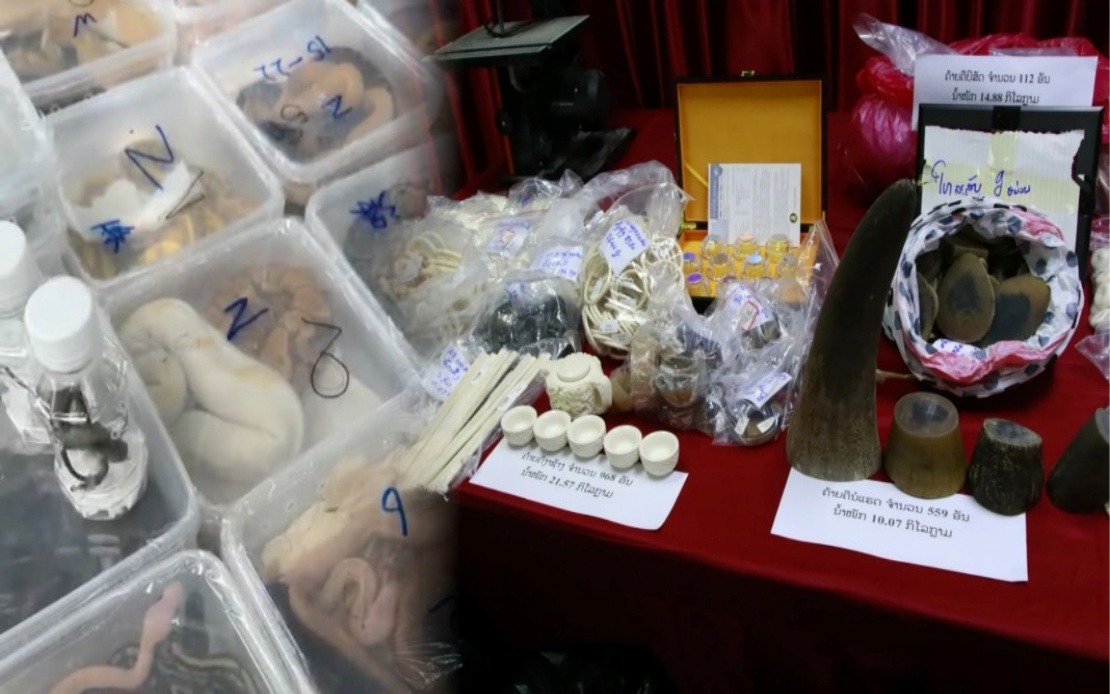
During an operation in Luang Prabang, the Lao Wildlife Enforcement Network confiscated approximately 60 kilogrammes of contraband wildlife materials from commercial channels. The haul included items commonly sought by traffickers: objects resembling ivory, extracted bear gallbladders, pangolin scales, and what authorities identified as rhinoceros horn. Additional seizures encompassed elephant skin powder, bird parts including hornbill heads, and traditional medicine preparations suspected of containing processed wildlife derivatives. Such items command premium prices in black markets across East and Southeast Asia, where they are marketed for supposed medicinal properties despite lacking scientific validation.
Four days after the Luang Prabang seizure, wildlife rangers achieved a more dramatic victory at Vang Tao International Checkpoint in Champasak Province, which straddles the border with Thailand's Ubon Ratchathani Province. Officers intercepted 294 live reptiles and small animals being transported on a commercial passenger bus bound for Bangkok. The captured creatures included multiple species of turtles, pythons, various snake species including green snakes and gold-ringed cat snakes, and numerous lizards. The animals' origin and intended destination suggest they were destined for the underground exotic pet trade or traditional medicine markets in Thailand and potentially beyond.
This enforcement success reflects mounting regional concern about wildlife smuggling's impact on biodiversity. Laos occupies a precarious geographic position, sharing borders with Cambodia, China, Myanmar, Thailand, and Vietnam, making it an inevitable transit point for trafficking networks seeking to move contraband between source countries and consumption centres. The country's relatively limited institutional capacity and porous frontiers have historically made it attractive to smugglers, who exploit weak border controls and corruption within law enforcement agencies.
The recent crackdowns align with a pattern of enforcement activity detected across the Mekong region. In late May, Thai authorities in Nakhon Phanom arrested a woman operating a traditional medicine and souvenirs shop, uncovering more than 100 protected animal remains believed sourced from Laos. Days earlier, Thai and Lao border authorities jointly dismantled an attempt to smuggle 130 kilogrammes of cut elephant ivory and animal carcasses across their shared frontier. These interconnected operations suggest law enforcement coordination is strengthening, though traffickers continue adapting their methods and routes.
The scale of the illegal wildlife trade extends far beyond these individual seizures. According to the United Nations Office on Drugs and Crime's World Wildlife Crime Report 2024, global wildlife trafficking generates approximately US$10 billion (RM41 billion) annually, placing it alongside human trafficking, narcotics smuggling, and arms dealing among the world's most lucrative criminal enterprises. The UNODC assessment emphasises that despite two decades of intensified international cooperation and national enforcement measures, illegal trade in wildlife persists as a systemic challenge affecting thousands of animal and plant species globally.
Critically, the UNODC report identifies corruption as the fundamental enabler of trafficking operations. Without complicity or negligence from officials at multiple points along supply chains—from rural poaching sites to border checkpoints to urban markets—the scale of commercial wildlife crime would be substantially diminished. This reality confronts regional governments with uncomfortable truths about institutional weaknesses and the necessity of addressing both enforcement capacity and governance integrity simultaneously.
For Malaysia and other Southeast Asian nations, the Laos operations carry significant implications. The region's interconnected trade flows mean that animals and products seized in Laos likely transit through or originate from multiple countries including potentially Malaysia. The expertise demonstrated by Lao Wildlife Enforcement Network and Thai authorities offers useful lessons for strengthening border controls, improving inter-agency intelligence sharing, and building capacity for identifying smuggled species. Malaysian authorities participate in regional frameworks including ASEAN and the CITES convention, yet enforcement effectiveness varies considerably across member states.
The captured reptiles and seized animal products also highlight the persistent demand side of trafficking dynamics. Traditional medicine markets remain significant drivers of wildlife demand across Asia, as do exotic pet industries and luxury goods trades. Without sustained demand reduction efforts—including public education, regulatory restrictions on wildlife product sales, and enforcement against retail traders—enforcement at production and transit points will only partially interrupt trafficking flows.
Laotian authorities' willingness to conduct high-profile operations and publicise results suggests evolving political commitment to conservation. However, sustainability of these efforts depends on sustained funding, consistent training, and periodic rotation of personnel to minimise corruption vulnerabilities. International donors and organisations including UNODC and TRAFFIC provide support, but the core responsibility rests with national governments to prioritise wildlife protection alongside competing development priorities.
The 294 animals rescued in the Champasak seizure now face uncertain futures. Many reptiles cannot be easily repatriated to wild populations due to trafficking-related stress, disease exposure, and uncertainty regarding original capture locations. Rehabilitation and sanctuary care require resources that wildlife authorities in Laos often struggle to secure adequately. These downstream consequences of trafficking—the welfare burden imposed on enforcement agencies—represent hidden costs rarely captured in discussions of trafficking's economic dimensions.
Regionally, these enforcement successes should encourage parallel action elsewhere. Vietnam, Thailand, Cambodia, and Myanmar all grapple with trafficking through their territories, yet coordination and information sharing remain inconsistent. Malaysia's position within regional supply chains and its role as a consumption market for certain wildlife products position it as having both responsibilities and opportunities to contribute more assertively to disrupting these networks. Strengthening ASEAN-level coordination on wildlife law enforcement would amplify the impact of individual national operations like those recently undertaken in Laos.
Ultimately, the exposure of this trafficking network represents enforcement success but not strategic victory. The underlying drivers—poverty in source communities, corruption enabling smuggling, persistent consumer demand, and high profits—remain largely unaddressed. Sustaining momentum against wildlife trafficking will require sustained commitment from law enforcement alongside complementary strategies addressing demand, livelihood alternatives, and institutional reform across the entire region.