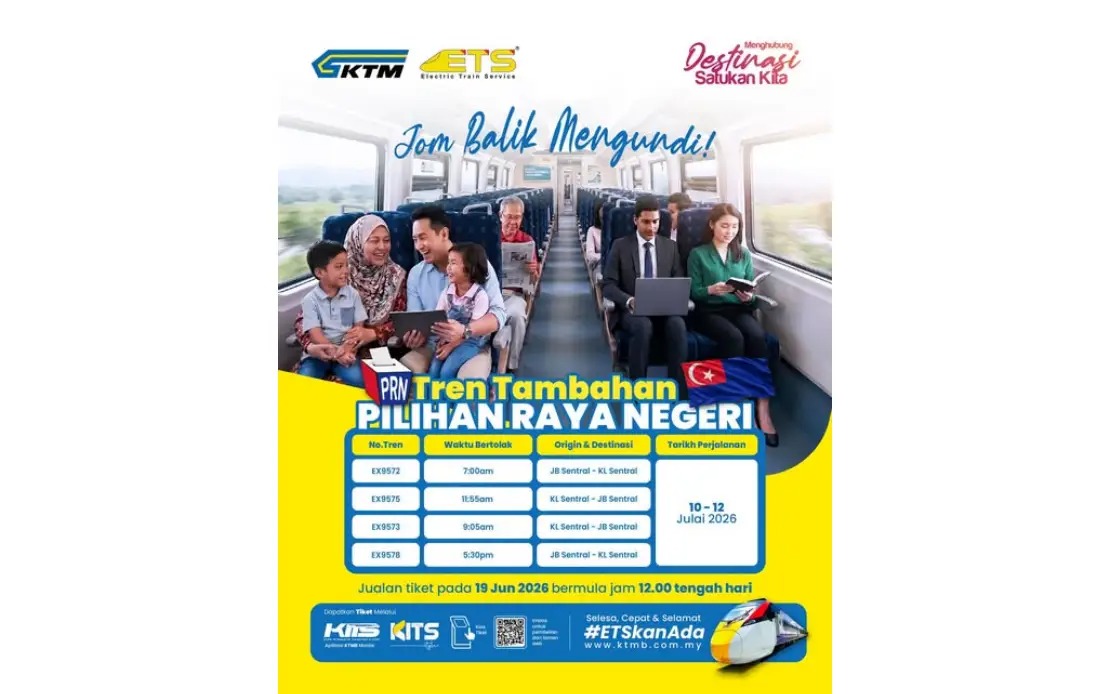
Keretapi Tanah Melayu Berhad (KTMB) has responded to anticipated travel demand by arranging extra Electric Train Service (ETS) capacity on southern routes during the Johor state election cycle. The national rail operator announced the enhanced schedule through its social media channels, signalling institutional recognition that electoral events typically generate significant internal migration as citizens return to their constituencies to cast votes.
Ticket reservations opened at midday on June 19, with KTMB offering multiple purchase avenues to maximise accessibility for travellers. Prospective passengers can book through the KTMB Mobile application, the KITS Style platform, the carrier's official website at online.ktmb.com.my, or by visiting physical ticket counters at designated stations. This multi-channel approach reflects standard industry practice during peak-demand periods and demonstrates KTMB's effort to streamline the booking experience across digital and traditional channels.
The supplementary train services will operate across a three-day window from July 10 through July 12, effectively bracketing the election date itself. This scheduling allows voters arriving from other states sufficient time to settle, vote on the designated polling day, and return home without compressing travel into a single 24-hour period. The Election Commission's decision to hold the Johor state election on July 11 follows the State Legislative Assembly's dissolution on June 1, triggering the standard electoral timeline and administrative processes.
Electoral transport arrangements carry particular significance in Malaysia's federal system, where states conduct their own polls on different dates and internal migration during election season becomes a predictable socio-economic phenomenon. Voters living in urban centres like Kuala Lumpur or Selangor frequently maintain family ties and electoral registrations in their home states, particularly in constituencies like those across Johor. The reliance on rail infrastructure to facilitate this movement underscores the interconnectedness of Malaysia's transport networks and the dependency of electoral participation on accessible public transport.
For KTMB specifically, electoral periods represent both operational challenges and legitimacy opportunities. Executing expanded services smoothly demonstrates organisational competence and public-service orientation, qualities essential to a state-owned enterprise charged with serving the nation's transport needs. Conversely, bottlenecks or service failures during high-demand periods attract scrutiny and public frustration. By announcing enhanced capacity well in advance, KTMB telegraphs its preparedness and invites advance planning among travellers.
The Johor state election carries broader political implications across Southeast Asia's most economically developed Malaysian state. Johor's strategic location, adjacent to Singapore and serving as a crucial commercial hub, makes its governance structure and political complexion matters of regional interest. Enhanced transport infrastructure—including adequate rail capacity—contributes to the state's competitive positioning and quality of life, factors that influence electoral behaviour and governance priorities.
From a passenger perspective, the availability of additional southbound ETS services removes a potential friction point in the voting process. Individuals concerned about securing seats on congested trains need not delay their travel or compromise their electoral participation. This convenience factor, though seemingly minor, matters significantly for working professionals, parents managing childcare, and individuals with limited flexibility in their schedules. By absorbing demand surges, KTMB facilitates democratic participation and reduces practical barriers to voting.
The announcement also reflects evolving expectations around corporate social responsibility among government-linked entities. KTMB's proactive communication about electoral travel arrangements demonstrates alignment with democratic processes and recognition that facilitating civic participation constitutes part of its broader national mission. This stance has become increasingly common among Malaysian public institutions during election cycles, signalling acceptance that supporting electoral logistics is a legitimate and valued function.
Operationally, deploying additional train services requires coordinating multiple components: rolling stock availability, crew scheduling, maintenance coordination, and station capacity management. The fact that KTMB could announce supplementary services weeks in advance suggests that such contingency planning forms part of its standard electoral calendar management. This institutional preparedness, refined through multiple electoral cycles, enables the operator to respond to foreseeable demand fluctuations without operational chaos.
Looking beyond this particular election, the experience of managing electoral travel flows generates valuable data about passenger behaviour, peak-hour patterns, and infrastructure constraints. KTMB and transport planners can use this information to refine long-term capacity planning and service design. Each electoral cycle potentially contributes insights that shape future transport policy and investment decisions across Malaysia's rail network.