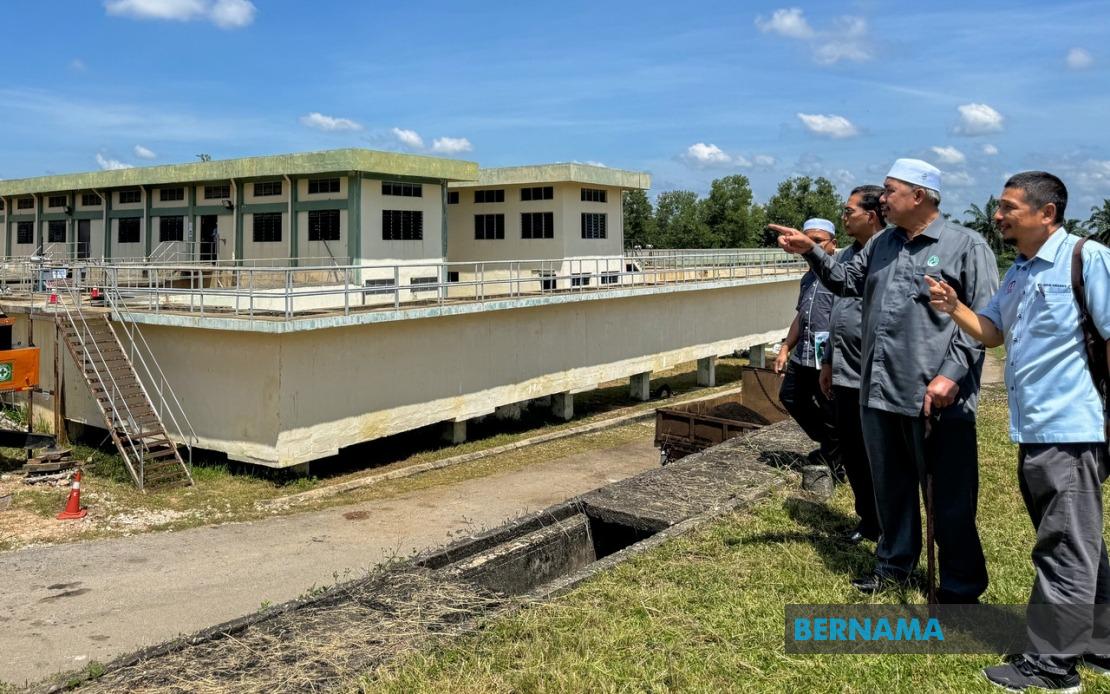
A significant infrastructure investment in Kelantan's water sector is poised to transform service delivery for tens of thousands of residents, with the completion of a RM11.5 million upgrade to the Merbau Chondong Water Treatment Plant. The project, which nearly doubles the facility's treated water output capacity, is expected to commence full operations in early September, addressing long-standing supply constraints that have plagued three districts in the northeast of Peninsular Malaysia.
The upgrade will increase daily production to 80 million litres from the previous 45 million litres, according to Datuk Dr Izani Husin, chairman of Kelantan's Public Works, Infrastructure, Water and Rural Development Committee. This expansion represents a transformative shift for water utility operator Air Kelantan Sdn Bhd, which has historically been unable to significantly raise output without compromising water quality. The technical barrier stemmed from limitations in the treatment facility's filtration systems, which previously struggled to maintain the required purity standards under increased throughput. The constraint has meant that despite growing demand from population growth and economic development, the utility had been unable to meet supply expectations across its service area.
The technological solution implements a Xylem Underdrain Leopold filtration system, a sophisticated treatment methodology that enables the plant to process between 70 and 90 million litres of raw water daily while maintaining stringent quality controls. This engineering advancement directly addresses the fundamental challenge that had restricted expansion: the capacity to handle higher volumes without degradation. The new system represents a fundamental upgrade in the plant's operational architecture rather than a simple capacity increase.
Quality improvements accompany the capacity gains. The turbidity level—measured by the Nephelometric Turbidity Unit scale—has been reduced from over 10 NTU to 3 NTU, a significant enhancement that ensures treated water meets contemporary drinking water standards. This metric is crucial for consumer health and satisfaction, as elevated turbidity indicates the presence of suspended particles and potential contaminants. The reduction demonstrates that the upgrade achieves simultaneous gains in both quantity and quality, a balanced outcome that reflects careful engineering design.
The immediate beneficiaries are approximately 34,000 account holders distributed across Machang, Pasir Puteh, and the southern portion of Kota Bharu district. These areas have experienced periodic water disruptions and insufficient pressure during peak demand periods, creating inconvenience for households and businesses. The upgrade addresses an accumulated backlog of service inadequacies that have accumulated over years of constrained supply. For residents in these districts, September's commencement of full operations promises measurable improvement in water availability and reliability.
However, the upgrade represents an intermediate solution within a broader infrastructure development strategy. The Kelantan state government and Pengurusan Aset Air Berhad are progressing plans for a new RM120 million Machang 1 Water Treatment Plant, which is anticipated to commence operations by 2030. This facility will generate 50 million litres daily, dedicated primarily to meeting Machang's expanding requirements while simultaneously freeing capacity at Merbau Chondong for redistribution to other districts facing supply challenges. The phased approach reflects a strategic commitment to systematically expanding infrastructure as demand grows and financial resources become available.
The Machang 1 project currently awaits finalisation of contractual arrangements between the state government and PAAB before contractor selection commences. This administrative stage suggests the project is advancing, though the multi-year timeline to completion provides time for detailed design optimisation and procurement processes. For Malaysian water sector observers, the dual-plant strategy demonstrates recognition that single-facility improvements, while valuable, cannot indefinitely serve expanding populations without eventually reaching practical limits.
Broader statewide progress on water supply issues shows measurable advancement. Air Kelantan has resolved approximately 70 percent of supply problems affecting 270,000 user accounts throughout Kelantan, with an institutional target to achieve at least 90 percent resolution by 2035. This roadmap suggests a systematic, time-bound commitment to addressing the accumulated infrastructure deficit that characterises many Malaysian states. The 20-year horizon reflects the scale of capital investment and planning cycles required to comprehensively modernise water systems.
For the Southeast Asian region, Kelantan's experience illustrates challenges common across rapidly developing areas. Many water utilities in the region contend with ageing infrastructure, population growth outpacing capacity, and technical constraints limiting expansion without quality sacrifice. The Merbau Chondong upgrade demonstrates that targeted technological investment can overcome such barriers, providing a case study for water authorities elsewhere addressing similar constraints. The Xylem filtration system application may offer lessons for neighbouring jurisdictions encountering comparable capacity limitations.
The September commencement date represents a critical milestone. Kelantan residents who have endured supply irregularities will gain material improvement in service reliability. Beyond immediate consumer satisfaction, stable water supply has broader economic implications, supporting business continuity and industrial operations that depend on reliable water access. For a state competing to attract investment and support economic development, infrastructure reliability serves as a foundational competitive advantage.
The state government's strategic framework suggests institutional maturity in approaching water security as a long-term development priority. The combination of immediate capacity enhancement through the Merbau Chondong upgrade, medium-term quality improvement targeting, and long-term infrastructure expansion through Machang 1 reflects coordinated planning across multiple timeframes. This approach contrasts with reactive crisis management, instead establishing Kelantan as progressively building capacity to serve its population comprehensively.
Looking forward, the successful completion and operation of this upgrade will generate performance data valuable for planning subsequent expansions. Water utility officials will gain operational experience with the Xylem system, optimise maintenance protocols, and establish benchmarks for cost-effectiveness and reliability. This institutional learning will inform design decisions for the Machang 1 facility and potentially other future projects. The upgrade thus serves both as an immediate solution and as a learning opportunity for long-term infrastructure management.

