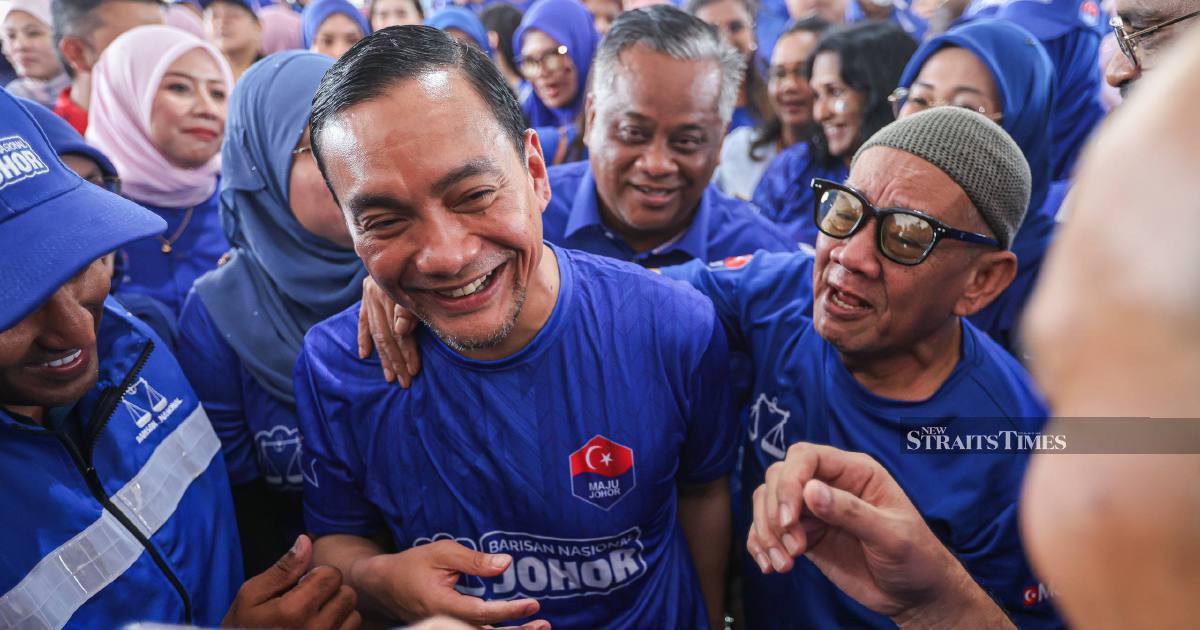
A peculiar political phrase has gained traction throughout Johor's recent election campaign, prompting UMNO's leadership to read it as a positive signal for the state's administration. Datuk Dr Asyraf Wajdi Dusuki, serving as UMNO's secretary-general, has interpreted the 'Onn tak Onn' phenomenon as demonstrating the electorate's growing comfort with Datuk Onn Hafiz Ghazi's performance as Johor Menteri Besar. The phrase, which plays on the Menteri Besar's name in a manner that carries nuanced meaning in the local political context, has surfaced repeatedly during campaign activities across the state.
The emergence of this linguistic phenomenon during an election cycle merits closer examination, as slogans and catchphrases often reveal underlying sentiments within voter populations. Rather than appearing as a spontaneous grassroots expression, the widespread adoption of the 'Onn tak Onn' phrase across multiple constituencies suggests a coordinated or at least naturally resonating message that has captured public imagination. For UMNO operatives, the circulation of this phrase offers reassuring evidence that their candidate enjoys broader acceptance than might otherwise be apparent through conventional polling mechanisms.
Johor's electoral landscape has historically been shaped by the dominance of UMNO and its coalition partners, though recent years have witnessed fluctuations in support patterns that kept many observers attentive to shifts in voter behaviour. Onn Hafiz's ascension to the Menteri Besar position represented a generational transition within the state's leadership, and his consolidation of power through public acceptance has become a narrative that UMNO wishes to emphasize to the broader electorate. The 'Onn tak Onn' messaging, whatever its precise connotation, appears designed to reinforce the notion that the current administration commands legitimacy beyond merely holding formal office.
The interpretation placed upon this phrase by Datuk Dr Asyraf Wajdi Dusuki carries implications for how UMNO measures success in state elections. Rather than relying solely on seat counts or vote share percentages, the party appears attuned to softer indicators of public sentiment—the kind of colloquial expressions that gain currency in coffee shops, markets, and community gatherings. This approach reflects a sophistication in political messaging that acknowledges how ordinary citizens actually discuss politics, often through wordplay, humour, and cultural references that bypass formal campaign rhetoric.
For voters in Johor, the proliferation of such phrases during election season provides an interesting window into how political identity is constructed and negotiated at the grassroots level. The phenomenon demonstrates that electoral campaigns operate on multiple registers simultaneously—the official pronouncements by party leadership coexist with organic or semi-organic messaging that emerges from within communities themselves. Whether the 'Onn tak Onn' slogan originated from party strategists or developed independently from voter sentiment, its adoption by campaign machinery suggests it resonates with audiences in ways that conventional messaging might not.
The state of Johor occupies a significant position within Malaysia's broader political architecture. As one of the peninsula's most populous and economically important states, voting patterns in Johor carry consequences that extend beyond local governance into national coalition calculations. UMNO's confidence in promoting the 'Onn tak Onn' phenomenon as evidence of public approval signals the party's assessment that Onn Hafiz's administration has successfully navigated the delicate balance between maintaining traditional UMNO support bases while potentially appealing to newer voter demographics.
Onn Hafiz's tenure as Menteri Besar has encompassed both continuity with established UMNO governance patterns and some initiatives that suggested responsiveness to contemporary policy concerns. His ability to sustain support across diverse segments of Johor's population—encompassing urban professionals, rural communities, and industrial workers—suggests a political coalescence that extends beyond party machinery into genuine public acceptance. The 'Onn tak Onn' phraseology, in this reading, becomes a linguistic manifestation of this broader political consensus.
The electoral environment in Johor reflects Malaysia's evolving political dynamics, where national coalition politics increasingly intersect with state-level governance challenges. Voters increasingly demand competence and responsiveness from their elected representatives, considerations that transcend traditional ethnic or religious political cleavages. By emphasizing public acceptance of Onn Hafiz's leadership rather than relying exclusively on party affiliation appeals, UMNO acknowledges this shift in voter expectations and attempts to position the current administration as meeting standards of performance and legitimacy.
Looking forward, how effectively UMNO translates the positive sentiment suggested by the 'Onn tak Onn' phenomenon into electoral success will depend on whether the party can maintain momentum and prevent competing narratives from gaining traction. Opposition parties and alternative political voices naturally contest UMNO's interpretation of public sentiment, offering different frameworks through which to understand voting behaviour. The extent to which Johor voters ultimately endorse UMNO candidates in the election will provide a definitive measure of whether such linguistic phenomena genuinely reflect deep public acceptance or represent more superficial expressions of political identity.

