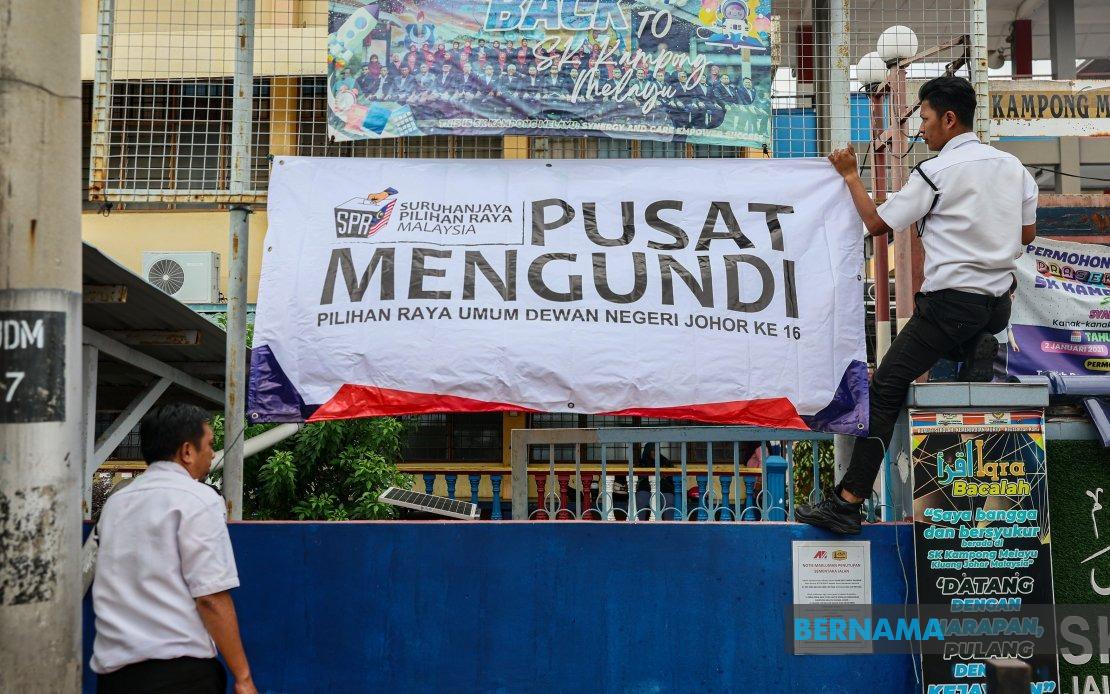
Johor's political landscape shifted into focus today as the state conducted its 16th legislative election, with an electorate exceeding 2.7 million citizens exercising their democratic right to determine representation across all 56 seats in the State Legislative Assembly. The scale of the undertaking underscores Johor's significance as Malaysia's second-largest state and a crucial electoral bellwether for national political trends, having demonstrated substantial voter interest in recent years despite historical turnout patterns.
Voting commenced simultaneously across the entire state at 8 am, with election administrators establishing 1,076 distinct polling centres and distributing voting operations across 4,889 individual streams to manage the anticipated volume of participants. This infrastructure represents a substantial logistical mobilisation by the Election Commission, designed to facilitate smooth access to ballot stations while maintaining the security and integrity of the voting process. The geographic distribution of these facilities becomes particularly crucial given Johor's expanse and population density variations across urban and rural districts.
The polling exercise marks the conclusion of an intensive two-week campaign period that concluded at midnight the previous evening, during which competing political coalitions and parties conducted extensive outreach activities to secure voter support. The timing of this election carries weight beyond Johor's borders, as state-level contests frequently provide indicators of shifting political sentiment that influence calculations at the national level. The composition of the final State Legislative Assembly could reshape the state's governance trajectory and potentially affect coalition dynamics affecting federal politics.
Operational procedures stipulated that polling centres would progressively close between 11 am and 6 pm depending on their respective locations, with island constituencies receiving priority closure times due to transportation constraints. Pulau Besar concluded voting at 11 am, while Pulau Aur and Pulau Pemanggil wrapped up at noon, reflecting the practical challenges of administering elections across maritime territories. The postal ballot mechanism, with 24,677 ballots issued to eligible voters unable to attend physical polling stations, required completion and submission by the 6 pm deadline to maintain electoral timetables.
The Election Commission mobilised an estimated 43,036 election workers throughout Johor to supervise voting operations, manage ballot distribution and collection, oversee security protocols, and administer the subsequent counting procedures. This substantial workforce deployment reflects the complexity of managing democratic exercises across diverse terrain and population centres. The commission projected that comprehensive results could emerge by 10 pm, contingent upon efficient counting operations and absence of significant procedural complications at individual stations.
The commission established a target of approximately 70% voter participation, representing an ambitious goal considering historical performance. The 2022 Johor state election recorded a 54.92% turnout, indicating that achieving the 70% benchmark would require a notably substantial increase in electoral engagement. Potential drivers of higher turnout could include heightened political polarisation, increased awareness of election significance, or demographic shifts in the voting population since the previous contest.
Weather conditions presented a secondary consideration affecting the voting day experience. The Malaysian Meteorological Department forecasted morning precipitation in Johor Bahru, Batu Pahat, Kulai, Muar, Pontian and Tangkak, with expected improvement toward afternoon and evening hours. Separate thunderstorm warnings covered Kluang, Kota Tinggi and Segamat during afternoon periods, while Mersing faced similar weather disruptions extending into the evening. Such conditions could marginally influence turnout patterns, particularly in districts where rainfall intensity discouraged voter travel during peak morning hours.
Early voting conducted on the preceding Tuesday demonstrated meaningful participation, with 20,607 security and military personnel and their spouses casting ballots in advance procedures designed for essential services workers unable to attend standard polling day operations. This advance participation rate suggests organised engagement among demographic groups with structured institutional support for voting access. The inclusion of security force members and their families in early voting mechanisms reflects administrative practices ensuring comprehensive democratic participation across state functions.
The electoral contest attracted considerable political competition, with 172 candidates representing diverse political movements contesting the 56 assembly positions. Pakatan Harapan and Barisan Nasional each fielded complete slates of 56 candidates, reflecting their status as principal competing coalitions. Perikatan Nasional presented 33 candidates, while Parti Bersama Malaysia fielded 15 aspirants. Smaller formations including MUDA with four candidates, Parti Orang Asli Malaysia with one, Parti Sosialis Malaysia with one, and six independent candidates completed the competitive field.
The pre-dissolution composition of the assembly revealed Barisan Nasional's dominance with 40 seats before dissolution, while Pakatan Harapan held 12 seats, Perikatan Nasional possessed three seats, and MUDA retained one seat. This distribution established clear baseline expectations for performance, with Barisan Nasional defending its majority position against Pakatan Harapan's challenge and emerging competitor formations attempting to capture voter attention. The substantial independent candidate participation might reflect local grievances or personality-driven campaigns rather than coordinated party-building efforts.
Employers received formal reminders regarding their obligations to grant employees sufficient time away from work obligations to participate in voting, reflecting legal protections for democratic participation embedded in Malaysian electoral frameworks. Such employer notifications attempt to mitigate workplace-related barriers to voting access, acknowledging that employment responsibilities represent a practical obstacle to participation for significant population segments.
The Johor election assumes heightened significance within Southeast Asia's evolving democratic context, where state-level contests frequently influence regional political calculations and demonstrate the vitality of competitive electoral processes in the broader region. Malaysia's ability to conduct complex multi-candidate contests across diverse constituencies demonstrates institutional capacity for managing democratic exercises at scale, providing a contrast to certain regional neighbours facing political instability or restricted competitive processes.

