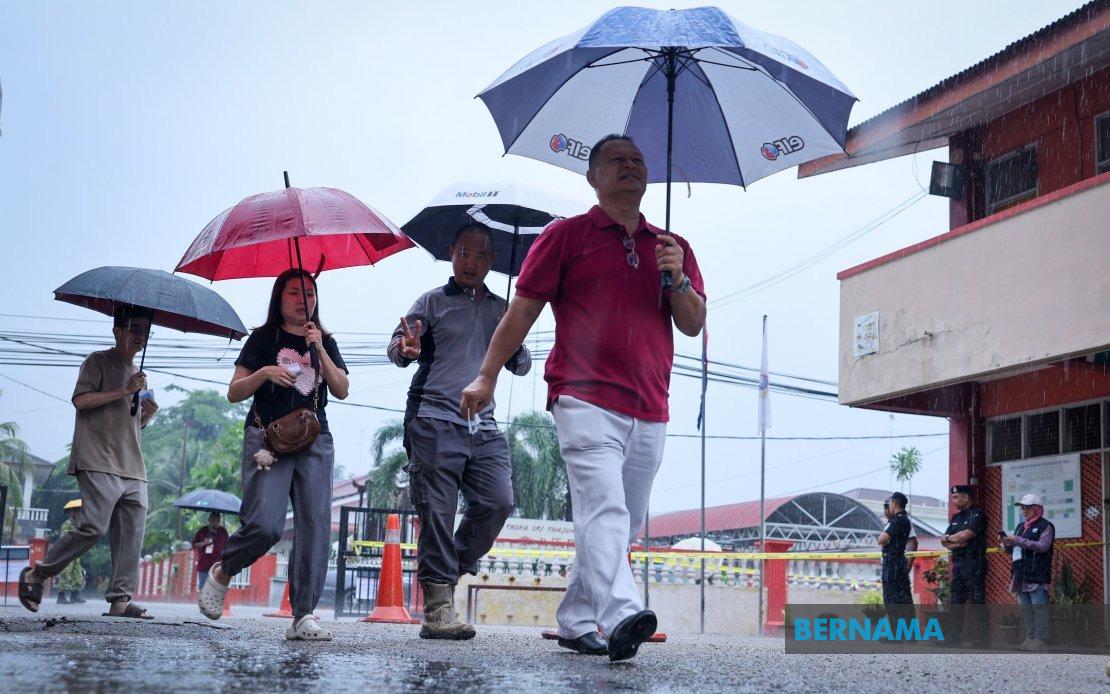
Voting in Johor's 16th state election commenced smoothly on July 11 as more than 2.7 million registered electors made their way to 1,076 polling centres distributed across the state to select representatives for 56 contested seats. The electoral exercise, which pit 172 candidates against one another, proceeded under predominantly clement conditions, though the southern district of Muar faced significant rainfall from dawn that tested voter determination to participate in the democratic process.
Election Commission personnel, law enforcement officials, and accredited media representatives had established their presence at polling stations well before the 8am commencement time, with observer reports from as early as 7am indicating full readiness across facilities. The advance mobilisation ensured smooth administrative operations and reflected the comprehensive preparation undertaken in the weeks preceding voting day. This logistical framework proved particularly important given the geographic spread of polling venues and the need to accommodate diverse voting preferences across Johor's varied constituencies.
Weather monitoring at representative polling locations painted a picture of regional variation. Sekolah Kebangsaan Seri Pantai in Mersing reported clear atmospheric conditions that created comfortable surroundings for early voters, whilst Dewan Raya Taman Ungku Tun Aminah in the state capital and facilities including SMK Senggarang in Batu Pahat and SJKC Kulai all experienced comparable pleasant conditions. These favourable circumstances facilitated orderly queuing and voting procedures, contributing to efficient processing of the electoral process in the state's northern and central zones.
The inclement weather confined to Muar nonetheless demonstrated voter commitment to exercising their franchise regardless of meteorological challenges. Heavy precipitation from morning hours failed to suppress participation at centres such as SJKC Limbong and Sekolah Kebangsaan Ismail 1 in that district, with citizens braving wet conditions to reach polling booths. This pattern underscored the significance voters attached to the election outcome and reflected sustained confidence in the electoral system's legitimacy despite the administrative burden posed by adverse environmental circumstances.
The election represented a pivotal moment in Johor's political trajectory following the dissolution of the state legislative assembly on June 1. The preceding parliamentary session had seen Barisan Nasional commanding 40 of the 56 available state seats, a commanding position supplemented by subsidiary representation from Pakatan Harapan's 12 seats, Perikatan Nasional's three representatives, and the Malaysian United Democratic Alliance's single legislator. This configuration meant that the ruling coalition entered polling day with significant structural advantages, though electoral dynamics remained fluid given the active canvassing by competing coalitions and emerging independent candidates.
The 172 candidates contesting the election represented diverse political orientations and demographic profiles, from established party machinery to grassroots-oriented independents. Their distribution across traditional urban constituencies, rural agricultural areas, and semi-urban growth zones reflected the state's economic and social heterogeneity. The contest therefore transcended simple coalition arithmetic, involving substantive debates regarding development priorities, local governance standards, and sectional interests spanning Johor's Chinese, Malay, and Indian communities as well as younger demographic cohorts.
Polling procedures adhered to Election Commission protocols, with voting stations opening at 8am and closing at times established through advance scheduling by the election authority. The specification of differentiated closing times across facilities accommodated varying population densities and logistical considerations, whilst maintaining standardised voting hours within defined geographic parameters. This staggered approach had proven effective in previous state elections and demonstrated institutional learning regarding optimal administration of large-scale simultaneous polling across dispersed locations.
Immediate commencement of vote counting following closure of individual polling stations ensured rapid tabulation and public disclosure of results, contributing to transparency in the electoral outcome. The concentration of counting operations within or immediately adjacent to polling venues rather than centralised tallying facilities reduced opportunities for procedural irregularities and facilitated observation by accredited representatives of competing candidates and election monitors. This decentralised approach had become standard practice in Malaysian state elections and reflected evolving international best practices regarding electoral integrity.
For Malaysian voters and the broader Southeast Asian region, Johor's electoral exercise carried significance beyond immediate state-level governance considerations. The state commands substantial economic weight within the Malaysian federation, encompassing substantial manufacturing capacity, agricultural production, and increasingly important technology sectors centred on emerging digital clusters. Electoral outcomes therefore influenced not merely state-level policy trajectories but ripple effects across the integrated economic landscape of the southern region, affecting investment decisions and sectoral development priorities affecting employment and commercial activity across state boundaries.
The participation figures and voting patterns emerging from the 1,076 polling centres would provide detailed mapping of electoral sentiment across Johor's diverse constituencies, offering indicators regarding shifting allegiances within traditional support bases and emerging voter coalitions. These signals carried implications extending beyond immediate state administration, informing analyses of the political trajectory within the broader Malaysian context and providing data regarding electoral durability of competing coalitions ahead of potential federal parliamentary contests. The election therefore functioned simultaneously as a state-level decision-making exercise and an indicative gauge of evolving political preferences within one of Malaysia's most populous and economically consequential states.

