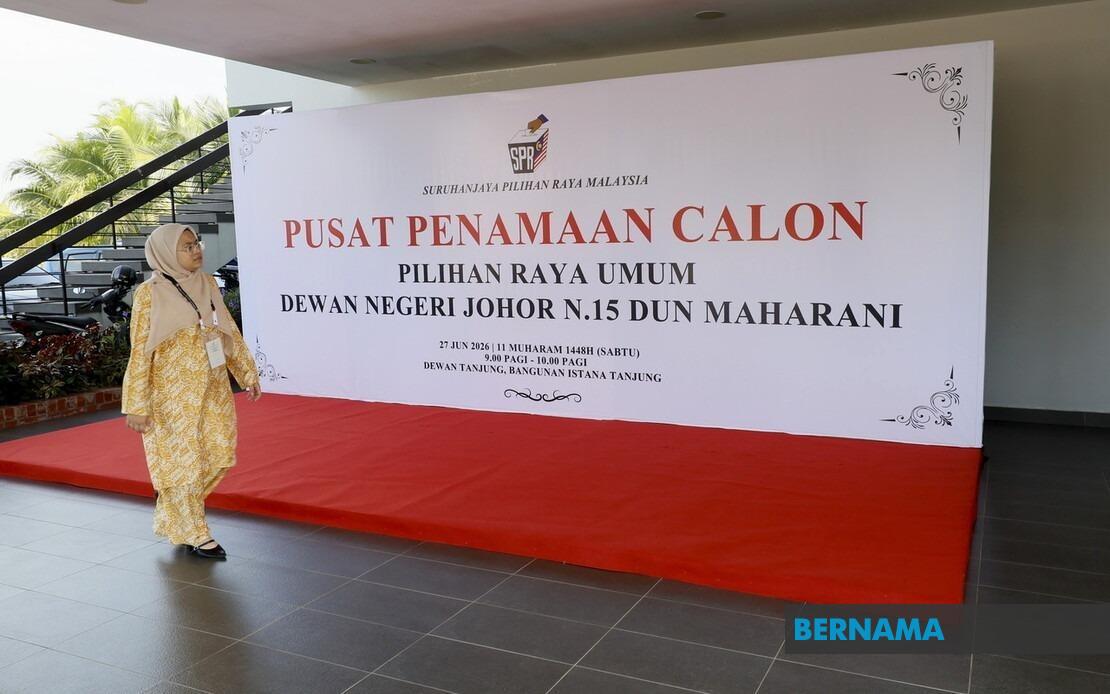
The 16th Johor State Election formally began today, marking the opening of one of Malaysia's most closely watched state contests in recent years. Nomination centres across all 56 state constituencies swung into operation from 9 am, with prospective candidates rushing to submit their papers to Returning Officers before the one-hour submission window closed at 10 am. The move represents a critical moment for the southern state's political landscape, which has witnessed significant realignment over the past three years since the 15th state election in 2018.
The scale of this election reflects the structural shifts in Malaysian politics following recent realignments. Preliminary figures released by the Election Commission indicate that 593 nomination forms had been distributed as of yesterday, with 133 prospective candidates having already confirmed their participation by submitting the mandatory election deposits. These numbers point to a substantially expanded candidate pool compared with previous contests, suggesting that multiple political groupings view Johor as a critical battleground in the broader national political competition.
The electoral roll for this contest spans 2,727,926 registered voters, encompassing 2,703,175 ordinary voters plus 12,041 military personnel and their spouses and 12,710 police officers and their spouses. This electorate size positions Johor as Malaysia's second-largest state election by voter numbers, underscoring its significance in any assessment of national political trends. The composition of the voting population, which includes substantial professional and security force components, may influence campaign messaging strategies across competing coalitions.
Pakatan Harapan enters this contest committed to contesting every single seat, deploying a tripartite structure consisting of PKR candidates in 20 constituencies, Amanah in 19, and DAP in 17. This allocation reflects internal coalition negotiations and perceived party strengths in different districts. Barisan Nasional, which controlled 40 seats before the assembly's dissolution on June 1, fields candidates across all 56 constituencies through UMNO's 36 nominees, MCA's 16, and MIC's four candidates. The presence of UMNO-led Barisan Nasional across the entire state underscores the coalition's intention to recover ground it has lost in recent election cycles.
Perikatan Nasional presents a more fragmented presence, with PAS contesting 11 seats, Bersatu 16, the newly registered Malaysian Indian People's Party five, and Parti Pejuang Tanah Air a single seat. This distribution reveals the complex internal dynamics within the PN coalition, where components negotiate seat allocations based on perceived competitiveness and community representation. The coalition's overall participation across 43 seats demonstrates ambitions to remain a significant force in Johor politics despite losing ground to both Pakatan Harapan and Barisan Nasional in recent federal elections.
Additional contenders inject further complexity into the electoral equation. Parti Ikatan Demokratik Malaysia fields four candidates, positioning itself as an urban-focused challenger to larger coalitions. Parti Sosialis Malaysia fields a single nominee, maintaining its historical presence despite negligible electoral prospects. Most notably, Parti Bersama Malaysia makes its electoral debut, contesting 15 seats and signalling ambitions to carve out political space outside the three major coalitions. This fragmentation suggests voters will face unprecedented choice, though it simultaneously raises questions about whether electoral competition will crystallise around core coalitional blocs or remain dispersed across multiple competitors.
The nomination day proceedings themselves typically generate considerable public enthusiasm, with party supporters congregating around nomination centres to demonstrate backing for candidates. Today's activities across the state will unfold under tight security arrangements, with the Election Commission deploying 4,832 police personnel to manage traffic and maintain order. Road closures affecting 19 major routes near nomination centres throughout Johor will require careful coordination to prevent congestion while ensuring nomination centre accessibility. Weather forecasts predict morning rainfall across several Johor districts, with afternoon thunderstorms anticipated, potentially affecting both the nomination process and the movement of supporters.
The formal campaign period now commences following the official declaration of eligible candidates and will extend for 14 days until 11.59 pm on July 10. This duration aligns with standard Election Commission protocols but represents a compressed timeframe for candidates to build momentum and communicate their platforms to voters across 56 geographically and demographically diverse constituencies. Early voting is scheduled for July 7, with polling day designated as July 11. The compressed timeline has prompted all major coalitions to rapidly accelerate campaign machinery investments and volunteer mobilisation.
Election Commission directives emphasise strict compliance with the Election Offences Act 1954 and local authority regulations throughout the campaign period. Restrictions on amplified campaign activities, including prohibitions on musical instruments and vehicle-mounted loudspeakers, apply rigorously. These regulatory frameworks seek to balance participatory campaign expression against public order maintenance, though enforcement consistency across 56 constituencies during high-intensity campaigning remains a persistent implementation challenge. Candidates and party operatives have been explicitly cautioned regarding compliance obligations.
The preceding political context shapes contemporary electoral calculations substantially. Before the assembly's dissolution, Barisan Nasional held commanding control with 40 seats, while Pakatan Harapan retained 12, Perikatan Nasional three, and MUDA one. This distribution reflected a state where Barisan Nasional maintained structural dominance despite substantial losses from its pre-2018 position. The interim period has witnessed internal coalition realignments, leadership changes, and shifting voter sentiment regarding corruption allegations and governance approaches. Whether the Johor electorate rewards incumbent Barisan Nasional control, opts for Pakatan Harapan's reform messaging, or fragments support across multiple challengers will provide crucial signals regarding Malaysian voters' political priorities heading toward the next federal election cycle.
The Johor result carries implications extending well beyond state boundaries. As Malaysia's third-most populous state and a economically significant southern industrial hub, Johor's political composition influences federal legislative calculations and national coalition confidence. A decisive outcome would strengthen the victor's platform credentials nationally, while a fragmented or competitive result would suggest continued voter volatility and coalition uncertainty persisting through subsequent electoral contests. Political analysts across Malaysia will scrutinise not merely which coalition prevails but the margin of victory, seat distribution patterns, and whether specific constituencies display shifting demographic or ideological voting patterns.

