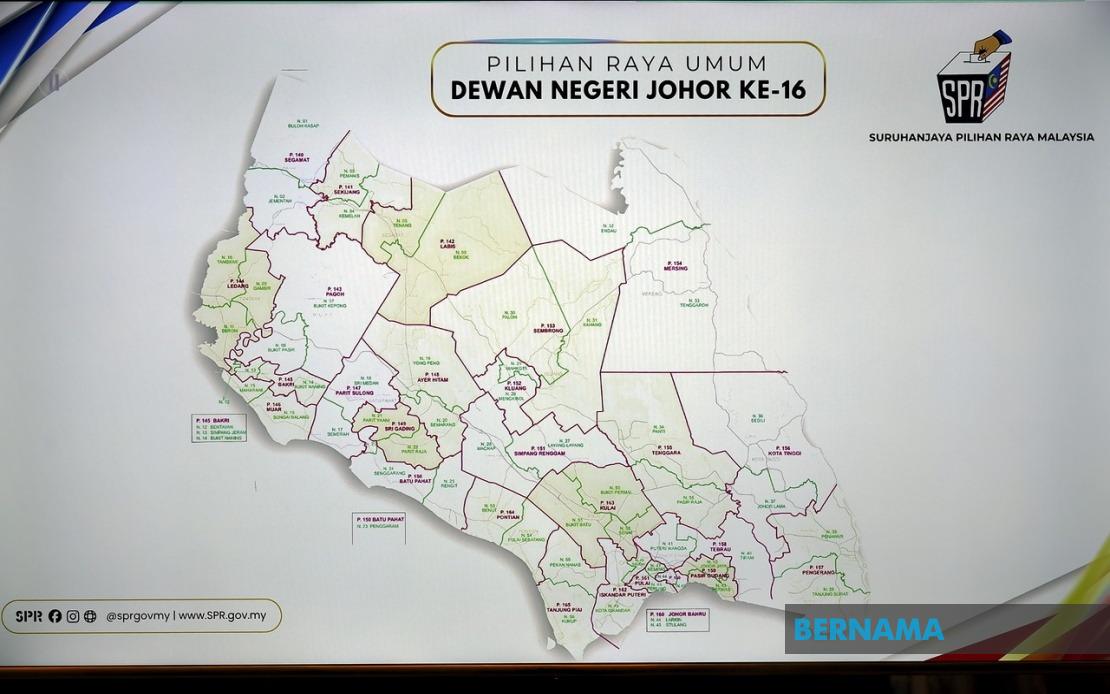
The political landscape of Johor is set to transform dramatically tomorrow as the 16th state election officially begins with nomination day, marking the commencement of an intensive campaign period across all 56 state assembly constituencies. The Election Commission has orchestrated a tight schedule, with candidate registration running between 9 and 10 am at designated centres throughout the state, followed by a screening process before the official candidate list is released. This compressed timeframe reflects the competitive intensity expected in what observers view as a pivotal contest that could reshape the state's political trajectory heading into Malaysia's broader electoral cycle.
The electoral calendar reveals the urgency driving all major political camps. Polling day is scheduled for July 11, preceded by early voting opportunities on July 7 that are intended to accommodate military and police personnel, as well as those unable to vote on the main election date. The Election Commission has confirmed that 2,727,926 registered voters are eligible to participate, a figure encompassing over 2.7 million ordinary voters alongside 12,041 military personnel and their spouses and 12,710 police officers and their spouses. This substantial voter base underscores Johor's importance as a political heavyweight within Malaysia's federal structure, given the state's substantial population and economic significance.
Pakatan Harapan has made a bold strategic move by contesting every single seat, deploying a carefully balanced coalition slate that reflects the power-sharing dynamics within the alliance. The distribution features 20 candidates from Parti Keadilan Rakyat, 19 from Amanah, and 17 from DAP, a configuration that balances each coalition partner's electoral interests while attempting to maximize their collective appeal across Johor's diverse constituencies. This comprehensive approach signals PH's determination to recapture ground lost in the previous election and reflects the leadership's assessment that momentum exists for territorial gains in this key state.
Barisan Nasional has matched this comprehensive commitment by fielding candidates across all 56 constituencies as well, demonstrating the coalition's resolve to defend its 2022 dominance. The BN slate comprises 36 UMNO candidates, 16 from the Malaysian Chinese Association, and four from the Malaysian Indian Congress, a composition that privileges the coalition's largest partner while maintaining representation for its component parties. This candidate distribution reflects the broader power dynamics within BN and the delicate balance required to maintain coalition cohesion in competitive electoral environments.
Perikatan Nasional has taken a more selective approach, though one that still represents substantial electoral ambition across the state. PAS is fielding 11 candidates, Bersatu 16, and the Malaysian Indian People's Party five, a total of 32 seats that indicates PN's strategic focus on specific constituencies where the coalition perceives competitive advantages. This more targeted approach differs markedly from the comprehensive strategies of PH and BN, suggesting differing assessments of electoral viability and available resources among the three major coalitions contesting Johor.
Smaller parties are also seizing the opportunity presented by this election cycle. MUDA is contesting four seats, representing the party's efforts to establish a foothold in Johor despite its recent emergence and limited organizational infrastructure. The Socialist Party of Malaysia is fielding a single candidate, maintaining its symbolic presence in electoral contests, while Parti Bersama Malaysia is making its electoral debut by contesting 15 seats, an ambitious entry that reflects the party's aspiration to establish itself as a meaningful political force within the state's political landscape.
The Election Commission has issued explicit guidance to prospective candidates regarding procedural requirements, emphasizing the importance of early verification of nomination forms and timely deposit payments to avoid last-minute complications that could result in disqualification. This administrative emphasis reflects lessons learned from previous elections and the commission's determination to ensure a smoothly executed nomination process. Candidates are being advised to verify forms at the Returning Officer's Office or State Election Office and to retain deposit payment receipts as proof when submitting official nomination papers, procedural safeguards designed to minimize disputes and irregularities during this critical phase.
Anti-corruption enforcement has been prioritized throughout the election period, with the Malaysian Anti-Corruption Commission issuing explicit warnings to all candidates and parties regarding unlawful conduct under the MACC Act 2009 and the Election Offences Act 1954. The MACC has established five dedicated 24-hour operations rooms at Tampoi, Batu Pahat, Kluang, Segamat, and Mersing, creating accessible reporting channels for the public to flag suspected corruption or abuse of power. This enforcement infrastructure demonstrates the authorities' commitment to maintaining electoral integrity and addresses concerns about potential misconduct that have characterized previous election cycles.
The 2022 Johor election results provide essential context for understanding the stakes in this 2024 contest. Barisan Nasional dominated that previous election by securing 40 seats, while Pakatan Harapan obtained 12 seats, Perikatan Nasional won three, and MUDA captured one seat. The substantial BN advantage reflects the coalition's traditional strength in Johor and its appeal among rural constituencies and older voters, though the 12 seats captured by PH demonstrated that the opposition maintained competitive strength in urban centres and among younger demographics. The minimal presence of PN and MUDA in the previous parliament suggests that these coalitions faced organizational and resource constraints, though both are now contesting more ambitiously.
The dissolution of the Johor State Legislative Assembly on June 1 initiated the formal legal process that culminates tomorrow with nomination day. This compression of the election timeline, from dissolution to nomination within approximately four weeks, has challenged all parties to rapidly mobilize candidate selection processes, campaign infrastructure, and messaging frameworks. The intensity required to achieve this acceleration has tested party machinery and revealed significant organizational disparities among the competing coalitions, with larger, more established parties generally adapting more smoothly than newer or less-resourced organizations.
For Malaysian and Southeast Asian observers, the Johor election holds broader significance beyond state-level governance considerations. The state's economic importance, its geographic location as a gateway between peninsular Malaysia and Singapore, and its role as a political barometer for the ruling federal coalition all contribute to the contest's elevated profile. A substantial swing in Johor's political complexion could influence federal political calculations, alter the balance within major coalitions, and reshape the perceived momentum heading into any future national electoral contest. The diverse coalitional arrangements—with PAS and UMNO competing rather than cooperating, while DAP and PAS maintain their ideological distance—reflect the fractured state of Malaysian politics and the intense competition for voter loyalty that characterizes the contemporary electoral landscape.

