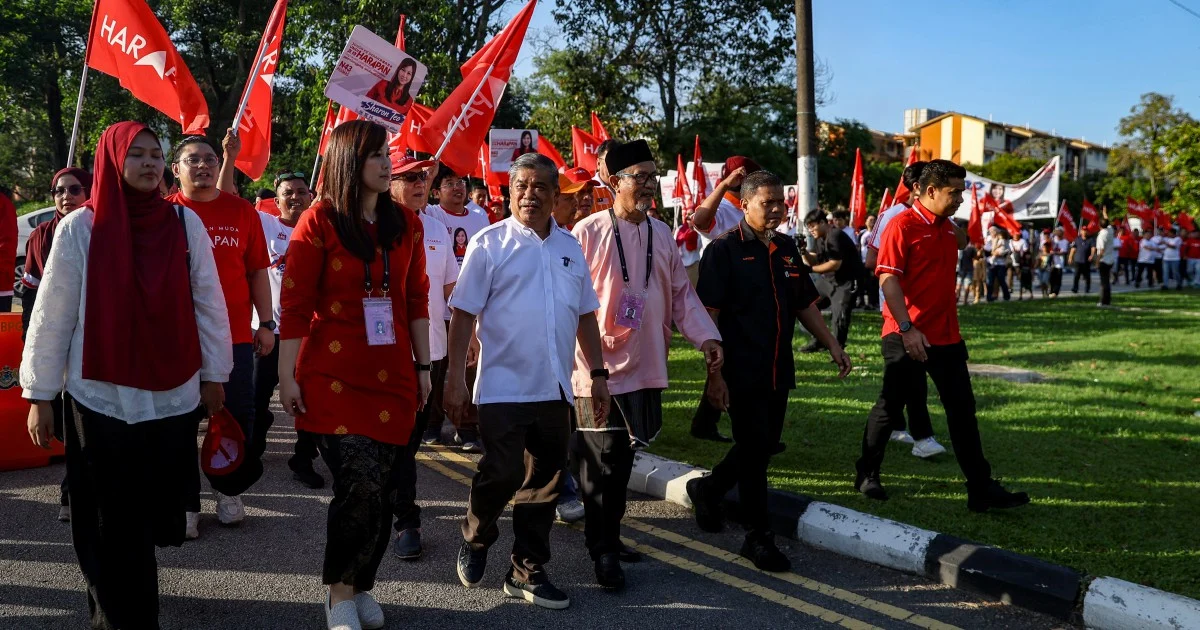
Sharon Teo, the Pakatan Harapan coalition's candidate for the Permas state constituency, arrived at the Dewan Muafakat Taman Mawar nomination centre in Pasir Gudang to a show of grassroots support. Supporters gathered at the venue greeted her with animated chants of "Johor undi Pakatan Harapan"—Johor votes for Pakatan Harapan—underscoring the coalition's effort to mobilize voters across the southern state ahead of the state election.
The vocal reception at the nomination filing reflects the intensity of electoral campaigning in Johor, a state long considered a traditional stronghold of the ruling Barisan Nasional coalition. The presence of enthusiastic supporters chanting at the nomination centre signals that Pakatan Harapan continues to build momentum in constituencies where the coalition seeks to challenge incumbent control. For Malaysian political observers, such scenes reveal the grassroots dynamics at play in state-level contests, where local candidate appeal and coalition messaging intersect.
Permas, situated in Pasir Gudang, represents a significant battleground in the broader Johor electoral landscape. The constituency has historically been contested between major political blocs, and Pakatan Harapan's nomination of Teo suggests the coalition is prioritizing this area as part of its statewide strategy. The decision to field a candidate here, combined with the visible support demonstrated during the nomination process, indicates that the coalition expects the seat to be competitive and believes it has a pathway to victory.
The chants captured at the nomination centre are emblematic of how Malaysian elections mobilize supporters along coalition lines. Pakatan Harapan, as a multi-party alliance comprising the Democratic Action Party, PKR, Amanah, and other partners, seeks to build unified electoral messaging across diverse constituencies. The repetition of the coalition name in supporter chants reflects efforts to maintain coalition cohesion and present voters with a clear alternative to incumbent administrations.
Johor has been a focal point for Malaysian politics at both state and federal levels. The state's electoral outcomes carry symbolic weight beyond its borders, influencing perceptions of political momentum and public sentiment toward competing blocs. Pakatan Harapan's visible organizing in constituencies like Permas demonstrates the coalition's determination to shift the political balance in a state where Barisan Nasional has historically maintained deep organizational roots and administrative advantages.
Sharon Teo's nomination filing marks a formal entry into what is likely to be an intensely contested campaign period. As a candidate, she becomes the public face of Pakatan Harapan's bid to capture the Permas seat, and her campaign messaging, background, and local connections will become subjects of ongoing scrutiny and electoral discourse. The enthusiasm demonstrated by supporters during her nomination underscores the coalition's confidence in her candidacy and their belief that she can resonate with local voters.
The nomination process itself is a crucial juncture in Malaysian electoral cycles. Filing nominations represents the formal commitment point where parties declare their candidates and begin the official campaign period. The atmosphere surrounding such filings—whether marked by large gatherings, visible enthusiasm, or subdued proceedings—often becomes part of the broader narrative about electoral momentum. In Teo's case, the animated support captured at Dewan Muafakat Taman Mawar generates positive optics for Pakatan Harapan and potentially influences undecided voters observing election dynamics.
For Malaysian voters in Johor, particularly those in urban constituencies like Permas where Pakatan Harapan has made electoral inroads in recent years, such nominations represent the moment when abstract political positioning becomes concrete through the selection of specific candidates. Teo's candidacy invites voters to evaluate her qualifications, vision for the constituency, and ability to deliver on coalition pledges. The supportive crowd at her nomination suggests the coalition has mobilized its base effectively in this particular area.
The broader context of Johor elections extends to questions about state governance, development priorities, and representation of diverse voter interests. Constituencies like Permas, encompassing residential areas and commercial hubs, attract voters concerned with urban planning, infrastructure, local services, and economic opportunity. How Pakatan Harapan and competing candidates address these constituency-specific concerns will likely determine electoral outcomes in individual seats throughout the state.
Political momentum in Malaysian elections frequently turns on visible demonstrations of support captured at key moments like nomination filings. The chants echoing through the nomination centre in Pasir Gudang contribute to broader perceptions that Pakatan Harapan maintains energized support in Johor, potentially encouraging turnout among coalition-aligned voters while signaling to uncommitted voters that the contest remains competitive. Such atmospherics matter in close electoral contests where margins often prove decisive.
For Southeast Asian readers observing Malaysian electoral patterns, the dynamics evident in Johor's state election reflect the region's broader experience with multi-party democracy, where incumbent administrations face ongoing challenges from opposition coalitions seeking to build credible alternatives. The capacity of Pakatan Harapan to organize visible support at nomination events demonstrates the coalition's continued organizational capability despite having experienced periods of federal government participation and opposition in recent years.
As the Johor state election campaign unfolds, constituencies like Permas will serve as critical testing grounds for competing electoral narratives. Sharon Teo's nomination, backed by vocal supporters, represents the opening salvo in what promises to be a substantive contest over state direction, representation, and governance priorities that will shape Johor's political trajectory in the years ahead.

