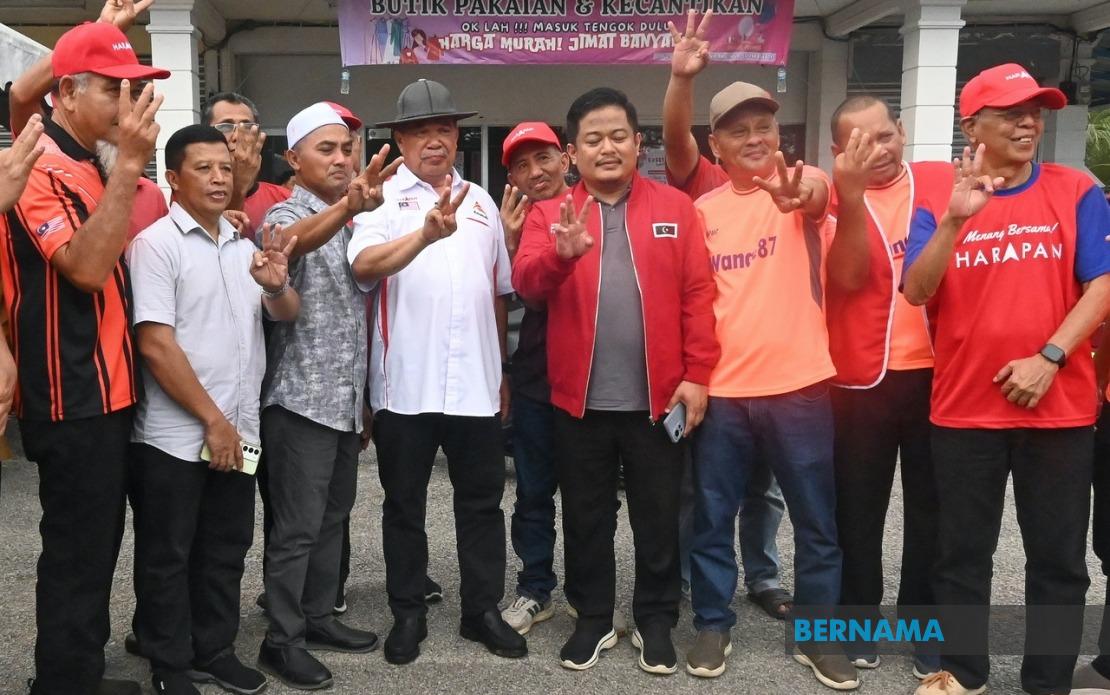
Datuk Seri Mohamad Sabu has made a direct appeal to Johor voters, urging them to provide Pakatan Harapan with a mandate in the state election scheduled for July 11, arguing that manifesto pledges remain hollow without electoral victory. Speaking in Rengit after the Johor Tour with Bang Mat programme, the Amanah president contended that voters must allow the coalition to govern in order to translate campaign promises into tangible policy outcomes.
The Minister of Agriculture and Food Security framed the election as a test of PH's credibility, directly addressing opposition accusations that the manifesto represents nothing more than recycled political promises. Mohamad Sabu insisted that the document genuinely reflects community concerns gathered through extensive field engagement, not merely repackaged slogans designed to win votes without substance. He positioned the manifesto as an authentic response to grievances articulated by ordinary Johor residents during countless campaign interactions.
Mohamad Sabu emphasised a crucial distinction between policy design and policy implementation. While acknowledging that any political organisation can draft an attractive manifesto, he argued that the real measure of a coalition's worth lies in its ability to execute promised reforms. This framing shifts the burden of proof onto electoral outcomes rather than campaign rhetoric, suggesting that PH's track record in office will ultimately vindicate or undermine the opposition's accusations of plagiarism. The sequencing matters critically here: voters voting PH into power becomes a prerequisite for assessing whether promises translate into action.
Should Johor voters entrust PH with control of the state government, Mohamad Sabu committed to swift implementation, indicating that work would commence as early as July 12, immediately following the election. This commitment to rapid action signals both confidence in the manifesto's achievability and recognition that voters will judge the coalition by how quickly it delivers visible results. The compressed timeline reflects awareness that initial momentum after an election victory often determines public perception of a government's competence and resolve.
The Amanah leader offered observations about shifting electoral sentiment in rural areas, noting a marked transformation in voter receptivity compared to the 2018 general election. He characterised PH's standing in Johor villages and markets as substantially improved, with public interactions becoming increasingly warm and personalised. This anecdotal evidence suggests that rural communities, traditionally considered strongholds for established parties, are gradually embracing PH as a legitimate alternative despite the coalition's relative youth as a political force in some peripheral areas.
The contrast Mohamad Sabu drew between 2018 and 2024 reflects broader shifts in Malaysian electoral behaviour and party brand recognition. Six years ago, PH remained unfamiliar to many rural Johor residents accustomed to dominant Barisan Nasional governance. The coalition's subsequent experience in federal office, albeit contested and complicated, has generated sufficient name recognition and perceived legitimacy that spontaneous public encounters now occur routinely. Whether this translates into decisive electoral support remains the central question, but the observation underscores how incumbency and time build voter familiarity even in traditionally conservative regions.
This campaign messaging strategy targets a specific vulnerability in PH's electoral positioning: the perception that the coalition lacks sufficient grounding in substantive policymaking. By demanding a vote to prove their manifesto's authenticity, Mohamad Sabu employs a rhetorical device that conflates electoral performance with policy credibility. Critics might argue this circular reasoning—vote for us to demonstrate we deserve your vote—but the underlying calculation reflects PH's awareness that rural and traditionally conservative voters harbour doubts about the coalition's capacity to govern effectively at state level.
For Malaysian politics more broadly, the Johor election carries implications extending beyond state boundaries. Johor represents the largest and economically significant state outside the federal capital region, making its electoral outcome consequential for national political trajectories. A decisive PH victory would reinforce the coalition's positioning as a credible alternative government capable of winning in diverse electoral contexts. Conversely, defeat in Johor would suggest that rural and semi-urban voters continue preferring established political structures, complicating PH's pathway to recapturing federal power in future general elections.
The early voting date for security forces is scheduled for July 10, with the main polling day following on July 11. This standard electoral procedure will provide preliminary indicators of voting patterns among uniformed personnel before the broader electorate casts ballots. Mohamad Sabu's public campaign activities in the days preceding the election appear designed to maximise voter turnout and consolidate support among communities where PH perceives genuine openness to political change, even as opposition parties mount competing appeals to tradition and continuity.

