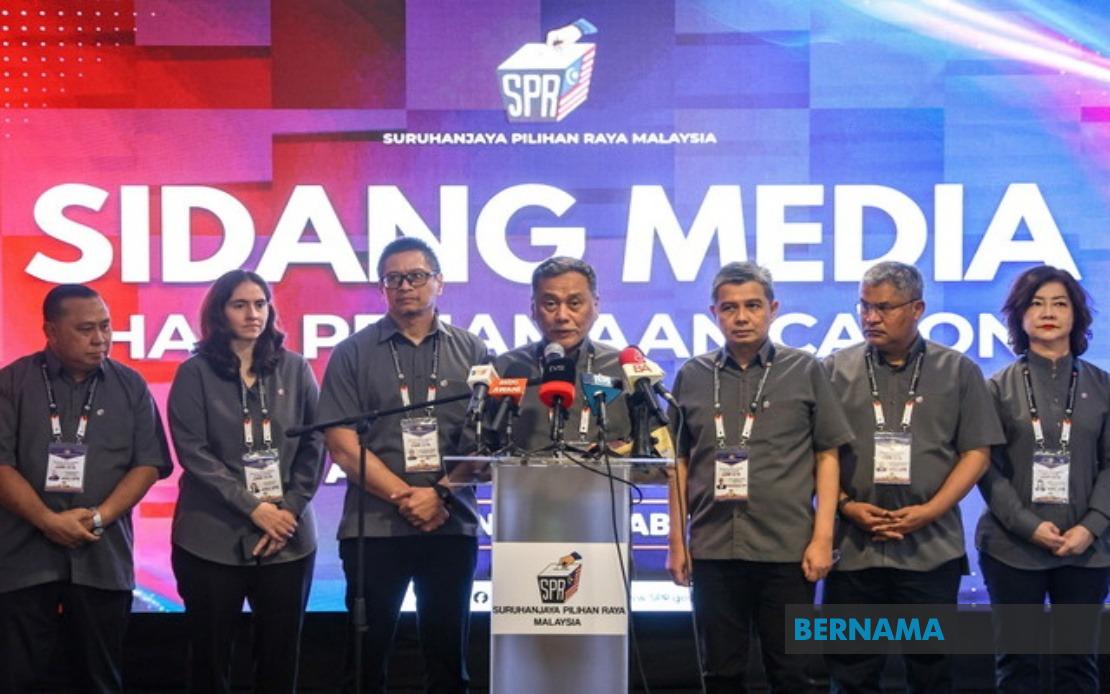
The Election Commission has formally cleared the way for Johor's 16th state election to proceed with a full slate of 172 candidates representing a broad spectrum of political interests. After closing the nomination process at all 56 nomination centres on June 27, the EC accepted every submitted nomination paper without disqualifying any hopeful, according to EC chairman Datuk Seri Ramlan Harun. This comprehensive field reflects the competitive nature of electoral politics in one of Malaysia's most closely watched states, where Johor's political trajectory has historically influenced broader national dynamics.
The gender composition of the candidate pool shows 138 men and 34 women standing for election, a ratio that underscores persistent gender imbalances in Malaysian politics at the state level. While the presence of female candidates reflects growing efforts toward representation, the 19.8 per cent female participation rate remains substantially below population parity. This disparity invites reflection on party mechanisms for candidate selection and the barriers women navigate in securing nomination support across the political spectrum, particularly in a state where Bumiputera considerations intersect with candidate vetting procedures.
The two largest coalitions have anchored their campaigns with identical candidate counts, each deploying exactly 56 nominees across all seats. Barisan Nasional, historically dominant in Johor politics and currently the state government, fields 56 candidates as it defends its position. Pakatan Harapan matches this number precisely, signalling a determined challenge to the incumbent coalition's control. This parity between the two major blocs sets the stage for an intensely competitive election where seat distribution may ultimately prove decisive in determining which coalition secures the mandate to govern.
Perikatan Nasional, which has emerged as a consequential third force in Malaysian politics over recent years, nominated 33 candidates for Johor's contest. This represents a significant commitment of resources and organizational capacity to a state election, though the party's numerical disadvantage compared to BN and PH suggests it may function more as a kingmaker or secondary competitor in most constituencies. The presence of PN candidates across the state reflects the ideological and political fragmentation that has characterised Malaysian electoral contests since 2018, when the prior distribution of political loyalties fundamentally shifted.
Beyond the three major political forces, a constellation of smaller parties and independent candidates will also contest. Parti Bersama Malaysia fields 15 candidates, establishing itself as a minor yet regionally relevant player in Johor politics. MUDA, the youth-focused party that gained prominence following the 2022 general election, has nominated four candidates, suggesting a measured approach to state-level competition. Parti Orang Asli Malaysia and Parti Sosialis Malaysia each contribute a single candidate, while six independent contenders will run without party affiliation. Together, these smaller entities represent alternative political voices and may capture votes in constituencies where major-party appeal has plateaued or where local issues supersede national narratives.
The nomination distribution has created a varied competitive landscape across Johor's 56 seats. Fourteen constituencies will witness straight fights between two candidates, a scenario that typically clarifies voter choice and frequently maximises turnout in those particular races. Twenty-seven seats feature three-cornered contests, the most common configuration and one that fragments the vote in ways that can produce outcomes with relatively modest vote shares. Twelve constituencies will host four-candidate fields, while three seats feature the most fragmented scenario of five candidates each. This mathematical diversity means that Johor's election will present no uniform competitive structure; instead, constituency-specific dynamics and localized candidate strength will influence outcomes far more than blanket state-wide trends might suggest.
The composition of this candidate field reflects broader regional and national political realignments. Johor's status as a populous, economically significant, and politically trendsetting state means that outcomes here reverberate through Malaysian politics. The strength shown by Pakatan Harapan's decision to field the same number as Barisan Nasional demonstrates confidence that the state remains competitive despite BN's traditional dominance. Perikatan Nasional's presence with 33 candidates indicates ambitions to translate its federal parliamentary gains into state-level representation, capitalising on any voter dissatisfaction with either major coalition.
For Malaysian politics more broadly, the Johor election serves as an important bellwether. The state has historically provided early signals of shifting voter sentiment before larger national contests. The quality of candidacy, campaign messaging, and ultimately voter response in Johor constituencies will inform political strategists about the texture of contemporary Malaysian opinion. Whether BN retains control, whether PH succeeds in wresting the state government, or whether a fragmented result necessitates coalition negotiations all carry implications for federal politics and potential future parliamentary composition.
The election commission's formal confirmation that all 172 nomination papers were accepted without disqualification indicates a procedurally smooth nomination process. This administrative efficiency contrasts with nomination periods in some prior Malaysian elections where technical objections or irregularities produced last-minute withdrawals or upheld challenges. The clean acceptance of every nomination reflects either strengthened EC processes or greater care by nominating parties in meeting formal requirements. For voters in Johor, this means the full slate of nominated candidates will appear on ballots, providing comprehensive choice across the ideological and political spectrum from establishment coalitions through to ideologically distinctive minor parties and local independents.

