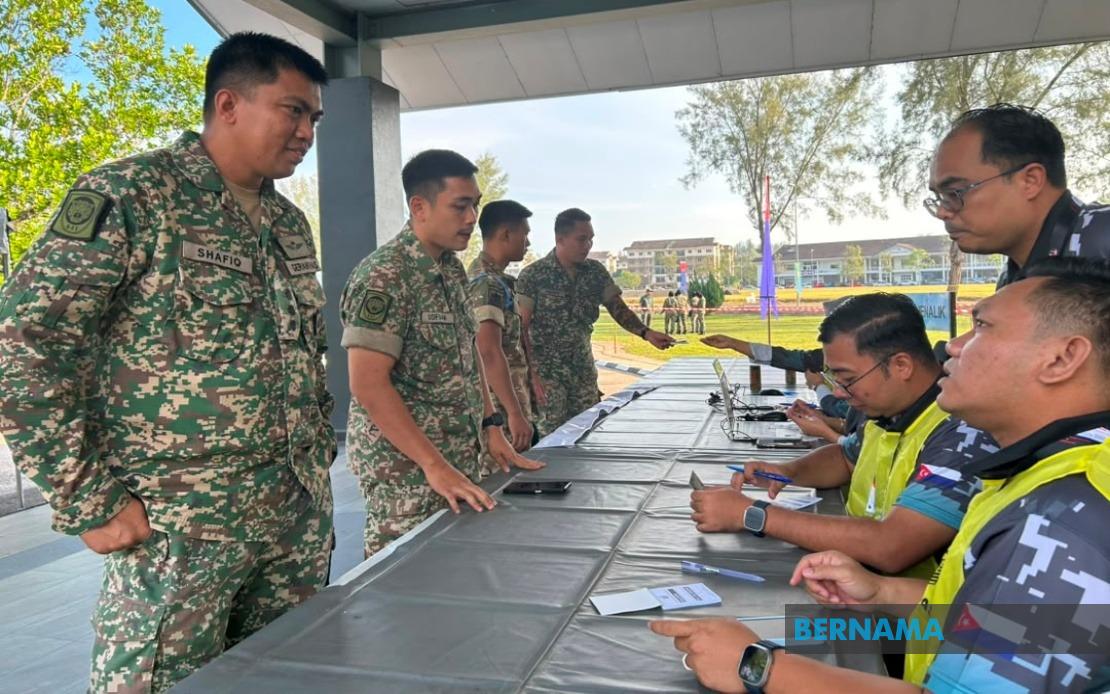
The pace of early voting in Johor's 16th state election has exceeded expectations, with more than half of registered early voters completing their civic duty by mid-morning on July 7. According to the Election Commission, 56.32 per cent of the designated early voter cohort—equivalent to 11,605 individuals out of 20,607 total early voters—had successfully cast their ballots by 11 am, signalling robust participation among the constituencies permitted to vote ahead of the main election day.
Early voting access in Malaysian state elections is carefully restricted to specific groups deemed essential to the running of the country, and in Johor's case, this comprises uniformed personnel and their immediate families. The composition of early voters reflects the security apparatus's critical role in election administration and national operations. The Royal Malaysia Police and General Operations Force, collectively representing the nation's primary law enforcement bodies, accounted for the largest portion of early voting activity, with 6,852 of their 12,063 registered personnel and spouses having participated by the mid-morning checkpoint.
The Malaysian Armed Forces contributed the second-largest contingent to early voting numbers, with 4,753 of the 8,544 eligible military personnel and their spouses having cast votes through the morning. These two security-focused groups together represented the overwhelming majority of the early voter population, reflecting standard practice in Malaysian elections where defence and police personnel, given their operational commitments and potential deployment, are permitted to vote before the general population. The turnout rates within these constituencies suggest strong internal mobilisation and awareness of the early voting opportunity.
The Election Commission had established 64 dedicated polling centres to accommodate the early voting process, which commenced at 8 am across the state. The geographical distribution of these centres was designed to provide reasonable access to registered early voters throughout Johor, balancing convenience with the logistical complexities of managing simultaneous voting locations. The staggered closure schedule, with centres closing progressively between noon and 6 pm depending on local voter numbers and venue circumstances, allowed flexibility in accommodating varying levels of demand across different districts.
The 16th Johor state election itself represents a significant electoral event in the state's political calendar, with 172 candidates competing for representation across 56 state assembly seats. The diversity of candidature reflects the multi-party nature of Malaysian electoral competition, though specific party distributions were not detailed in the early voting figures. Saturday's main polling day will determine the final composition of the Johor state assembly and, by extension, influence the trajectory of state governance and policy direction for the coming term.
The anticipated voter turnout for the Saturday election encompasses approximately 2.7 million eligible voters across the state, making this a substantial democratic exercise with implications for both Johor and the broader Malaysian political landscape. Johor, as one of the nation's largest states by population and economic significance, plays a consequential role in national political arithmetic. The state election serves as both a local mandate and a broader indicator of electoral sentiment that often resonates beyond state boundaries.
The strong early voting participation witnessed on July 7 provides preliminary evidence of electoral engagement among security personnel, though it does not necessarily predict turnout patterns for the wider electorate on Saturday. Historically, early voting constituencies in Malaysia demonstrate higher participation rates than average, reflecting the mandatory or near-mandatory nature of voting for uniformed personnel and the administrative coordination inherent in organised voting for institutional groups. However, the broader Saturday voter base comprises ordinary citizens with varying levels of political motivation and accessibility to polling stations.
For Malaysian readers monitoring the political implications of Johor's electoral process, several factors merit consideration. The state election precedes potential shifts in state-level administration, which could influence resource allocation, development priorities, and relationships with the federal government depending on the composition of the winning coalition. Johor's economic importance—the state is a significant contributor to Malaysia's GDP and hosts major industrial and port infrastructure—means that electoral outcomes carry implications for investment confidence and policy stability beyond purely political dimensions.
The Election Commission's real-time reporting of early voting figures through social media reflects modernised election administration in Malaysia, allowing both observers and the public to track voting progress transparently. This approach enhances public confidence in electoral integrity while providing journalists and analysts with objective data points to assess participation dynamics. The publication of detailed breakdowns by voter category offers insight into which constituencies engaged most actively with the early voting opportunity, though the small absolute numbers involved (fewer than 21,000 early voters out of 2.7 million total) mean early voting patterns serve primarily as mood indicators rather than definitive predictors.
As Johor voters prepare to head to polls on Saturday, the strong early voting performance among security personnel provides the Election Commission with operational confidence regarding their polling centre management and voter processing systems. Successfully executing the early voting phase without reported irregularities or logistical breakdowns suggests the infrastructure and procedures for the substantially larger main election should function smoothly. The transition from early voting to the main election day represents a crucial scaling test for the commission's organisational capabilities.

