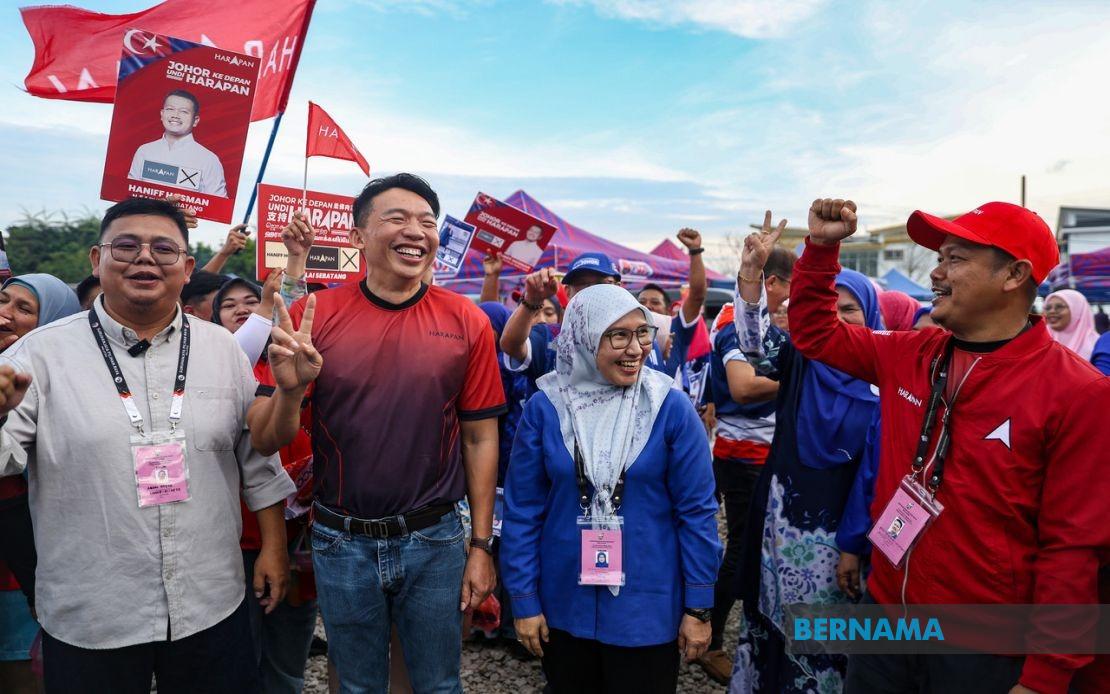
The Johor state election campaign took a notably cordial turn in Pontian when candidates from opposing political coalitions encountered one another while campaigning at Taman Megah night market, providing a striking moment of civility amid what is typically a heated electoral period. The unplanned meeting between three Pakatan Harapan representatives—Haniff @ Ghazali Hosman from Pulai Sebatang, Abd Razak Ismail from Benut, and Cheah Chee Hong from Kukup—and Barisan Nasional's Hasrunizah Hassan, the rival candidate for Pulai Sebatang, drew immediate attention from voters and observers present at the venue.
What began as a potentially tense intersection of two campaign teams, distinguishable by their distinctive red and blue flags, quickly evolved into a warm greeting among the political opponents. The scene underscored a dimension of Malaysian electoral politics that often remains underreported: the capacity for candidates and their supporters to maintain personal civility and mutual respect despite representing fundamentally different political visions. Market visitors paused in their shopping to observe the moment, seemingly struck by the contrast between the competitive nature of elections and the courteous interaction unfolding before them.
Haniff, speaking to journalists following the encounter, characterised the meeting as emblematic of healthy democratic practice rather than an uncomfortable collision of opposing forces. He emphasised that the campaign environment in Pontian has remained peaceful and constructive, free from the inflammatory rhetoric or confrontational incidents that occasionally mar electoral periods in other regions. His remarks reflected a broader narrative emerging from the Johor campaign: that voters and candidates alike are conducting themselves with restraint and respect for the democratic process, even as they vigorously pursue their respective political objectives.
The significance of this encounter becomes clearer when viewed against the broader context of Malaysian electoral politics. State elections frequently witness intense competition and occasionally bitter personal exchanges, particularly when multiple constituencies are contested simultaneously. The Johor state election, scheduled for July 11 with early voting on July 7, encompasses numerous contests across the state, yet the tenor of campaigning appears to have remained largely civil. The Pontian incident serves as a barometer of sorts, suggesting that democracy in Johor is maturing in ways that prioritise substantive policy debates over personal animosity.
Cheah, the PH candidate for Kukup, used the opportunity to reinforce his coalition's messaging while simultaneously acknowledging the collegiality of the moment. His statement urging voters in the three constituencies to support Pakatan Harapan maintained the campaign's competitive edge while not detracting from the broader message of peaceful, respectful electoral engagement. This balance—competing vigorously whilst maintaining dignity and respect—represents a model that resonates with voters increasingly fatigued by divisive political discourse.
Hashrunizah's perspective on the interaction further illuminates the candidates' understanding of their roles as custodians of democratic values. Rather than viewing such encounters as awkward or problematic, she reframed them as normal occurrences reflecting Johor's democratic maturity. Her characterisation of the moment as energising rather than threatening to her campaign suggests a confidence in her coalition's message and an appreciation for the structural health of the electoral process itself. By emphasising that Barisan Nasional and Maju Johor remain undeterred and motivated despite these meetings, she demonstrated that civility need not translate into weakness or lack of conviction.
The Pontian night market walkabout provides valuable lessons for Malaysian politics more broadly, particularly as the country navigates an era of increasingly polarised national discourse. That candidates representing opposing coalitions could meet, exchange greetings, and continue their respective campaigns without incident or rancour speaks to the resilience of democratic norms at the state level. This contrasts sharply with some higher-level political exchanges, where personal invective and accusations of bad faith sometimes dominate media coverage.
From a voter perspective, such demonstrations of inter-party civility may prove consequential. Malaysians increasingly express fatigue with adversarial politics, and campaigns that emphasise policy substance over personal attack tend to resonate with pragmatic, results-oriented electorates. The Johor campaign's apparent commitment to this approach could influence voting behaviour, particularly among swing voters who view elections as opportunities to evaluate candidates' competence and vision rather than their capacity to deliver partisan soundbites.
The composition of the three-candidate PH walkabout itself reflects the coalition's strategic approach to the Johor contest, presenting a unified front across multiple constituencies whilst maintaining individual candidate visibility and identity. Similarly, Hasrunizah's solo presence at the same venue underscored Barisan Nasional's parallel efforts to ensure comprehensive ground coverage. The peaceful coexistence of these competing campaign strategies within the same space demonstrated logistical coordination and mutual understanding between campaign teams.
Looking toward the July 11 election, the Pontian incident establishes a template for how the remaining campaign period might unfold. With early voting scheduled for July 7, candidates have limited time to consolidate their messaging and mobilise supporters. The peaceful, respectful tone evident in the night market encounter could define the campaign's final weeks, distinguishing the Johor state election as a model of democratic engagement. This approach may prove particularly significant given Johor's historical importance as a political bellwether and the state's role in shaping broader narratives about Malaysian governance and electoral culture.
The encounter also reflects evolving voter expectations regarding political conduct and professionalism. Modern Malaysian electorates, particularly in urban and semi-urban areas like Pontian, increasingly value candidates who can articulate their positions clearly whilst respecting opponents as fellow citizens deserving of dignity and courtesy. The four candidates' spontaneous demonstration of this quality may have resonated more powerfully with night market visitors than any prepared campaign speech could achieve. By showing rather than merely telling voters about their commitment to democratic values, these candidates modelled the behaviour they presumably expect from one another should they assume office.

