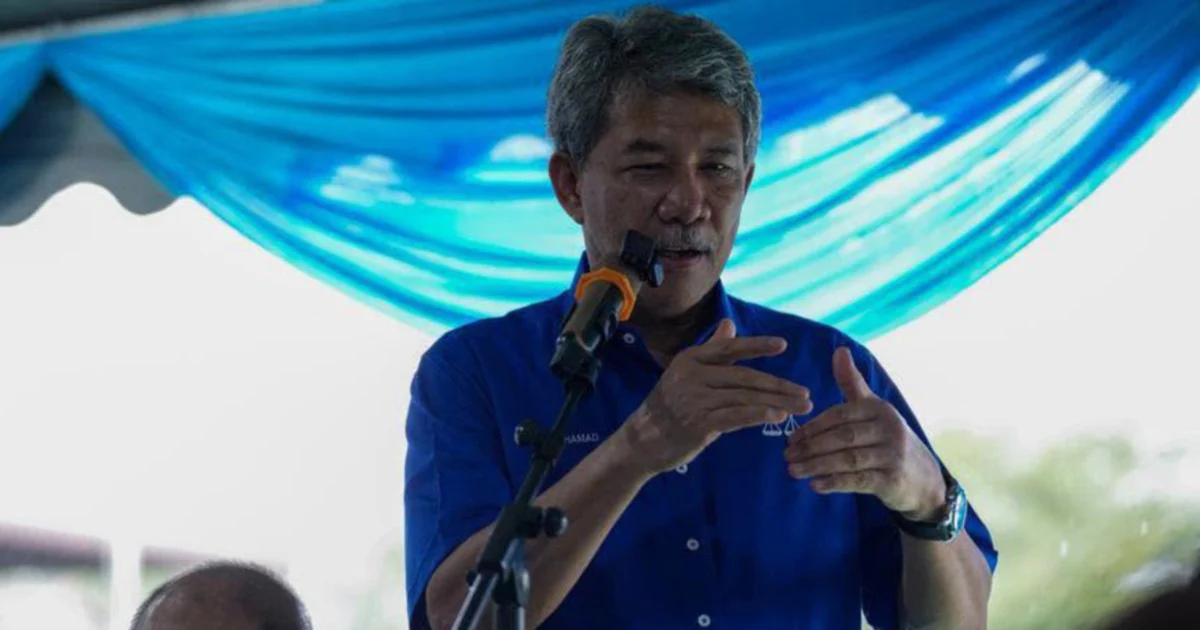
A prominent Barisan Nasional politician has struck back sharply at Pakatan Harapan leadership for promoting what he characterises as a misleading narrative: that the upcoming Johor state election is fundamentally about securing the release of incarcerated former prime minister Datuk Seri Najib Razak. Speaking at an event in Tebrau, the BN representative contended that such assertions misrepresent the true nature of the electoral contest and appear designed to deflect attention from substantive governance issues.
The allegation, repeatedly advanced by PH operatives in recent weeks, suggests that a BN victory in Johor could precipitate a gubernatorial pardon for Najib or other legal interventions favouring him. This line of argument has become a recurring feature of opposition campaign messaging, intended to mobilise their base by raising the spectre of impunity for a figure widely associated with the 1Malaysia Development Berhad scandal and its attendant financial improprieties. The BN official rejected such insinuations as politically motivated scaremongering detached from electoral realities.
Najib currently serves a prison sentence handed down by the Malaysian courts in connection with his conviction on charges related to misappropriation of state funds and abuse of authority. His legal status remains a sensitive topic within Malaysian political circles, with his substantial supporter base in Umno and affiliated constituencies viewing him as the subject of judicial persecution, whilst critics view his conviction as a natural consequence of accountability mechanisms. The question of potential clemency measures has periodically surfaced in political discourse, generating considerable public debate about the appropriate balance between rule of law considerations and political pragmatism.
The BN spokesman's intervention reveals underlying tensions within the coalition partnership and signals growing frustration at what establishment figures perceive as opposition tactics relying on personalised attacks rather than policy differentiation. By focusing public conversation on Najib's predicament rather than competing visions for Johor's development, PH risks appearing overly fixated on personality politics at the expense of addressing bread-and-butter concerns affecting ordinary residents. The BN narrative pivots instead toward economic management, infrastructure development, and social welfare provisions.
From a strategic perspective, Johor remains a crucial electoral battleground for both major political coalitions. The state has historically served as a proving ground for national political movements and frequently prefigures broader electoral trends at the federal level. A BN victory would reinforce the coalition's claim to renewed electoral viability following years of electoral setbacks, whilst a PH success would demonstrate sustained momentum and validate their governing credentials established during the 2018-2020 period. Stakes therefore extend well beyond state-level governance into calculations about federal political trajectories.
The opposition's framing appears calculated to mobilise their urban and youth-oriented voting constituencies by invoking rule of law anxieties and anti-corruption sentiment—dimensions that performed strongly during the 2018 general election campaign that unseated the BN after six decades. By continuously linking BN electoral prospects to potential legal relief for Najib, PH seeks to characterise a vote for the incumbent coalition as tacit endorsement of institutional subversion. Conversely, the BN position emphasises that elected officials operate within circumscribed constitutional and legal parameters and cannot simply override court decisions through executive fiat.
The exchange reflects deeper polarisation within Malaysian politics concerning accountability mechanisms and the proper relationship between political office and judicial independence. Concerns about instrumentalisation of the justice system surface periodically from both sides of the political divide, with the Najib case serving as a touchstone for broader anxieties about rule of law standards. Malaysian voters face mounting expectations that political leaders demonstrate principled commitment to institutional integrity rather than merely advancing factional interests through whatever means available.
Tok Mat's intervention also underscores difficulties faced by the BN coalition in rehabilitating its public image following the tumultuous Najib era and subsequent internal convulsions. The coalition continues confronting voter scepticism rooted in memories of alleged governance failures and ethical lapses during the preceding administration. Restoring public confidence requires demonstrating substantive policy competence and institutional reform rather than simply waiting for electoral cycles to gradually erode public memory. The Johor contest thus represents an opportunity to cement renewed credibility through effective local governance.
Looking forward, the electoral campaign will likely feature continued sparring over these narratives, with each coalition endeavouring to frame the stakes according to its strategic advantage. For Malaysian observers, the contest offers valuable insights into evolving political dynamics, coalition stability, and voter priorities in an increasingly complex electoral environment. The eventual outcome will carry implications not merely for Johor's immediate governance but for the broader trajectory of Malaysian politics heading toward the next federal electoral cycle.

