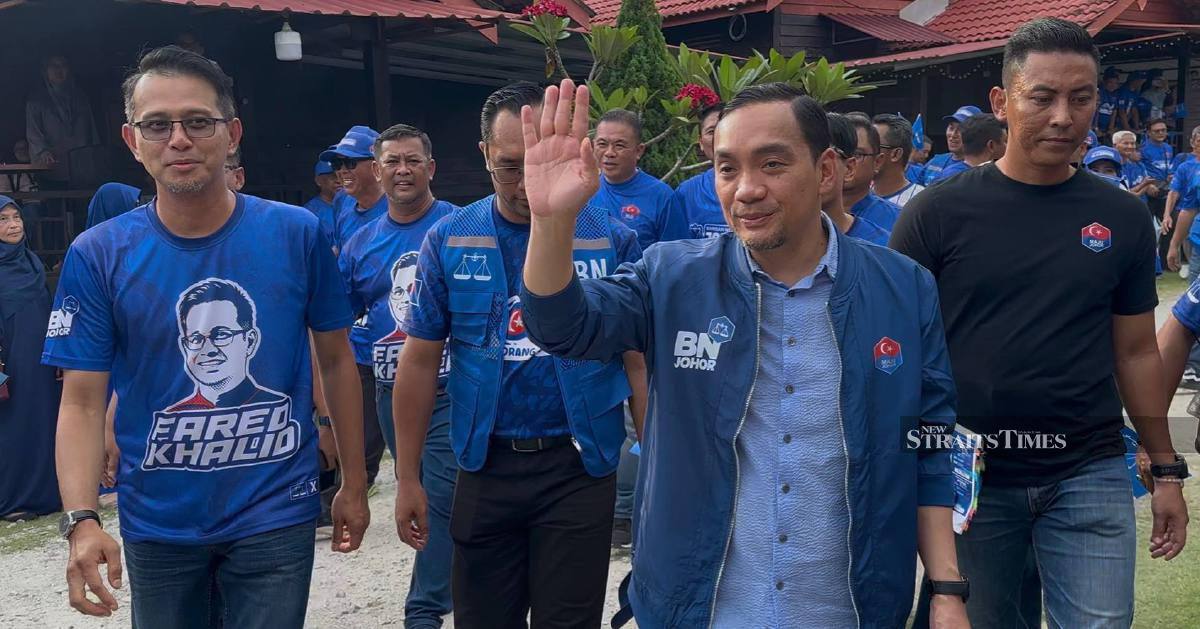
Johor's caretaker Menteri Besar Datuk Onn Hafiz Ghazi has moved to quash suggestions that the upcoming state election serves purposes beyond the electoral process itself, insisting instead that the poll exists fundamentally to return democratic authority to the electorate. Speaking in Batu Pahat, he underscored that the primary aim of dissolving the state assembly and calling for fresh voting is straightforward: to allow Johor voters to choose their next government through the ballot box.
The remarks appear calculated to deflect mounting speculation and chatter surrounding the election's true motivations, with observers and political analysts questioning whether certain factions within the ruling coalition might be using the electoral exercise to achieve secondary objectives unrelated to governance. Such suspicions have gained traction in Malaysian political discourse, where state-level elections occasionally become entangled with wider factional struggles and attempts to shift the national political landscape.
Onn Hafiz's intervention represents a deliberate effort to frame the election discourse around democratic fundamentals rather than allowing discussion to drift toward questions about hidden agendas. By repeatedly emphasising the legitimacy of returning power to voters, the caretaker leader seeks to establish a narrative centred on constitutional propriety and the renewal of the government's popular support. This rhetorical positioning is strategically important in Malaysian politics, where public confidence in electoral integrity and the purity of democratic process remains sensitive among a diverse electorate.
The emphasis on securing a fresh mandate also carries practical implications for the ruling coalition's campaign strategy. By positioning the election as a straightforward exercise in democratic renewal, rather than as a vehicle for resolving internal power disputes or advancing other political objectives, the coalition can appeal to voters on grounds of governance and development rather than factional alignment. This approach potentially broadens its appeal beyond entrenched supporters to swing voters and those inclined toward stability and continuity in state administration.
Johor, as Malaysia's second-largest state economy and a significant contributor to federal revenues, represents consequential political territory. Elections in the state historically carry weight beyond Johor's borders, often signalling broader trends in voter sentiment and the health of ruling coalition support in the peninsula's developed southern regions. Consequently, the narratives that leaders construct around Johor elections tend to influence perceptions of legitimacy and democratic vitality across the nation.
The timing of Onn Hafiz's statement merits consideration. By explicitly denying that extraneous political purposes underpin the election, he implicitly acknowledges that such speculation exists—and that it carries sufficient weight to require public rebuttal. This defensive posture suggests that despite efforts to control the narrative, questions about the election's rationale continue circulating within political circles and among informed observers. The very necessity of issuing such clarifications indicates underlying anxieties about public perception.
Within Malaysian political culture, state elections have occasionally become entangled with broader factional struggles within ruling parties and coalitions. Previous instances have seen observers question whether electoral exercises at the state level serve simultaneously to resolve internal leadership disputes, shift balance between factions, or create political openings for particular figures. Onn Hafiz's insistence that the Johor poll operates solely within traditional democratic parameters thus carries defensive implications, even as he frames it in positive terms.
The caretaker Menteri Besar's emphasis on returning mandate to voters also invokes a principle of democratic legitimacy that remains powerful in Malaysian political discourse. Voters across the peninsula have demonstrated through multiple electoral cycles their capacity to hold governments accountable and demand accountability through the ballot. By anchoring his statement in this fundamental democratic principle, Onn Hafiz positions himself and the electoral process on high ground regarding legitimacy and popular sovereignty.
For Malaysian voters in Johor, particularly swing voters and those concerned about the integrity of political processes, such clarifications may carry weight or may provoke further scepticism depending on their political orientation and historical trust in state leadership. The state's electorate has demonstrated nuanced voting preferences in recent cycles, rewarding parties and coalitions perceived as offering good governance alongside factional stability. Onn Hafiz's statement directly addresses voter anxieties about whether their votes will genuinely determine the next government, or whether the election serves merely as choreography for predetermined outcomes determined by elite bargaining.
The statement also carries implications for opposition parties contesting the election. By establishing that the election should be understood purely as a mandate-seeking exercise, the ruling coalition sets parameters for political debate that potentially disadvantage those seeking to introduce questions about governance performance or policy direction. Opposition parties must navigate the terrain established by such framing, either accepting the presented paradigm or mounting counter-arguments about what the election truly represents in the context of broader Malaysian political dynamics.
As campaigns formally commence and Johor voters receive information about the election, Onn Hafiz's clarification establishes an official position that election observers, media outlets, and political analysts will reference and contest. The underlying tension between his stated purpose—a simple democratic renewal—and speculation about hidden motives will likely persist throughout the campaign period, shaping how voters interpret candidates' positions and election outcomes themselves.

