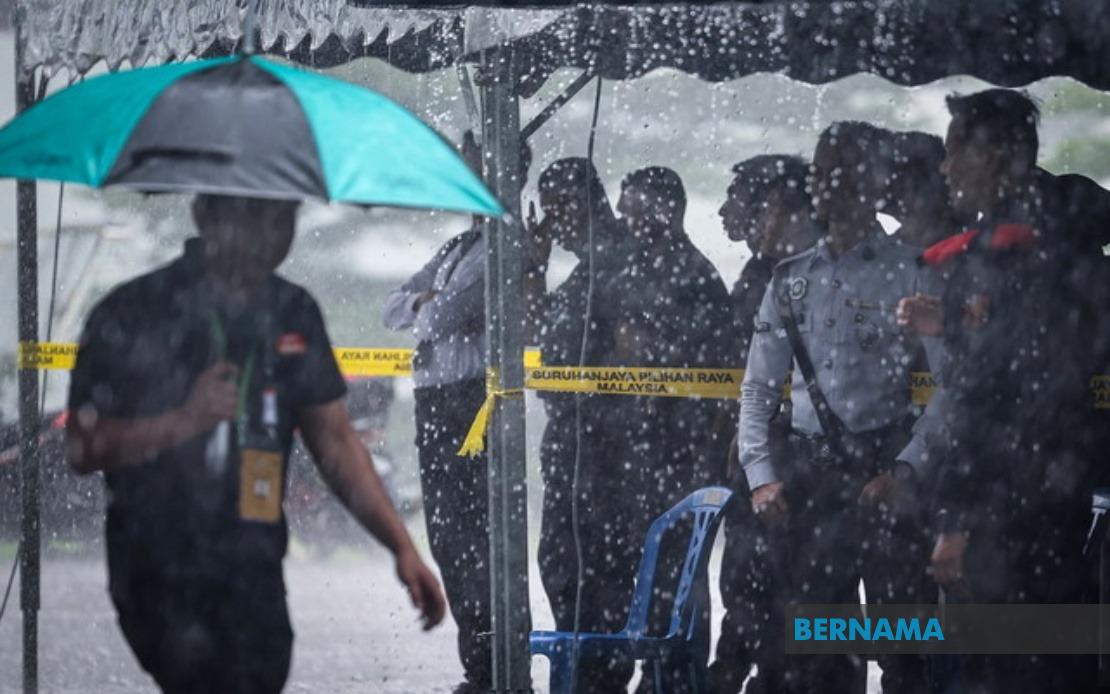
The 16th Johor state election got off to a well-organised start on Wednesday as security forces participated in early voting at the State Police Contingent Headquarters in Johor Bahru. A sudden downpour shortly before 9.40 am posed a minor logistical challenge, but the polling operation continued without material disruption, demonstrating the operational readiness of election administrators to handle adverse weather conditions.
Membership of the uniformed services receives special early voting privileges under Malaysian electoral law, recognising their operational commitments and the difficulty many face in taking leave to vote on general polling day. For the Johor state election, this arrangement encompasses an unusually large cohort: approximately 12,067 police personnel and their spouses will participate in early voting, reflecting both the size of Johor's security establishment and the inclusion of family members in the early voting scheme.
Despite the intensity of the rainfall, which briefly interrupted outdoor activities at the venue, the administrative machinery proceeded smoothly. Officers and staff arriving for their turn at the ballot box adapted quickly to the weather, moving expeditiously through the polling centre to complete their voting obligations. The scene illustrated the discipline characteristic of such institutions, with personnel navigating the temporary inconvenience while maintaining orderly queues and proper electoral procedures.
The early voting process also extended to alternative arrangements for personnel unable to attend in person. An additional 643 police officers and their eligible family members are voting by post, a provision that acknowledges both the geographic distribution of the force across Johor and the reality that some service members may be deployed or on assignment during the early voting window. This dual approach—in-person and postal voting—ensures maximum participation across the security forces.
Johor's state election represents a significant democratic exercise for Malaysia's southern state, with 172 candidates competing for representation across 56 state constituencies. The breadth of candidacy reflects genuine multi-party competition and grassroots engagement in the electoral process. The scale of the contest suggests considerable public interest and political activity in the lead-up to the poll, with various parties mobilising supporters and presenting their visions for state governance.
The general electorate will exercise their franchise on Saturday, when polling stations across the state open to more than 2.7 million eligible voters. This figure underscores Johor's demographic significance within Malaysia and its importance as a political battleground. The concentration of such a large voting population within a single state exercise makes Johor contests influential bellwethers for broader political trends and government performance assessments.
The successful execution of early voting under challenging weather conditions carries practical significance for election administrators responsible for delivering free and fair elections. The seamless management of a large, transient voting population—personnel with specific operational schedules—demonstrates institutional competence and planning rigour. Such demonstrations of administrative capability build public confidence in the electoral machinery and reinforce perceptions of institutional impartiality.
For the uniformed services themselves, early voting represents both a civic responsibility and a logistical concession to operational realities. Police personnel and their families, much like military members who vote at separate centres, operate under deployment schedules and duty rosters that may conflict with standard polling hours. By facilitating their participation through dedicated early voting sessions, the electoral system acknowledges these constraints while ensuring no citizen is effectively disenfranchised by professional obligations.
The participation of security force families in these dedicated voting sessions reflects the modernisation of Malaysian electoral practices. The inclusion of spouses alongside serving officers recognises evolving family structures and the reality that many households contain multiple eligible voters, all of whom merit equal opportunity to cast ballots without conflict between electoral participation and duty commitments.
As Saturday's general polling approaches, the smooth conduct of early voting at the Johor Bahru police headquarters suggests the election commission has properly organised its logistics and contingency planning. The ability to maintain voting order and momentum despite unexpected weather demonstrates preparedness for the larger exercise ahead. With nearly 2.8 million voters expected across 56 contests, maintaining such orderliness and efficiency across all polling stations will be essential to delivering a credible and professionally administered state election.

