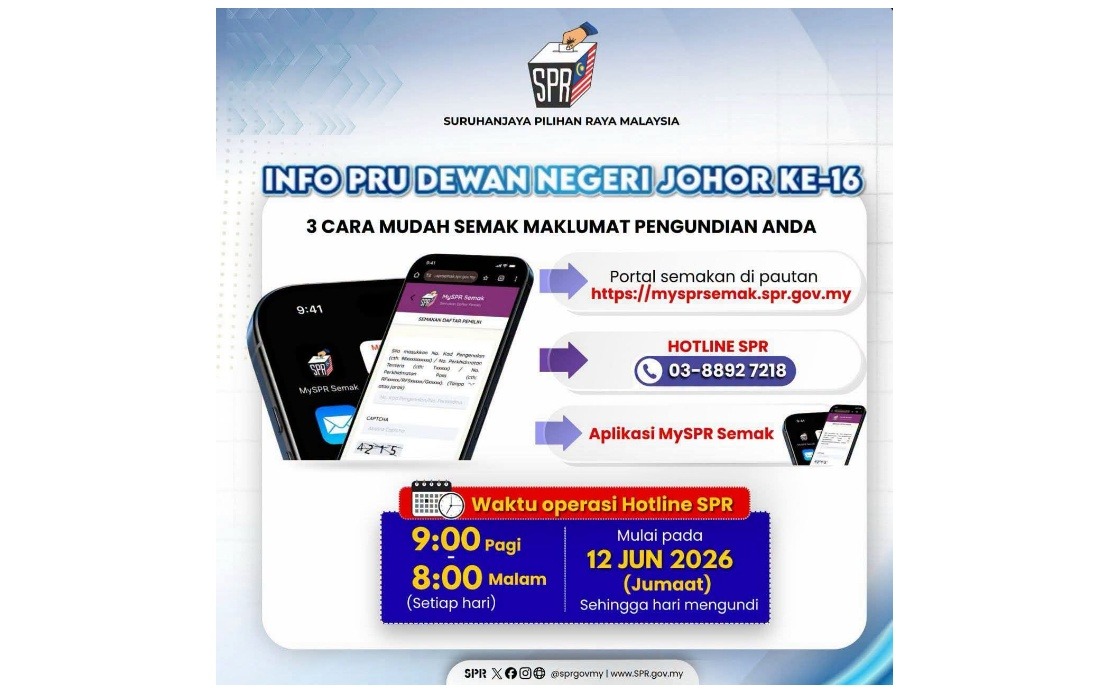
With the 16th Johor state election scheduled for Saturday, July 11, the Election Commission has issued a timely reminder for registered voters to verify their assigned polling stations and voting streams ahead of the crucial ballot. The electoral body is encouraging voters across the state to use the MySPR Semak online portal or its accompanying mobile application to locate their designated voting locations, a straightforward step that can prevent confusion and administrative delays on polling day itself. This proactive measure aims to streamline the voting process and ensure smoother operations across all polling stations throughout Johor on election day.
The scale of the electoral exercise is substantial, with approximately 2.7 million eligible ordinary voters expected to participate in determining the composition of the state assembly for the next term. These voters will be selecting 56 state assembly representatives across the constituency boundaries, making this one of the more significant state-level contests in Malaysia's recent political calendar. The high voter registration figure underscores public engagement with the democratic process in Malaysia's southern industrial and commercial heartland.
Advance polling has already taken place, providing an indication of the logistical capacity and organisational readiness of the electoral machinery. Last Tuesday saw early voting concluded, with a combined total of 19,471 personnel and their family members casting ballots in advance. This cohort comprised 7,960 military personnel along with their spouses, demonstrating the military's participation in the electoral process, and 11,511 police officers including those from the General Operations Force and their respective family members. These early voting numbers suggest solid participation among security personnel, who are traditionally granted the opportunity to vote before general polling day due to their operational commitments.
The election has attracted a diverse and fragmented field of candidates, reflecting the increasingly competitive nature of Malaysian state politics. A total of 172 candidates are contesting the 56 available seats, creating an average of more than three candidates per constituency—a figure that indicates genuine competition across most electoral divisions. The two established major coalitions are fielding equal slates of 56 candidates each: Pakatan Harapan and Barisan Nasional both present complete lineups for every seat, highlighting their determination to contest every division and their respective organisational capacity.
Beyond the two mainstream coalitions, Perikatan Nasional has fielded 33 candidates, representing a substantial challenge to the electoral landscape in Johor. The newly registered Parti Bersama Malaysia is contesting 15 seats, suggesting a focused regional strategy in key areas rather than an all-out assault on every constituency. The Malaysian United Democratic Alliance, a newer political vehicle, has nominated four candidates, indicating a more selective approach to participation. Additionally, smaller parties including Parti Orang Asli Malaysia and Parti Sosialis Malaysia are also in the race, while six independent candidates are seeking office without party affiliation, reflecting the space for individual candidates within Malaysia's electoral framework.
This diversity of candidates and parties represents both the strength and complexity of Malaysia's democratic system. Voters in Johor will face extensive choice at the ballot box, requiring them to navigate multiple political options and evaluate different visions for state development and governance. The presence of coalition candidates, established opposition movements, emerging political parties, and independent voices ensures that the election will test the electorate's preferences across a wide ideological and organisational spectrum. For voters unfamiliar with all these options or uncertain about their local electoral arrangements, the Election Commission's reminder to verify polling details becomes particularly valuable.
The practical importance of the Election Commission's advisory should not be underestimated. Voters who arrive at incorrect polling stations will face delays and potential complications in exercising their franchise, while administrative staff managing polling stations benefit from accurate information about expected voter flows and spatial arrangements. By encouraging voters to check their details in advance through digital platforms, the Electoral Commission is leveraging technology to reduce on-the-day confusion and optimise operational efficiency. The MySPR Semak system, which maintains comprehensive voter registration data, provides an accessible means for individuals to confirm their information without requiring visits to government offices.
For Malaysian voters generally, the Johor election represents an important democratic exercise at the state level, where governance decisions affecting daily life—including education provision, local infrastructure, business licensing, and state-level economic initiatives—are determined. The outcome will influence the political direction of one of Malaysia's most economically significant states and may provide indicators of broader electoral sentiment within the country. The diversity of candidates and parties ensures that voters have genuine choices reflecting different political philosophies and policy priorities, from the established two-coalition system to emerging political movements and community-focused independent candidates.
The Election Commission's reminder serves as a final call for voters to prepare adequately for their participation in the democratic process. By taking a few moments to verify their polling locations before Saturday, voters can ensure they are ready to cast their ballots efficiently and without unnecessary complications. This straightforward administrative action—verifying one's polling centre and voting stream—represents a fundamental prerequisite for meaningful electoral participation, allowing voters to focus on their actual voting decision rather than logistical uncertainties when they arrive to vote.

