The campaign for Johor's 16th state election has reached its decisive final hours, with all major political coalitions deploying their top leadership across the state to consolidate support before the official campaigning period closes at 11:59 pm on July 10. With 172 candidates competing for 56 state legislative seats, the contest has crystallized into a three-way battle between the ruling Barisan Nasional, the opposition Pakatan Harapan coalition, and the increasingly competitive Bersama party, each making distinct appeals to Johorean voters on the eve of polling.
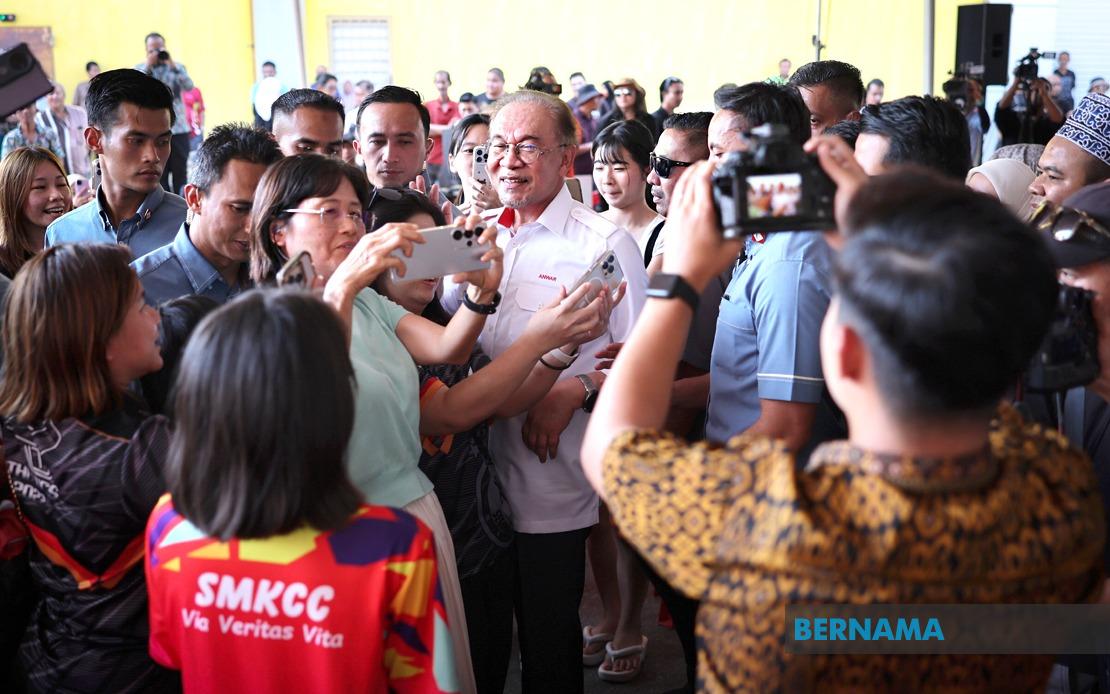
Prime Minister Anwar Ibrahim led the Pakatan Harapan drive with an intensive tour spanning five key constituencies, demonstrating the coalition's determination to wrest control of Malaysia's second-largest state economy from Barisan Nasional's grip. The PH Chairman's itinerary began in Bukit Gambir, moved through Bukit Batu and Layang-Layang, and culminated in the strategically important Pasir Gudang area with the 'Johor Ke Depan, Undi Harapan Grand Finale Programme'. This geographical spread underscores PH's recognition that victory hinges on capturing diverse constituencies across both urban industrial zones and suburban residential areas where voter sentiment has become increasingly fluid in recent years.
Within the PH coalition, ground-level campaigning reflected a grassroots dimension often overlooked in national politics. Larkin state seat candidate Suhaizan Kaiat adopted an informal walkabout strategy at a major shopping mall, accompanied by Amanah Vice President Dr Dzulkefly Ahmad, allowing direct voter engagement beyond formal speeches. Suhaizan's emphasis on the responsibility incumbent upon him to represent the diverse feedback and concerns aired throughout the campaign suggests an awareness that campaign platforms must translate into tangible governance commitments. This localized approach contrasts with the more centralized messaging emanating from the PM's office, reflecting how coalition politics requires both top-down narrative control and bottom-up community responsiveness.
The Barisan Nasional campaign, meanwhile, adopted a markedly different tenor in its final push. Deputy Prime Minister Ahmad Zahid Hamidi chose a spiritual dimension by attending a supplication event in Kulai, signaling that BN is leaning on traditional Muslim-Malay voter concerns and the role of faith-based appeals in electoral politics. This strategic choice reflects BN's historical reliance on cultural and religious resonance within the Johor electorate, where Umno and Bersatu traditionally maintain strong grassroots networks. More tellingly, incumbent Johor Menteri Besar Onn Hafiz Ghazi issued a public apology via Facebook for administrative shortcomings, a defensive posture suggesting that BN faces genuine accountability questions on state governance performance that cannot be easily dismissed.
Bersatu President Tan Sri Muhyiddin Yassin's final appeal represented an attempt to frame the election as a choice among substantive policy alternatives rather than personality-driven politics. His call for voters to synthesize information gathered during the two-week campaign period echoes a broader shift in Malaysian electoral dynamics, where voters increasingly demand evidence-based decision-making over partisan loyalty. Muhyiddin's measured rhetoric contrasts sharply with the more aggressive positioning of other coalition leaders, possibly reflecting Bersatu's strategic ambiguity regarding post-election coalition configurations and its desire to preserve flexibility regardless of the outcome.
The Bersama party's final 'Ceramah Finale' event, headlined by Rafizi Ramli and Nik Nazmi Nik Ahmad, signaled that this increasingly organized opposition force intends to consolidate the anti-establishment vote that has grown frustrated with both traditional coalitions. Rafizi's pledge to synthesize, dissect, and counter all campaign issues raised suggests that Bersama perceives itself as offering intellectual rigor and fresh problem-solving approaches distinct from the more conventionally-routed BN and PH. This positioning may resonate particularly strongly among younger, urban Johorean voters increasingly skeptical of entrenched political establishments.
MUDA, the youth-focused reform party, deployed its own finale event with President Amira Aisya Abd Aziz emphasizing voter agency and empowerment. MUDA's explicit focus on reminding citizens of their electoral power represents a conscious attempt to energize previously disengaged voter blocs and frame political choice as a personal empowerment exercise rather than merely selecting between competing elites. This messaging strategy, combined with MUDA's digital-native campaign infrastructure, positions it as a potential spoiler in closely-contested marginal seats.
The Malaysian Meteorological Department's forecast of clear morning conditions transitioning to afternoon thunderstorm potential adds a practical dimension to electoral analysis. Weather patterns significantly influence voter turnout, particularly among older voters and those in rural areas with less developed transportation infrastructure. Clear morning conditions should facilitate higher initial voter turnout, potentially advantaging whichever coalition has strongest ground operations ready to mobilize supporters before afternoon weather deterioration potentially reduces later-day participation.
The scale of this election—172 candidates across 56 seats—underscores Johor's significance within Malaysia's political hierarchy. As the state generating substantial federal revenue through Port Klang operations, petrochemical industries, and palm oil production, control of Johor's state apparatus carries implications extending well beyond regional governance into national economic policy and federal-state relations. A change in state control could alter intra-coalition dynamics at the national level, particularly given current tensions within the federal ruling coalition regarding power distribution and policy direction.
For Malaysian observers and Southeast Asian political analysts, the Johor election represents a crucial test of whether Malaysia's post-2018 democratic revival has generated sustainable institutional changes or merely produced temporary disruptions to pre-existing power structures. The competing strategies deployed on election eve—from Anwar's energetic personal campaigning to Onn Hafiz's apology to Rafizi's intellectual framing to MUDA's empowerment messaging—reveal an electorate increasingly sophisticated in demanding coherent governance narratives rather than accepting purely transactional political arrangements. Tomorrow's results will indicate whether voter sophistication translates into genuine political realignment or represents merely cyclical electoral volatility within fundamentally stable power structures.

