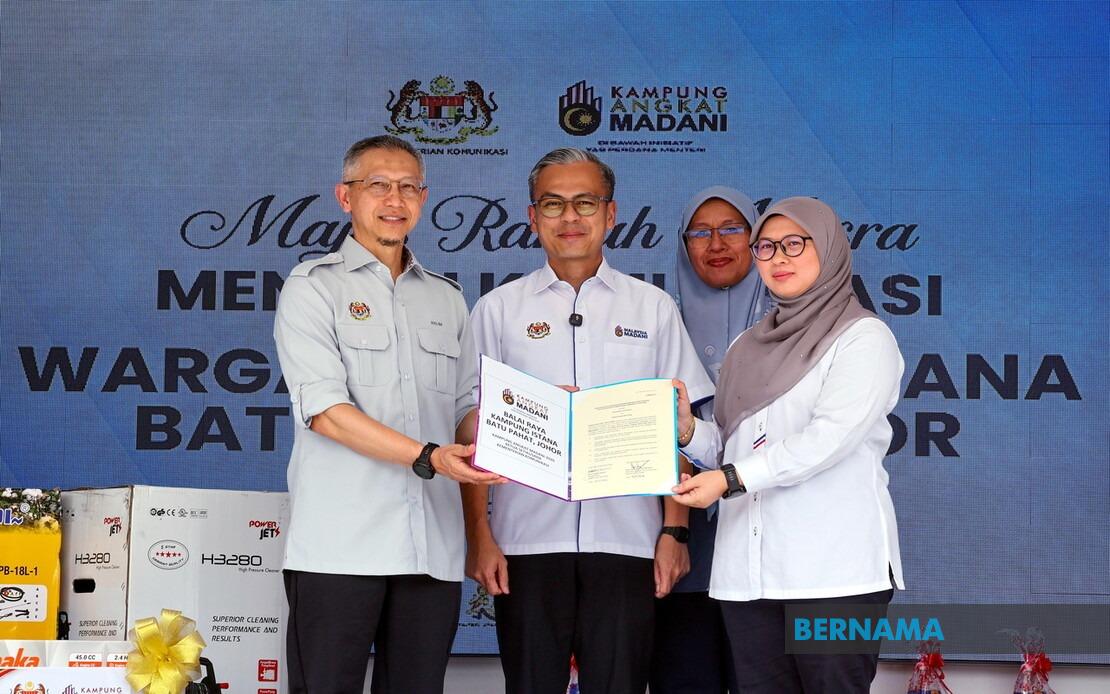
The upcoming Johor state election represents a pivotal moment for voters to decide who should lead the state towards prosperity, according to Pakatan Harapan Communications Director and Communications Minister Datuk Fahmi Fadzil, who firmly rejected characterisations of the contest as a referendum on any individual or political figure. Speaking during a campaign visit to Kampung Istana in Batu Pahat, Fahmi drew a clear distinction between voting based on personal sympathies and making choices grounded in substantive policy and governance records, describing the latter as the appropriate lens through which Johor residents should evaluate their options.
His remarks came in direct response to statements by Datuk Nazifuddin Mohd Najib, who claimed that a Barisan Nasional victory would demonstrate public endorsement for his father Datuk Seri Najib Razak to receive a pardon. Such framing, Fahmi suggested, should alarm citizens by crystallising what is genuinely at stake in the election. The controversy highlights a recurring tension in Malaysian politics where electoral outcomes are interpreted through the prism of high-profile personalities rather than governance agendas, a dynamic that complicates meaningful policy debate and risks reducing electoral choice to personality-driven calculation.
Fahmi articulated a concern that reverberates across Southeast Asian democracies struggling to build institutional strength independent of charismatic or historically significant individuals. He contended that treating elections as vehicles for advancing personal rehabilitation or vindication contradicts the fundamental purpose of democratic participation, which should centre on communities' material welfare, institutional development, and long-term prosperity. By framing the election as fundamentally about Johor's future trajectory, PH seeks to redirect voter attention towards governance capacity, economic management, and social development rather than historical grievances or individual rehabilitation claims.
The minister also addressed erosion of traditional political allegiances, particularly the once-reliable support DAP commanded among non-Malay urban constituencies, which increasingly cannot be assumed permanent in contemporary Malaysian politics. He emphasised that no political party should regard public support as a fixed or immutable resource that requires no continuous cultivation and maintenance. This observation reflects genuine shifts in voter behaviour across Malaysia, where demographic changes, rising education levels, and evolving economic anxieties have prompted citizens to evaluate parties more critically based on contemporary performance rather than historical association.
Fahmi's comments suggest PH is attempting to capitalise on fluidity in Johor's political landscape, where traditional UMNO-BN dominance appears less monolithic than in preceding decades. He highlighted defections or expressions of support from individuals previously associated with opposition parties or even BN component parties, interpreting these as evidence of growing appeal transcending conventional factional boundaries. The invocation of former Rengit assemblyman Datuk Dr Mohd Puad Zarkashi's public backing for PH candidates signals that even within Johor's heartland, traditionally considered UMNO stronghold, political calculations are shifting.
The minister also referenced support from Bersatu members for PH's Sri Medan candidate Hishamuddin @ Misrin Ishak, suggesting emerging cross-party cooperation or at minimum voter openness to PH alternatives regardless of current party affiliation. Such developments, while modest, indicate that the monolithic party structures that once governed Johor politics may be fragmenting. These dynamics carry implications beyond Johor, potentially foreshadowing broader patterns of political realignment across Malaysia as voters increasingly evaluate parties instrumentally rather than through inherited loyalty or ethnic-communal identity frameworks alone.
Fahmi's emphasis on voter agency and the invaluable nature of electoral choice carries particular resonance given historical patterns where Malaysian politics has sometimes been dominated by elites negotiating settlements among themselves with limited authentic grassroots participation. By insisting that voters retain power to reject narratives prioritising individual rehabilitation over collective welfare, he implicitly challenges citizens to exercise that power meaningfully. This framing aligns with broader global trends towards voter demand for authentic engagement with policy substance rather than personalised narratives or symbolic politics disconnected from lived experience.
The 16th Johor State Election will unfold across 56 seats with 172 candidates competing on July 11, with early voting scheduled for July 7. The timing is significant as Johor remains economically consequential within Malaysia's federation, given its manufacturing base, port infrastructure, and domestic consumption patterns. Electoral outcomes there consequently reverberate across national economic confidence and government revenue projections. An unexpected PH breakthrough would dramatically reshape the national political balance, potentially providing momentum toward greater federal parliamentary influence, whereas a BN consolidation would reinforce its remaining state bastions despite recent federal-level diminishment.
Fahmi's insistence that the election concerns governance capacity and state development rather than personal political scores reflects PH's strategic calculation that portraying themselves as forward-looking and BN as backward-facing could mobilise sufficient voters from multiple communities. By contrast, BN's apparent strategy of linking electoral support to endorsement of a former prime minister risks reinforcing perceptions that the coalition remains entangled with controversial historical figures and personalised interests rather than collective advancement. This divergence in messaging strategy suggests fundamentally different understandings of what contemporary Malaysian voters prioritise in electoral decisions.
The underlying dynamics also illuminate enduring questions about institutional development in Malaysian democracy. Whether elections can genuinely function as mechanisms for accountability and programmatic choice or remain primarily vehicles for inter-elite competition and personality-driven calculation continues generating debate. Fahmi's intervention suggests PH recognises that voter demand for substance-focused campaigns represents genuine opportunity, implying that at least portions of the Malaysian electorate have evolved beyond simple factional loyalty. Whether such aspirations can successfully overcome entrenched structural incentives and historical patterns remains uncertain, but the Johor election will provide important evidence of contemporary voter orientations.
The campaign intensity surrounding Johor reflects recognition that state elections, while ostensibly regional contests, carry significance for national political trajectories and precedential weight for future electoral contests. A decisive outcome in either direction would shape subsequent campaign strategies across Malaysia, potentially validating either personality-driven or policy-focused approaches to electoral mobilisation. For regional observers, the Johor election exemplifies broader Southeast Asian democratisation patterns where traditional patronage networks and personalised authority structures increasingly encounter challenges from voters demanding institutional performance and transparent governance, creating complex electoral dynamics that defy simple categorisation as purely democratic advancement or persistent authoritarianism.

