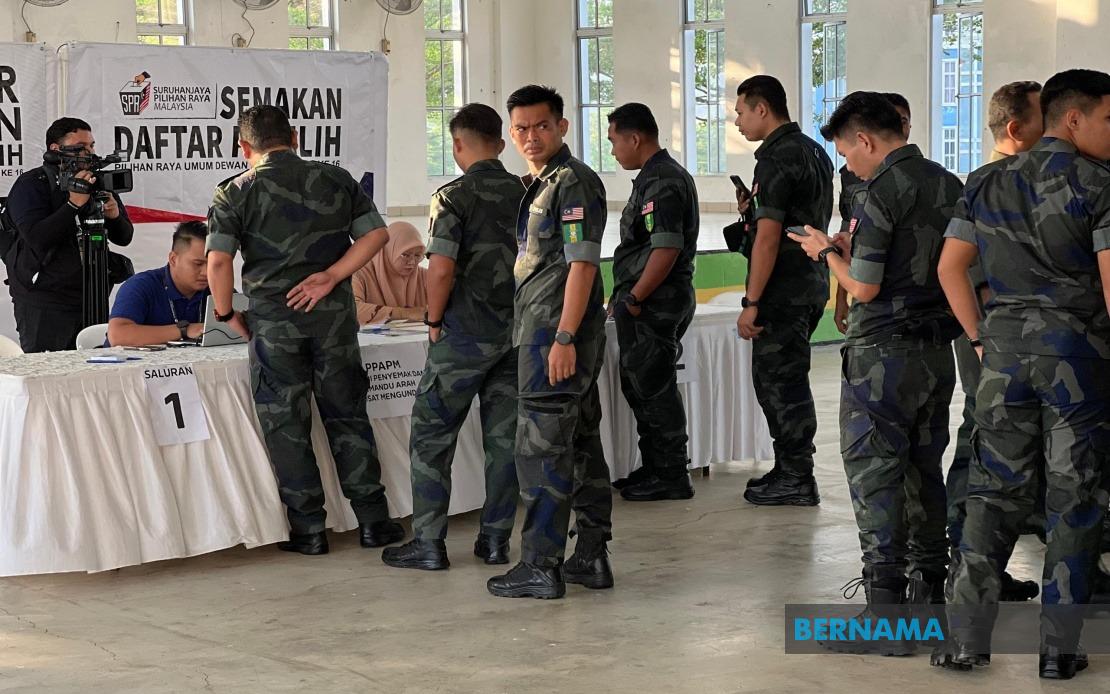
Early voting commenced across Johor on July 7 as the Election Commission activated 64 dedicated polling centres to facilitate members of the security establishment ahead of the state's general election scheduled for Saturday. The initiative was designed to enable 24,751 personnel from the Malaysian Armed Forces, Royal Malaysia Police, and General Operations Force, alongside their spouses, to exercise their voting rights without disrupting essential security operations. This staggered voting arrangement reflects standard electoral practice in Malaysia, allowing uniformed services personnel to participate in democratic processes while maintaining operational readiness.
The Malaysian Armed Forces contingent represented the smaller segment of early voters, with 12,041 military personnel and their spouses designated to cast ballots across 11 specifically allocated polling centres. This distribution underscores the military's organisational structure and geographic deployment across Johor, ensuring that troops stationed in various locations could access convenient voting facilities. The remaining security voters—12,710 individuals comprising PDRM officers, GOF members, and their families—were dispersed across a considerably larger network of 53 polling stations, reflecting both the Royal Malaysia Police's more extensive civilian-facing footprint and the General Operations Force's complementary role in internal security.
The Commission's scheduling arrangement required centres to operate under a staggered closure protocol rather than closing simultaneously. Initial closures began at noon, with the final centres ceasing operations at 6 pm, a timetable designed to accommodate personnel with varying shift patterns and operational commitments. This flexible approach recognises the unpredictable demands placed on security forces, particularly during election periods when police and military resources may be redirected toward election security and management duties. The extended voting window also reduces congestion at individual centres, minimising queuing and potentially expediting the overall process.
Weather conditions across several Johor districts on voting day favoured participation. Survey data captured by Bernama indicated predominantly sunny conditions in Batu Pahat, Muar, Pontian, and Tangkak, weather patterns that typically encourage voter turnout by reducing physical discomfort and eliminating transport delays caused by rain. Favourable meteorological circumstances often correlate with higher participation rates, a factor of particular significance for a state election where voter engagement shapes electoral mandates and government formation.
The early voting mechanism itself carries broader implications for Johor's democratic process. By enabling security personnel to vote beforehand, the state election framework prevents potential conflicts between voting duties and operational deployments. Personnel posted to polling station security duties on election day would otherwise face complications in exercising franchise rights, creating either logistical complications or ethical dilemmas. Early voting resolves this tension systematically, though it does mean final security force numbers available for Saturday's polling stations will reflect personnel already committed to voting procedures.
The 16th Johor state election represents a significant electoral exercise, with approximately 2.7 million ordinary voters scheduled to participate across 56 state constituencies on Saturday. This figure dwarfs the early voting security contingent, illustrating the vast disparity between uniformed personnel and the civilian electorate. However, the security forces' early participation carries symbolic weight—their voting rights affirm constitutional principles of universal suffrage regardless of professional status, a principle essential to Malaysia's democratic credentials and institutional legitimacy.
Johor's early voting administration reflects the Election Commission's institutional maturity in managing complex logistics. Coordinating 64 separate venues across multiple districts, processing voters from different agencies with distinct hierarchical structures, and synchronising closure schedules across this dispersed network requires considerable operational planning. Such execution validates the EC's capacity to manage the forthcoming Saturday polling across 56 constituencies and substantially larger voter populations with similar organisational rigour.
The early voting process also serves administrative purposes beyond mere convenience. Vote counting can commence immediately after early voting concludes, accelerating result tabulation and reducing the period between polling and declaration. For a state election where coalition formations and government composition remain to be determined, earlier vote verification through early counting provides preliminary indicators of electoral momentum and potential outcomes, information valuable to political actors preparing for post-election negotiations.
Regional observers monitor Johor elections closely given the state's political significance. Johor remains a demographic and economic powerhouse within Malaysia's federal structure, and its state government composition influences national political calculations. Security forces' participation in this electoral exercise, even in numerically modest proportions, reinforces the institutional neutrality that electoral commissions must maintain. By providing dedicated, professionally administered facilities for uniformed voters, the EC signals that security personnel enjoy the same electoral rights as civilian populations, a principle fundamental to democratic civilian-military relations.
The logistical success of early voting operations establishes operational templates for Saturday's larger polling exercise. Lessons regarding queue management, voter information provision, and centre administration from the security force voting will inform adjustments to the broader election-day infrastructure. Any procedural refinements developed through early voting centres can enhance efficiency and accessibility when the general electorate votes Saturday, potentially improving overall participation rates and voter satisfaction with electoral administration.

