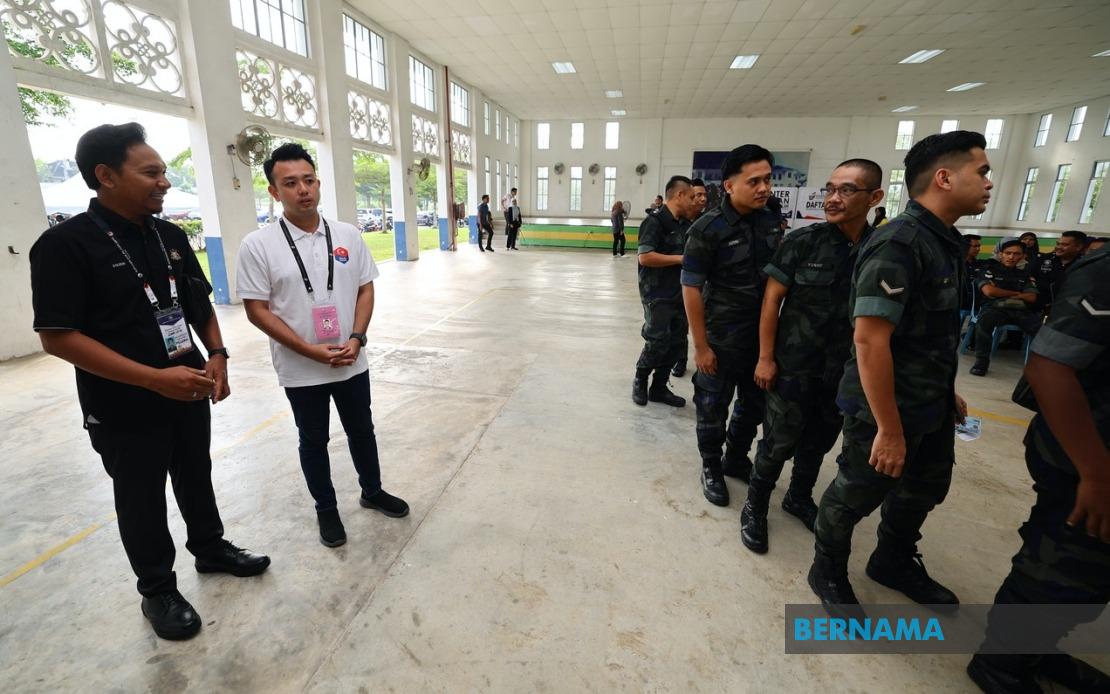
The 16th Johor State Election is entering its final stretch, with Saturday's polling day marking the culmination of an intense campaign period. On Thursday, just three days before voters head to the polls, candidates from Pakatan Harapan, Barisan Nasional, and Perikatan Nasional set aside their electioneering activities to monitor the early voting process designated for members of the security forces and their spouses. This coordinated observation underscores the significance of transparent electoral procedures and the need for all contesting parties to maintain confidence in the integrity of the voting mechanism.
At the 5th Battalion General Operations Force Camp in Simpang Renggam, the three contenders for the Layang-Layang seat presented a united front in observing proceedings. Guna Balakrishnan, representing Pakatan Harapan's bid to reclaim ground in Johor, stood alongside Chua Jian Boon of the ruling Barisan Nasional coalition and Abd Mutalip Abd Rahim of Perikatan Nasional. Their collective presence demonstrated a commitment to witnessing firsthand how election officials managed the voting process for uniformed personnel, a constituency whose participation is crucial to the overall electoral outcome. Similarly, the three candidates contesting the Tenggaroh seat—Muhamad Amerul Muhamad of Perikatan Nasional, Mohd Youzaimi Yusof representing Barisan Nasional, and Md Yusof Dawam of Pakatan Harapan—gathered at the Iskandar Camp early voting centre in Mersing to conduct their own observations.
The early voting exercise involved a substantial portion of Johor's electorate. A total of 20,607 registered voters participated in the early voting process, comprising 8,544 members of the Malaysian Armed Forces and their spouses, alongside 12,063 police personnel and their spouses. This combined figure reflects the significant number of security sector employees who serve in Johor and their immediate families. The Election Commission activated 64 early voting centres statewide, which opened at 8 am and closed in staggered intervals between noon and 6 pm depending on voter load and geographical location. The logistics of managing such a distributed voting operation required meticulous planning and coordination between security agencies and election officials.
Despite challenging weather conditions, with rain affecting several voting locations throughout the morning, the early voting process proceeded without disruption. Security personnel arrived in organized waves, adhering strictly to the procedures established by Election Commission officers. This orderly flow demonstrated the discipline inherent in the security forces, as well as the effectiveness of advance planning by electoral authorities. The rain, rather than becoming an obstacle, seemed merely a backdrop to an otherwise smooth administrative exercise. Such resilience in the face of adverse conditions bodes well for Saturday's main polling day, when weather could similarly impact turnout across the broader electorate.
Senior military and law enforcement officials added their own presence to the proceedings, reinforcing the importance placed on the early voting exercise. Army Chief General Tan Sri Azhan Md Othman and 21st Special Service Group commander Major General Datuk Ahmad Shuhaimi Mat Wajab visited the Iskandar Camp site in Mersing, their attendance signifying institutional oversight of the electoral process. Johor police chief Datuk Ab Rahaman Arsad cast his own ballot at Dewan Dato Onn, the Johor headquarters of the police force, setting an example for subordinates and demonstrating leadership participation in the democratic exercise.
The breadth of candidate participation across different constituencies and parties suggests a deliberate effort to build post-election credibility regardless of outcomes. When candidates from competing coalitions jointly witness electoral procedures, they collectively create a record of transparency that becomes difficult to challenge later. This practice is particularly relevant in Johor, a politically significant state where Barisan Nasional maintains entrenched support but where Pakatan Harapan and Perikatan Nasional have been making incremental gains in recent contests. For Malaysian voters observing from other states, the Johor election serves as a barometer of shifting political preferences within a state that has historically been a powerbase for federal ruling coalitions.
The election itself involves substantial stakes, with 172 candidates competing for 56 seats in the Johor State Legislative Assembly. This ratio of roughly three candidates per seat reflects the three-way competition that now characterizes Malaysian electoral politics, a significant departure from the era when two-coalition contests dominated. The presence of viable third options through Perikatan Nasional has fragmented the opposition vote in some areas while creating new political dynamics in others. Candidates like Lim Chin Eng, described as the oldest contestant in this election cycle, represent the older generation of Malaysian politicians who continue to contest despite demographic changes within the electorate and shifting policy priorities among younger voters.
The focus on specific constituencies and candidates—Layang-Layang, Tenggaroh, Kempas, and Bukit Permai—highlights the localized nature of electoral competition, where individual personality, constituency service records, and community connections often matter as much as national political narratives. Muhammad Faezuddin Mohd Puad's observation of voting at Kempas Police Station and Datuk Jafni Md Shukor's presence at Kulai District Police Headquarters exemplify how candidates maintain direct engagement with constituencies even as larger political forces shape the broader election landscape. These personal touches help explain why, despite national political trends, some incumbents manage to retain their seats or challengers manage to upset long-standing representatives.
For readers across Southeast Asia, the Johor election offers insights into how Malaysia's democratic institutions function in practice. The peaceful observation of voting procedures by contesting candidates, the orderly participation of security personnel, and the visible presence of senior officials all reinforce that despite political competition's intensity, procedural legitimacy remains valued by major political actors. This contrasts sharply with electoral environments elsewhere in the region where such transparency cannot be taken for granted. The professionalism demonstrated in Johor's early voting exercise contributes to maintaining public confidence in electoral outcomes, crucial for political stability in a nation as ethnically and religiously diverse as Malaysia.
As Saturday's main polling day approaches, the precedent set by Thursday's early voting becomes relevant. The smooth administration of voting for security personnel, the acceptance of this process by all major political factions, and the visible participation of senior leaders in observing procedures establish a baseline of expectations for how the broader election will be conducted. Whether weather, logistical challenges, or other contingencies arise, the framework tested on Thursday will likely inform how officials and candidates respond. The 172 candidates vying for 56 seats carry into the final campaign days the implicit understanding that whatever their political differences, they share common stakes in maintaining electoral integrity that serves all participants and ultimately legitimizes the government that emerges from Saturday's voting.
The Johor State Election represents more than a routine exercise in representative democracy; it tests whether Malaysia's electoral system can accommodate increasingly fragmented political competition while preserving public confidence in outcomes. The candidates' willingness to observe early voting procedures together, the security forces' orderly participation despite their institutional roles, and the administrative competence displayed all suggest that this test is being met, at least in procedural terms. How voters respond on Saturday will reveal whether procedural legitimacy translates into acceptance of substantive electoral outcomes, regardless of whether preferred candidates triumph or fall short of expectations.

