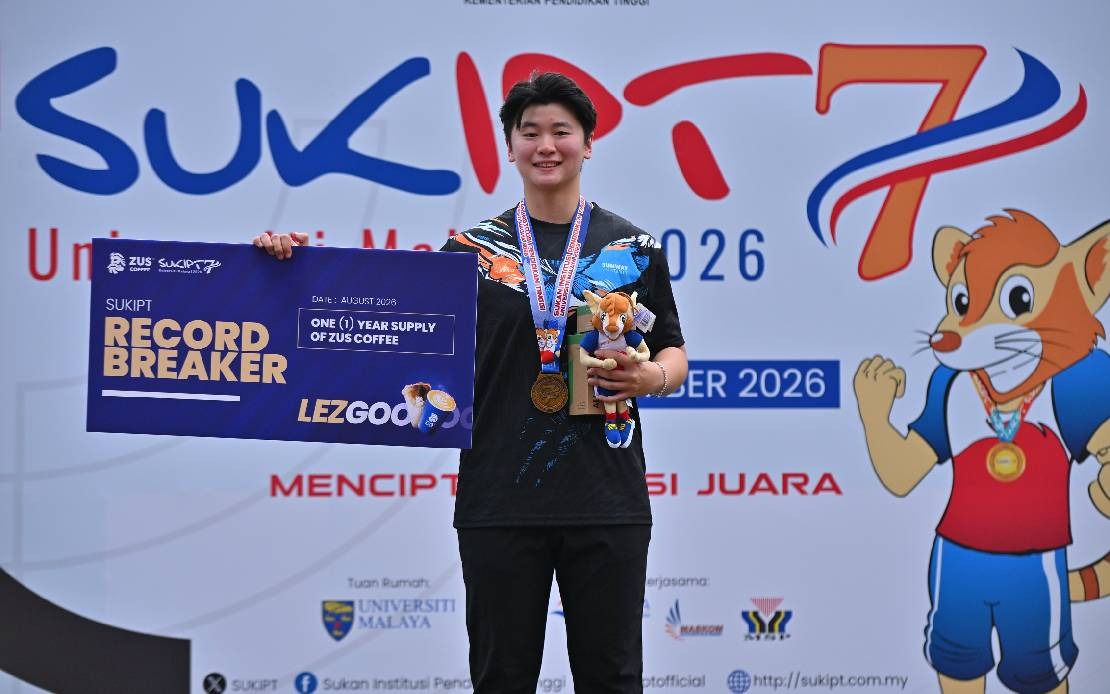
On National Day, 22-year-old Ng Jing Xuan delivered a standout performance for Sunway University at the 2026 Higher Education Institutions Sports Games (SUKIPT), launching the javelin to 46.92 metres and obliterating the competition's previous benchmark. Her effort at the UM Arena, Universiti Malaya, erased a decade-old meet record of 44.41 metres established by Nur Fatin Adibah Suharman from Universiti Malaysia Perlis during the 2016 edition, cementing Jing Xuan's status as one of the country's most promising track and field talents.
While the gold medal performance certainly merited celebration, Jing Xuan revealed a more ambitious target had eluded her grasp. Her national record of 52.17 metres remained unconquered despite being the focal point of her preparations for the games. The gap between her achievement and her personal benchmark—over five metres—underscores the incremental nature of elite athletic progression and the specialised conditions required for record-breaking performances. Yet the athlete's philosophical approach to the result demonstrated maturity beyond her years, as she acknowledged the value of what had been accomplished rather than dwelling solely on what might have been.
The preparation leading into SUKIPT was notably rigorous. Following her participation in the Asian U23 Athletics Championships, Jing Xuan undertook a month-long intensive training regimen specifically designed to peak for these university games. Such structured periodisation, common in elite athletic programmes, aims to synchronise physical readiness with competition dates. However, the optimal conditions for achieving national records—factors ranging from weather to equipment to psychological readiness—do not always align with competition schedules, a reality the athlete acknowledged with candour.
External circumstances also played a role in her performance trajectory. A schedule adjustment that shifted her event from afternoon to morning created logistical and rhythmic challenges. For javelin throwers, the timing of competition carries subtle but significant implications. Morning sessions often present different atmospheric conditions, potentially affecting how the implement travels through the air. More substantially, athletes build competitive rhythms throughout events; an unexpected shift can disrupt the mental preparation and warm-up patterns that contribute to optimal performance. Jing Xuan's recognition of this factor reveals the sophisticated understanding elite athletes maintain of variables beyond raw physical ability.
Her competitive dominance at SUKIPT was nonetheless comprehensive. The silver medal went to Farisha Athirah Wai from Universiti Pendidikan Sultan Idris, whose throw of 36.21 metres placed her significantly behind. Tai Yu Tian of Universiti Putra Malaysia secured bronze with 32.74 metres. The substantial margins between first and second place underscore Jing Xuan's technical superiority and the depth of her conditioning relative to her university-level peers. Such gaps, spanning roughly ten metres between gold and silver, suggest the progression pathway toward senior national and international competition remains clear.
The SUKIPT triumph arrives at a strategic juncture in Jing Xuan's athletic calendar. The ASEAN University Games scheduled for December represent an important stepping stone toward broader Southeast Asian recognition. These games provide platforms for university athletes to establish themselves before transitioning to senior national teams and international federations. Success in the AUG category can facilitate pathways to coaching support, sponsorship, and selection for higher-level competitions. For Malaysian athletics, which has historically struggled to maintain consistent javelin excellence at regional and global levels, emerging talent like Jing Xuan represents a valuable investment.
Beyond the ASEAN stage lies the SEA Games, the region's premier sporting showcase held biennially. Jing Xuan has explicitly identified the next SEA Games as a target for bringing glory to Malaysia through international competition. The SEA Games javelin events attract formidable competitors from Thailand, Vietnam, and the Philippines, nations with stronger athletics infrastructures. Competing at that level demands not only consistent record-breaking performances but also mental resilience, technical refinement, and access to world-class coaching and facilities. The progression from university records to senior national records to SEA Games medals represents a multi-year development trajectory.
The National Day context of her record carries symbolic weight beyond sporting achievement. Jing Xuan's contribution to Sunway University and, by extension, Malaysian sporting pride resonates with broader narratives of national development and youth excellence. University sports remain a critical talent pipeline for national teams across most Olympic disciplines. When individual athletes succeed at this level, they simultaneously inspire younger competitors, validate investment in grassroots programmes, and elevate the visibility of sports requiring substantial technical training and resources.
Looking ahead, Jing Xuan's focus will necessarily shift toward closing the gap between her current capability and her national record. The 52.17-metre benchmark, set during previous competition, establishes a tangible goal. The distance between 46.92 metres and 52.17 metres—approximately 11 per cent—could plausibly be bridged through continued technical refinement, strength and conditioning improvements, and competitive experience at increasingly demanding levels. Such marginal gains, accumulated across multiple training cycles and competitions, characterise the path toward senior national and international prominence in throwing events.
Her willingness to remain grounded despite impressive achievement, combined with articulated goals for the ASEAN University Games and SEA Games, positions Jing Xuan as a prospect worthy of sustained attention from national sporting authorities and potential sponsors. The SUKIPT record represents validation of her current trajectory but also marks a beginning rather than a culmination. For Malaysian athletics, particularly in the throwing disciplines where consistent international representation remains inconsistent, nurturing talent like Jing Xuan through university competition toward senior representation constitutes a strategic priority. The momentum generated by meet records and gold medals, if channelled toward systematic preparation and international exposure, can translate into the breakthrough performances that elevate Malaysia's standing in Asian and Southeast Asian athletics.

