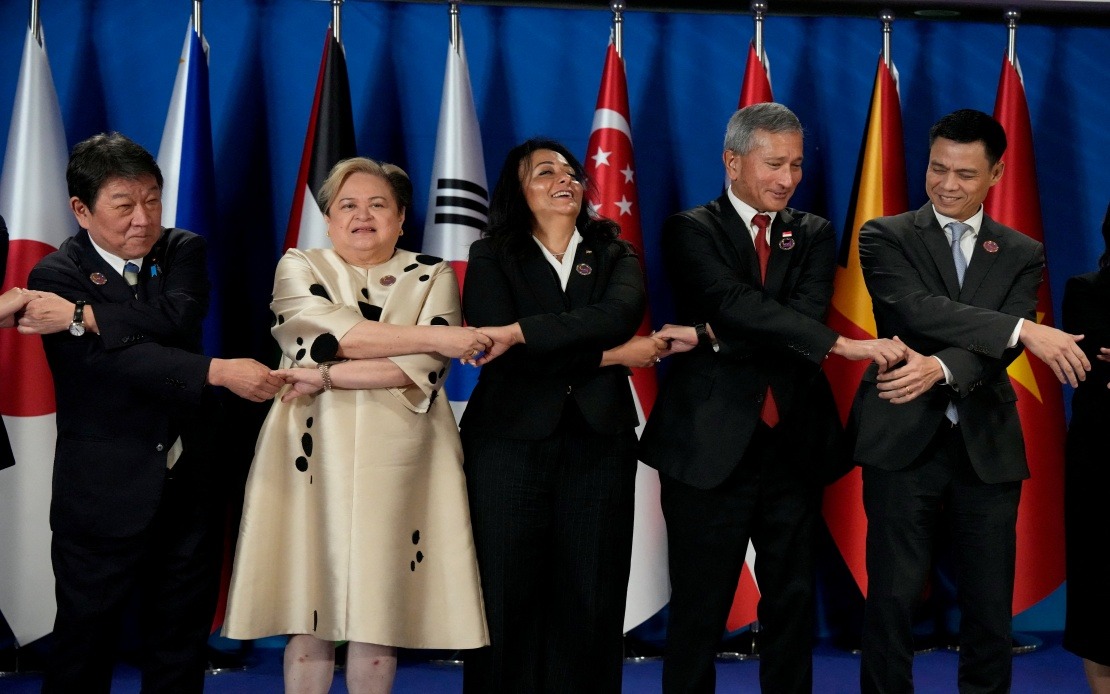
Japan, South Korea, Australia and New Zealand used high-level ministerial meetings in Manila this week to reaffirm their commitment to ASEAN partnership while addressing shared regional anxieties about geopolitical competition, economic disruption and the rapid advancement of transformative technologies. The Post-Ministerial Conferences underscore how the bloc remains central to the strategic calculations of major democracies seeking to navigate a more fractious Indo-Pacific landscape.
Japanese Foreign Minister Toshimitsu Motegi framed Tokyo's engagement as grounded in respect for ASEAN's institutional unity and regional leadership. Beyond diplomatic platitudes, Japan identified concrete areas for collaborative advancement: digital transformation, artificial intelligence adoption and the transition toward sustainable energy systems. This signals Japan's recognition that technological modernisation now ranks alongside traditional security concerns in determining regional competitiveness and stability. For Malaysia and other ASEAN members, Japanese support in these domains carries particular weight given Tokyo's technological expertise and substantial capital capacity.
South Korea's perspective, articulated by Foreign Minister Cho Hyun, centred on the interconnected crises cascading through the region. Supply chain disruptions that began during the pandemic continue reverberating through manufacturing networks; instability in West Asia threatens energy markets and shipping routes crucial to Southeast Asian economies; and the artificial intelligence revolution is reshaping labour markets and geopolitical advantage simultaneously. Cho's emphasis on strengthening "solidarity" suggests Seoul views ASEAN cohesion as essential ballast against these centrifugal forces. Seoul has moved beyond rhetoric by launching specific collaborative platforms: an AI companionship initiative and a cultural and creative industries initiative that offer tangible pathways for technological transfer and economic diversification.
New Zealand's Foreign Minister Winston Peters articulated concerns that resonate deeply across the region. He identified renewed great-power competition, erosion of the international rules-based system, AI advancement, and climate change as defining challenges of the current era. Unlike previous decades when ASEAN could navigate great-power rivalries through strategic ambiguity, the current environment demands more active coalition-building. Peters' emphasis on partnership as "our greatest strength" reflects New Zealand's understanding that smaller and mid-sized powers must pool resources and institutional knowledge to maintain agency in an increasingly polarised world.
Australian Foreign Minister Penny Wong offered the most sobering assessment, explicitly characterising the past twelve months as "challenging" and noting that geopolitical competition has intensified while the margin for miscalculation has narrowed dangerously. Wong's reference to "shocks" in West Asia, the broader region and the global economy acknowledges that volatility in distant theatres—from the Middle East to energy markets—directly impacts Southeast Asian prosperity. Her attention to food and energy security, fertiliser supplies and fuel costs reflects Australia's focus on material vulnerabilities that ASEAN members, particularly agricultural exporters, face acutely.
Wong's advocacy for ASEAN-led economic resilience mechanisms—specifically the ASEAN Power Grid and the Digital Economy Framework Agreement—demonstrates that substantive cooperation increasingly focuses on infrastructure integration and digital governance rather than security alliances alone. For Malaysian policymakers, such frameworks offer opportunities to position the country as a node within regional supply chains and digital networks while reducing dependence on any single external power.
The Australian minister's characterisation of ASEAN as the region's centre—the entity that "holds the centre," builds relationships, shapes rules and fosters shared resilience—represents a diplomatic inversion worth noting. Rather than framing ASEAN as a subordinate regional architecture existing within a Western-led or Chinese-dominated international order, Wong portrays the bloc as the primary architect of regional futures. This rhetorical positioning matters because it provides diplomatic cover for ASEAN members seeking to maintain independent strategic space while engaging multiple external powers.
The convergence of messaging from these four nations suggests a coordinated strategy to deepen ASEAN partnerships precisely as concerns about regional stability mount. Each power identifies different but complementary entry points: Japan emphasises technology and sustainability; South Korea highlights innovation and creative industries; New Zealand stresses institutional partnerships; Australia focuses on economic resilience infrastructure. Collectively, they offer ASEAN a portfolio of engagement options that need not require choosing between competing blocs.
For Malaysia specifically, these ministerial declarations carry practical implications. As a founding ASEAN member with growing technological ambitions and significant trade exposure to supply chain disruptions, Malaysia stands to benefit substantially from Japanese expertise in digital systems, South Korean innovation partnerships, New Zealand's institutional knowledge and Australian infrastructure collaboration. The challenge lies in effectively channelling these external commitments into domestic capacity-building rather than allowing them to remain aspirational diplomatic statements.
Crucially, these engagements occur as ASEAN itself faces internal coherence tests. Myanmar's instability, the South China Sea disputes, and divergent economic development trajectories create internal fissures that external powers acknowledge but cannot resolve. The ministerial conferences reveal that Japan, South Korea, Australia and New Zealand understand ASEAN unity as a prerequisite for their own strategic interests rather than a charitable objective. This alignment of interests creates genuine opportunity for Southeast Asian nations willing to leverage external partnerships while preserving collective voice on regional questions.

