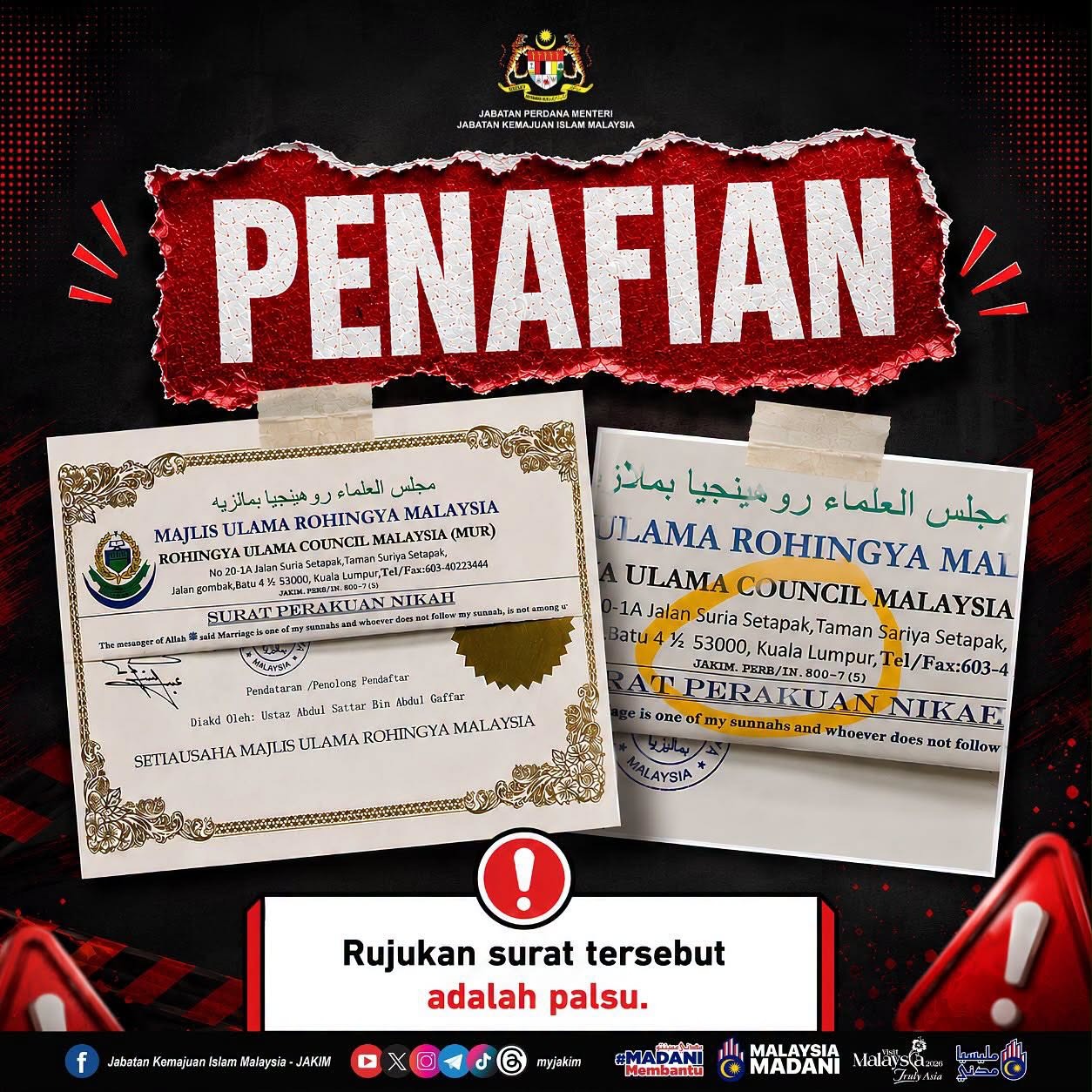
The Department of Islamic Development Malaysia (JAKIM) has formally rejected claims that a marriage-related letter currently spreading across social media platforms originated from the agency, revealing that the document carries a fraudulent reference number. The authentication announcement, posted on JAKIM's official Facebook page on July 15, represents a significant warning to Malaysians about the prevalence of counterfeit religious documents being distributed online.
The problematic letter, purportedly issued by the Malaysia Rohingya Ulama Council to certify marriage declarations, displayed the reference number "JAKIM.PERH/LN.800-7(5)" — a designation that JAKIM has now categorically stated does not exist in its records. The document's circulation on social media raised immediate concerns among observers who questioned whether the letter held any official legitimacy or legal standing under Malaysia's Islamic governance framework.
JAKIM's statement clarifies that neither the federal department nor any of the state Islamic religious councils or departments across Malaysia have ever engaged the Malaysia Rohingya Ulama Council to manage, certify, or handle marriage-related matters on their behalf. This distinction is crucial because Malaysia's marriage administration for Muslims falls under the purview of state-level Islamic authorities, with JAKIM serving a coordinating and advisory role. The revelation exposes what appears to be an attempt to legitimise an organisation's authority by falsely invoking government institutional credibility.
The incident underscores a growing problem of document forgery targeting Malaysia's Islamic administrative apparatus. With religious matters carrying significant social and legal consequences for Muslim citizens, the weaponisation of fraudulent official-looking correspondence poses genuine risks to the public. Individuals who mistakenly rely on such fake documents for marriage registration or related legal proceedings could face complications when attempting to formalise their unions through proper channels.
Malaysian authorities are increasingly concerned about the sophistication of modern document fraud. The forged letter's inclusion of what appeared to be an authentic departmental reference number demonstrates how perpetrators exploit public familiarity with official formatting and bureaucratic procedures to enhance credibility. Such tactics are particularly effective in religious contexts, where many citizens defer to authority and may not possess detailed knowledge of proper verification procedures.
In response to the situation, Minister in the Prime Minister's Department (Religious Affairs) Dr Zulkifli Hasan announced that a formal investigation would be initiated once complete information was gathered. This governmental response signals the seriousness with which authorities view the matter, positioning it not merely as a social media inconvenience but as a potential criminal matter requiring official scrutiny.
JAKIM has issued a public advisory urging Malaysians to exercise greater caution when encountering religious documents, particularly those with legal or administrative implications. The department recommends that citizens independently verify the authenticity of any questionable papers by contacting JAKIM directly or consulting their respective state Islamic religious authorities. This guidance reflects a recognition that document verification, while straightforward for officials, remains a challenge for ordinary citizens navigating Malaysia's multi-tiered Islamic administration system.
The incident carries broader implications for institutional confidence and public trust. As religious authorities continue to issue official correspondence and maintain administrative records, the circulation of counterfeits undermines faith in legitimate communications from these bodies. Individuals may now approach genuine JAKIM or state Islamic council documents with greater scepticism, potentially delaying important religious and civil procedures.
For individuals in Malaysia's Rohingya communities, the misappropriation of their group's name to create fraudulent documents represents an additional concern. By falsely attributing authority to the "Malaysia Rohingya Ulama Council", bad actors may inadvertently compromise the reputation of legitimate religious scholars and community leaders within the Rohingya population. This collateral damage extends the consequences of the forgery beyond the immediate victims to broader community relationships.
The broader Southeast Asian context makes this episode particularly relevant. Across the region, religious administrative systems face similar challenges with counterfeit documentation, particularly where governance relies on layered authority structures. Malaysia's experience provides instructive lessons for neighbouring countries about the importance of robust verification systems and public education surrounding document authenticity.
Moving forward, JAKIM may need to implement enhanced security features on official correspondence or develop more accessible public verification mechanisms. Digital authentication systems, readily available in many developed nations' bureaucracies, could significantly reduce the burden on citizens seeking to confirm document legitimacy. Such improvements would strengthen public confidence while reducing the administrative load on religious authorities handling verification inquiries.
For now, the public warning serves as a reminder of the perpetual vigilance required in an age where digital communication and social media amplification can rapidly disseminate false information. Citizens dealing with any marriage-related documentation or other religious administrative matters should prioritise direct contact with official authorities over reliance on documents obtained through informal channels or social media sources.

