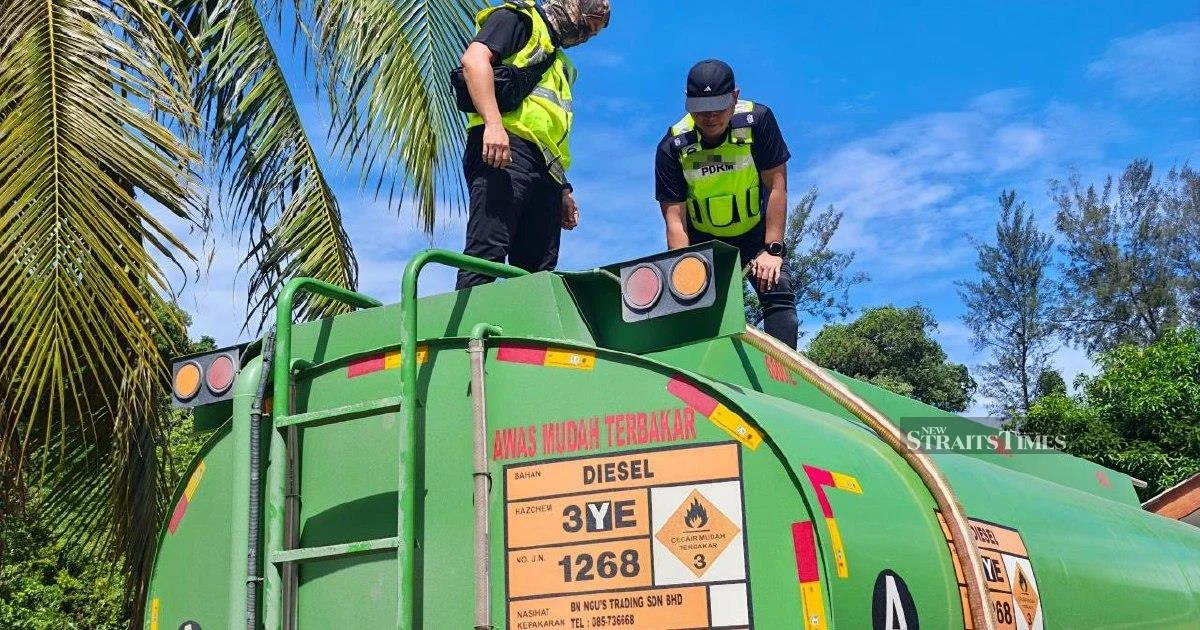
Enforcement authorities in Miri have moved swiftly against an underground diesel trafficking network, uncovering a hidden depot concealed within a residential bungalow in Tanjung Lobang. The operation, which targeted the diversion of subsidised diesel meant for legitimate commercial use, resulted in the seizure of 15,000 litres of fuel and the arrest of four men suspected of orchestrating the scheme. The discovery underscores the persistent challenge Malaysian authorities face in combating fuel smuggling and subsidy abuse in border regions and coastal areas.
The bungalow operation represents a particularly brazen attempt to circumvent fuel controls. Rather than operating from an obvious commercial location, perpetrators had established what amounted to a mobile distribution hub disguised as a residential property. This approach not only made detection more difficult but also allowed operators to blend seamlessly into residential neighbourhoods, limiting the visibility that traditional industrial depots would attract. The use of domestic premises for illicit fuel storage and distribution demonstrates how criminal syndicates are adapting tactics to evade routine compliance checks.
Subsidised diesel, which carries significantly lower retail prices than world-market rates, represents an attractive commodity for diversion. Malaysian authorities maintain fuel subsidies to help buffer transportation costs and support small businesses, but these mechanisms create perverse incentives. When the price gap between domestic and regional markets is substantial, smuggling networks emerge to exploit the differential. Neighbouring jurisdictions with higher fuel prices provide lucrative black markets, making cross-border diversion schemes economically viable despite enforcement risks.
The seizure of 15,000 litres suggests an operation with meaningful throughput rather than small-scale personal stockpiling. At current wholesale prices, this quantity would represent significant commercial value, indicating the network likely supplied multiple customers across an extended distribution chain. The scale implies organised coordination, warehouse management, and probably regular resupply operations. Breaking such networks requires identifying not just the storage location but also upstream suppliers providing fuel and downstream dealers moving product into end markets.
Sarawak, where Miri is located, has historically been vulnerable to fuel smuggling operations. The state's extensive coastline, maritime borders with neighbouring Brunei and Indonesian territories, and relatively sparse population in certain districts create operational advantages for smuggling networks. Tanjung Lobang's location makes it particularly relevant to such activities, sitting within reasonable reach of both territorial waters and transport corridors that connect to broader Southeast Asian markets. Authorities have conducted multiple anti-smuggling operations in the region over recent years, yet the persistence of such schemes suggests either continuous replacement of dismantled networks or incomplete disruption of core infrastructure.
The four arrests represent initial accountability, though investigators will likely focus on determining the broader network structure. In typical smuggling operations, roles vary substantially—some individuals handle logistics and storage, others manage distribution and customer relationships, while additional actors may control upstream acquisition or downstream sales. Understanding each suspect's position within the hierarchy helps authorities target the network's most critical nodes. Further investigation may reveal whether these individuals operated independently or represented a branch of a larger syndicate spanning multiple locations.
Fuel subsidy programmes globally face inherent vulnerability to diversion. When governments artificially suppress domestic prices to support affordability objectives, they inadvertently create incentives for circumvention. Malaysia's experience mirrors patterns observed across Asia and the Middle East, where similar subsidy structures have spawned persistent smuggling challenges. However, subsidy removal carries political costs and affects vulnerable populations dependent on lower fuel prices, creating a dilemma for policymakers balancing fiscal sustainability against social impact.
The detection mechanism behind this particular bust remains unclear from available information, but typically such operations are discovered through intelligence gathering, tip-offs from the public or commercial competitors, routine inspections, or undercover investigations. The fact that authorities identified a well-concealed operation within a residential property suggests either sophisticated intelligence work or that enforcement agencies had developed specific suspicions warranting targeted investigation. Enhanced inter-agency coordination between customs, excise, police, and maritime authorities has improved detection capacity in border regions over the past decade.
Beyond the immediate enforcement success, this operation highlights broader implications for fuel security and supply chain integrity in Malaysia. When significant volumes of subsidised fuel exit legitimate channels, they artificially inflate demand on official distribution networks while simultaneously depriving the government of expected revenue. The estimated loss extends beyond the fuel's intrinsic value to encompass enforcement costs and administrative burden. Over time, persistent diversion erodes the effectiveness of subsidy programmes as tools for supporting legitimate businesses.
The seizure contributes to ongoing efforts to tighten fuel smuggling controls across Malaysian waters and borders. Authorities have implemented vessel monitoring systems, enhanced checkpoint procedures at key transit points, and strengthened coordination with neighbouring enforcement agencies. Such comprehensive approaches acknowledge that fuel smuggling is fundamentally a transnational problem requiring regional solutions. Disrupting individual operations, while necessary, addresses symptoms rather than root causes.
Government officials have not yet disclosed additional details regarding the investigation's progression or whether it connects to previously identified smuggling networks. Typically, prosecution proceeds through the Customs Act or related legislation, with sentences reflecting the severity of subsidy diversion. Conviction outcomes from similar cases influence sentencing patterns and deter participation in such schemes, though determined criminals often perceive enforcement risk as manageable against potential profits.
This operation reinforces that fuel smuggling remains a significant law enforcement priority. The bungalow depot's discovery and the substantial seizure quantity demonstrate both the operation's scale and authorities' capacity to conduct targeted enforcement. However, the persistent emergence of replacement operations suggests that until either subsidy structures fundamentally change or regional price differentials narrow, opportunistic syndicates will continue attempting circumvention. The four arrests represent accountability for current participants, yet broader structural challenges surrounding fuel subsidies and cross-border price differentials will likely sustain such criminal activities unless addressed through more comprehensive policy measures.


%22%2F%3E%3C%2Fpattern%3E%3C%2Fdefs%3E%3Crect%20width%3D%22100%25%22%20height%3D%22100%25%22%20fill%3D%22url(%23ph40buhg)%22%2F%3E%3Crect%20width%3D%22100%25%22%20height%3D%22100%25%22%20fill%3D%22url(%23ph40buhp)%22%2F%3E%3Ctext%20x%3D%2250%25%22%20y%3D%2250%25%22%20text-anchor%3D%22middle%22%20dominant-baseline%3D%22central%22%20fill%3D%22rgba(255%2C255%2C255%2C0.95)%22%20font-family%3D%22Georgia%2C%20'Times%20New%20Roman'%2C%20serif%22%20font-weight%3D%22700%22%20font-size%3D%22320%22%20letter-spacing%3D%22-0.02em%22%3EGRS%3C%2Ftext%3E%3C%2Fsvg%3E)