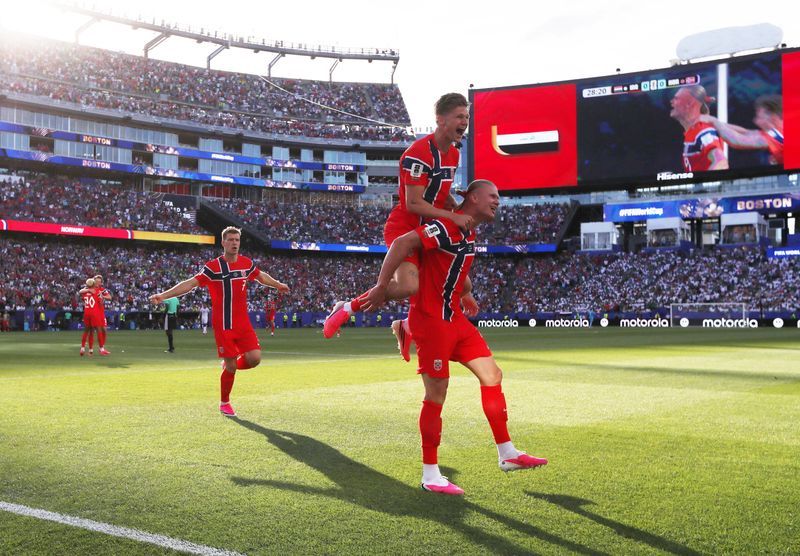
Erling Haaland wasted little time making his presence felt on football's biggest stage, opening his World Cup account with a masterful two-goal performance as Norway decisively dispatched Iraq 4-1 in their tournament opener on Tuesday. The young Norwegian striker's electric first-half display provided the perfect vindication for those who questioned whether his exceptional club form would translate to international competition, though his manager Stale Solbakken had clearly built the team's entire tactical framework around unleashing the lethal forward at every opportunity.
What makes Haaland's contribution particularly remarkable is the pattern of success he has established across the sport's most demanding arenas. His brace in Qatar now extends an astonishing streak: he has scored on his debut appearance in the German Bundesliga, the English Premier League, the Champions League knockout stages, and now the World Cup finals. Few strikers in modern football carry such immediate impact across such varied and competitive environments, a testament to his predatory instincts and physical dominance in the box.
The manner of his goals revealed the different facets of his game that have made him such a prized talent. His opening strike showcased his poaching ability at its finest—a crisp finish from David Moller Wolfe's cross that required only the slightest deflection. His second goal, however, displayed the aggressive pressing that defines his high-intensity approach. Haaland forced a panicked backpass from Iraq's defence with relentless pressure, and when the goalkeeper attempted a rushed clearance, the Norwegian's positioning allowed him to block the ball into the net. It was opportunism born of constant motion and hunger.
Norway's performance, however, was considerably less polished than the scoreline might suggest. The team committed numerous unforced errors and delivered wayward passes throughout the contest, creating the impression of a side still finding its rhythm in tournament football. Captain and playmaker Martin Odegaard, typically the creative fulcrum of Norway's attack, appeared surprisingly subdued in midfield, struggling to impose the controlling influence expected of him. Despite dominating possession at various stages, Norway allowed Iraq genuine opportunities to trouble them, most notably the goal that briefly reduced the deficit to 4-1 through Aymen Hussein.
Yet such deficiencies mattered little with Haaland playing at this level of ruthlessness. Norwegian Prime Minister Jonas Gahr Stoere had noted before the match that individual brilliance must serve the team's collective purpose, and in Haaland, Norway possesses a player of such finishing quality that the entire side's tactical philosophy revolves around creating chances for him. Solbakken's system appears designed with almost singular purpose: provide Haaland service in dangerous areas and allow his predatory instincts to flourish. When the rest of the team functions smoothly, as occurred during stretches of this match, the result is devastating.
The victory assumes additional significance for Norwegian football given the nation's 28-year drought without World Cup participation. Norway's previous appearance at the men's tournament came in 1998, making this return a momentous occasion for the country's football-supporting public. The emotions surrounding the team's comeback to the tournament's main stage—coupled with the performance of such a generational talent in Haaland—create a potent mixture of excitement and expectation across the nation. The striker himself appeared conscious of this responsibility, his demeanor reflecting the weight of national pride he carries.
The result temporarily places Norway atop their group on three points, though France's earlier 3-1 victory over Senegal means the Norwegians lead only on goal difference. This standings position, while advantageous, provides a deceptive sense of comfort given the calibre of opponents still to face. Haaland himself acknowledged the need for substantial improvement from his teammates despite the commanding victory, indicating awareness that Iraq, while respectable, hardly represents the calibre of competition the tournament will ultimately demand.
For Malaysian and Southeast Asian observers, Haaland's arrival at the World Cup stage carries particular relevance given the region's growing interest in elite European football. The striker's trajectory—from Manchester City prospect to continental superstar to now World Cup revelation—encapsulates the modern pathway for talented youngsters in a globalised football landscape. His success also underscores the gap between regional Southeast Asian football and the elite tier, a reality that shapes domestic leagues throughout Malaysia, Thailand, and neighbouring nations where the concentration of wealth and talent in Europe's top divisions remains evident.
Haaland's demeanour throughout the match and in post-match reflections suggested a player fully embracing the magnitude of the moment. His comment that he hoped people back home were celebrating, combined with his acknowledgement that his team had fulfilled expectations by avoiding an embarrassing defeat, indicated both confidence and respect for the tournament's demands. The striker's willingness to speak about the occasion, despite his typically reserved approach with media, suggested this particular stage had penetrated even his measured exterior.
Looking ahead, Norway will attempt to build on this positive start against more formidable opposition, and much will depend on whether Haaland's supporting cast can elevate their performance to match the quality his finishing provides. If they can, Haaland's World Cup campaign has the potential to define an entire tournament. If they cannot, his two-goal debut, however impressive in isolation, may ultimately represent a false dawn in Norway's campaign.

%22%2F%3E%3C%2Fpattern%3E%3C%2Fdefs%3E%3Crect%20width%3D%22100%25%22%20height%3D%22100%25%22%20fill%3D%22url(%23ph40buhg)%22%2F%3E%3Crect%20width%3D%22100%25%22%20height%3D%22100%25%22%20fill%3D%22url(%23ph40buhp)%22%2F%3E%3Ctext%20x%3D%2250%25%22%20y%3D%2250%25%22%20text-anchor%3D%22middle%22%20dominant-baseline%3D%22central%22%20fill%3D%22rgba(255%2C255%2C255%2C0.95)%22%20font-family%3D%22Georgia%2C%20'Times%20New%20Roman'%2C%20serif%22%20font-weight%3D%22700%22%20font-size%3D%22320%22%20letter-spacing%3D%22-0.02em%22%3EGRS%3C%2Ftext%3E%3C%2Fsvg%3E)