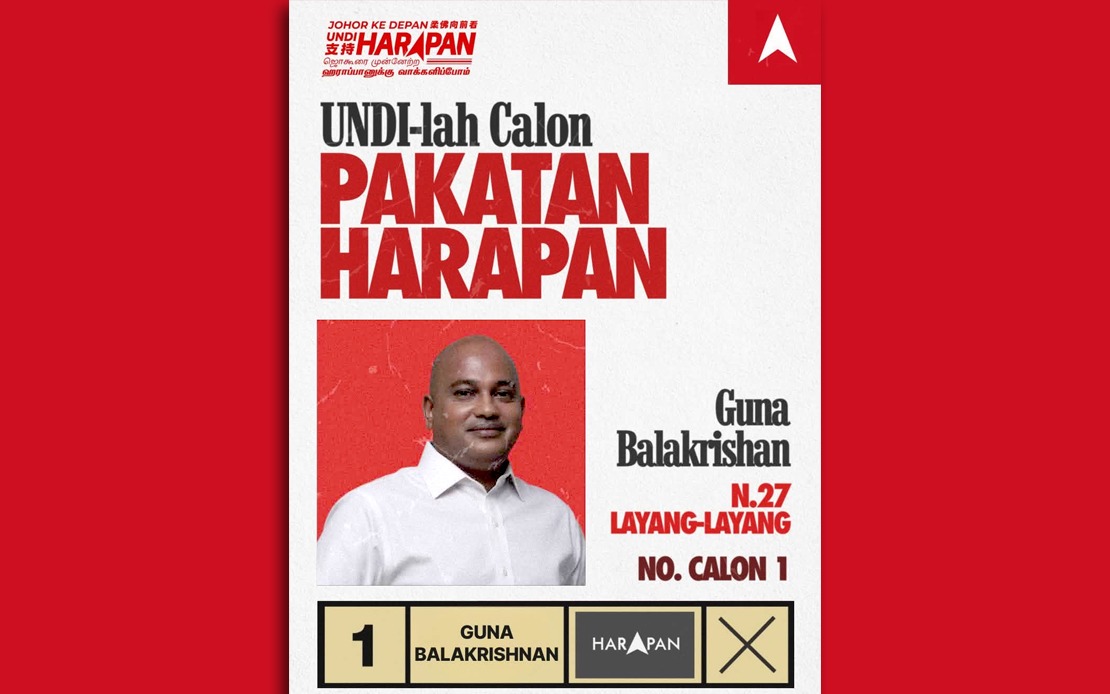
Pakatan Harapan candidate Guna Balakrishnan has unveiled a comprehensive development framework for the Layang-Layang state constituency, positioning himself as a bridge between residents and government machinery in what promises to be a competitive three-way contest during Johor's ongoing state election campaign. The manifesto represents an attempt to address what Guna identifies as persistent infrastructure and welfare gaps affecting the 25,181 registered voters in the constituency, with pledges spanning critical municipal services, youth opportunities, and targeted support for vulnerable populations.
The candidate's platform begins with the perennial challenge facing many Johor communities: recurring flooding. Guna has committed to tackling inundation problems that regularly impact settlements including Kampung Senda, Sungai Sayong, Kampung Tengah Renggam, Ulu Benut, Simpang Renggam and Kampung Chokro. Rather than offering vague promises, his campaign emphasises accelerating flood mitigation infrastructure projects, upgrading drainage systems that have become antiquated in many areas, and instituting proper maintenance schedules for roads and public facilities. This focus reflects the reality that flood management remains a defining issue for rural and semi-urban Johor constituencies, where inadequate drainage often compounds the effects of monsoon seasons and poor land-use planning.
Beyond infrastructure, Guna's manifesto addresses the digital divide that continues to hinder rural development across Malaysia. He proposes expanding internet coverage to remote areas within Layang-Layang, recognising that consistent broadband access has become essential for educational advancement and small-business viability in the post-pandemic economy. Complementing this digital initiative, he has also pledged to improve street lighting across the constituency, a practical measure that enhances both safety and quality of life in communities where public security remains a concern.
Economic empowerment forms another pillar of the PH candidate's platform. Guna has committed to supporting small traders and merchants who form the backbone of the local economy, while simultaneously exploring opportunities to develop Renggam's tourism potential as a revenue-generating sector. This dual approach recognises both the immediate needs of existing small-business operators and the longer-term necessity of diversifying income sources within the constituency. Such strategies align with broader state and national efforts to reduce economic dependency on traditional sectors and create sustainable livelihood alternatives.
Youth development receives particular emphasis in Guna's proposals, reflecting demographic realities in many Johor constituencies where young people often lack adequate training and recreational opportunities. He has pledged to expand access to Technical and Vocational Education and Training (TVET) programmes, addressing skills gaps that have historically made Malaysian youth less competitive in the labour market. Additionally, his proposal to establish a motorsports track within the constituency represents an innovative approach to youth engagement, offering a structured and safer environment for talented individuals interested in motorsport while channelling youthful energy away from less constructive activities.
The manifesto also extends to social welfare provision, with specific attention to women's empowerment and senior citizen wellbeing. Guna has outlined initiatives to strengthen women's entrepreneurship, acknowledging the disproportionate economic vulnerabilities many women face, particularly in rural areas. His proposal to establish a Senior Citizens Activity Centre (PAWE) reflects recognition that Malaysia's ageing population requires not merely passive support but active engagement opportunities that maintain dignity, purpose, and social connection among elderly residents.
Guna has framed these pledges as grounded commitments rather than election rhetoric, emphasising his intention to work collaboratively with the Johor state government, local authorities, and relevant federal agencies to actualise them. This collaborative framing appears designed to address voter skepticism about election promises, a widespread concern in Malaysian constituencies where promised developments frequently fail to materialise after polling day. By positioning himself explicitly as an intermediary between constituents and government structures, Guna is articulating a particular vision of representative democracy focused on accessibility and responsiveness.
The Layang-Layang contest represents a three-way battle, with Guna competing against Barisan Nasional's Chua Jian Boon and incumbent Abd Mutalip Abd Rahim, who represents Perikatan Nasional. This triangular configuration means the election outcome will depend not only on PH's capacity to mobilise its base but also on how the opposition votes split between BN and PN, factors that often prove decisive in close Malaysian electoral contests. The constituent areas Guna has highlighted—predominantly rural settlements scattered across the constituency—suggest a campaign strategy targeting voters concerned with basic municipal services and economic opportunity.
The timing of Guna's campaign outreach, occurring ahead of the July 11 election date with early voting scheduled for July 7, reflects standard campaign pacing in Malaysian state elections. His public manifesto unveiling appears timed to capture media attention and establish his policy credentials before voters make final decisions. For Malaysian political observers, particularly those monitoring Johor's electoral dynamics, this contest offers insights into how opposition parties are positioning themselves in a state where Barisan Nasional traditionally maintains significant electoral advantages, while Perikatan Nasional has emerged as a disruptive force complicating traditional two-coalition contests.
The manifesto's comprehensiveness—addressing everything from flood management to senior citizen welfare—suggests Guna's campaign team has conducted community consultations to identify priority concerns. However, the manifesto's credibility will ultimately depend on his ability to demonstrate both responsiveness to constituent grievances and capacity to deliver within the constraints of state and local government structures. For Layang-Layang voters, the central question will be whether these pledges represent realistic commitments grounded in understanding of fiscal and administrative realities, or aspirational promises that cannot withstand the constraints of actual governance.

