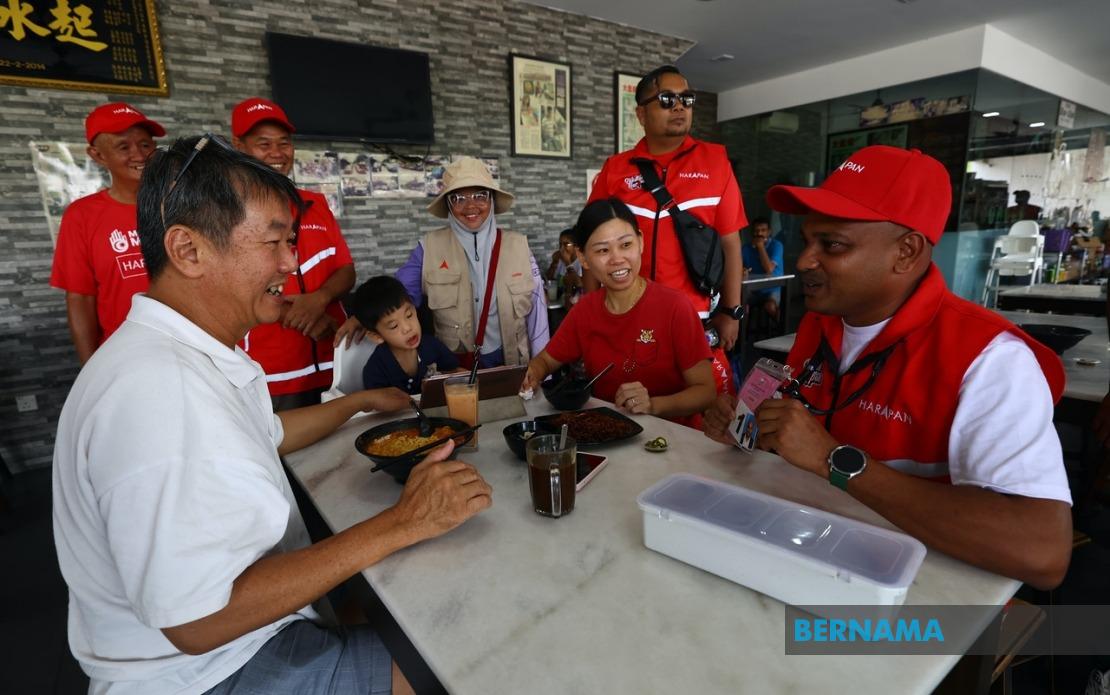
With the Johor state election just days away, Pakatan Harapan's candidate for the Layang-Layang state seat, Guna Balakrishnan, is executing a final intensive push to reach the remainder of the constituency that has eluded his campaign efforts. Speaking at the PH operations centre in Kluang on July 5, Guna revealed that his team had already canvassed approximately 80 per cent of the electorate across the division, and was determined to saturate the final fifth of the constituency before voters head to the polls on July 11.
The scale of this final sprint underscores the competitive nature of the Layang-Layang contest, where every percentage point of voter contact potentially determines the outcome. With 25,181 registered voters in the constituency, the margin of victory could rest on convincing undecided or hard-to-reach pockets of the community. Guna framed his intensified effort in forceful terms, pledging to shift from merely meeting targets to exceeding them, metaphorically raising his commitment from 100 to 200 per cent to ensure no voter remains unpersuaded. This language reflects both the urgency of the final week and the recognition that late-campaign outreach often determines swing voters' choices.
The central challenge Guna identifies transcends mere constituency logistics: convincing Layang-Layang residents that Pakatan Harapan represents genuine change for Malaysia's governance. This messaging strategy positions the local election within the broader national political narrative, appealing to voters who view their ballot as a referendum on alternatives to incumbent power structures. By linking constituency-level representation to macro-level governance transformation, Guna attempts to mobilise voters motivated by systemic reform rather than purely parochial interests.
To translate this governance narrative into concrete appeal, Guna has unveiled a multi-dimensional manifesto addressing practical concerns affecting daily life in the constituency. Infrastructure development features prominently, with pledges to tackle flooding—a recurring hazard in parts of Johor—alongside improvements to road networks and street illumination. These commitments directly address physical vulnerabilities that many rural and semi-rural constituencies experience, where poor drainage and inadequate lighting constrain both safety and economic activity. The emphasis on these basics reflects recognition that development must begin with foundational services before progressing to higher-order aspirations.
Beyond infrastructure, Guna's platform pivots toward human development, acknowledging that contemporary economic prosperity demands investment in skills and capability. His commitment to expanding Technical and Vocational Education and Training opportunities for youth addresses a critical gap in Malaysian education policy, where academic pathways dominate while skilled trades remain undersupplied and undervalued. Similarly, his support for women's entrepreneurship programmes responds to both gender equity imperatives and economic necessity, as women represent underutilised productive capacity in many communities. These initiatives signal recognition that inclusive growth depends on broadening opportunity beyond traditional power holders.
The digital connectivity strand of Guna's manifesto acquires particular salience in a post-pandemic Malaysian context where internet access has become foundational to education, commerce, and social participation. Rural constituencies in Johor, like many areas nationwide, continue experiencing patchy broadband coverage that disadvantages students, small businesses, and job seekers. By elevating this technical issue to manifesto prominence, Guna demonstrates awareness that physical isolation from digital infrastructure translates into economic and social marginalisation. This positioning appeals to aspirational communities seeking integration into national economic networks.
Crucially, Guna's platform extends to senior citizen welfare through his proposal to establish community activity centres, or PAWE. This reflects demographic realities facing Malaysian constituencies, where ageing populations require not merely financial support but social integration and purposeful engagement. The emphasis on inclusive well-being across generational lines—from youth skills development to elder community participation—presents a comprehensive vision of constituency development rather than targeted interventions for particular groups. This holistic framing potentially broadens Guna's appeal across demographic segments.
Local traders and residents interviewed conveyed enthusiastic reception to Guna's campaign messaging and manifesto proposals. Tan Ah Kiat, a 55-year-old trader, explicitly credited Guna with understanding community priorities, particularly flood mitigation and infrastructure enhancement. His endorsement carries weight because traders often function as informal community barometers, their support signalling that local business interests view the candidate as aligned with commercial viability and community stability. Tan's particular emphasis on internet connectivity improvements suggests this issue resonates beyond abstract development goals to tangible business constraints.
Similarly, R. Kalaiselvan's support for Guna's human capital initiatives, especially TVET expansion and women's entrepreneurship, demonstrates that the manifesto successfully bridges aspirational and pragmatic concerns. Kalaiselvan's explicit appreciation for the senior citizen welfare component suggests that comprehensive rather than piecemeal development agendas resonate with voters seeking candidates with long-term constituency vision. His language of "inclusive long-term vision" implies that voters recognise and value political commitment extending beyond electoral cycles.
The Layang-Layang contest unfolds as a three-cornered battle, with Guna facing Barisan Nasional's Chua Jian Boon and incumbent Abd Mutalip Abd Rahim representing Perikatan Nasional. This configuration creates complex voter calculus, as PH must either consolidate reform-oriented voters or persuade supporters of the incumbent to switch allegiances. Early voting on July 7 will provide preliminary indications of engagement levels, while the July 11 ballot determines whether Guna's intensive final week effort successfully converted canvassed voters into actual support.
For Malaysian observers, the Layang-Layang contest exemplifies broader Johor state election dynamics, where federal-level political consolidation among the Malay-Muslim voter base creates uncertainty despite apparent power structures. Pakatan Harapan's performance in constituencies like Layang-Layang will indicate whether the coalition has stabilised its support following the 2022 federal election transition or continues facing erosion. Regional readers across Southeast Asia may also note how Malaysian elections increasingly reflect global patterns of centrist coalition-building against nationalist-oriented alternatives, suggesting ideological realignment transcending traditional communal politics.

