The Malaysian government is deepening its commitment to small business development through a series of ground-level initiatives designed to help micro, small and medium enterprises capture opportunities in the country's expanding wholesale and retail markets. Speaking in Nibong Tebal, Minister Steven Sim Chee Keong outlined plans for the Ministry of Entrepreneur and Cooperatives Development (KUSKOP) to deploy multiple support programmes targeting both individual entrepreneurs and cooperative organisations seeking to expand their footprint in one of Malaysia's most dynamic economic sectors.
Data from the Department of Statistics Malaysia reveals the scale of opportunity available. The wholesale and retail trade sector generated sales valued at nearly RM175 billion in April 2026, representing a year-on-year increase of 15.3 per cent. This sustained growth trajectory reflects robust consumer demand within the domestic economy, driven by policy efforts to manage living costs, stabilise commodity pricing, and enhance household purchasing power. The sector's resilience offers a compelling platform for smaller players to scale operations and reach broader customer bases.
Minister Sim, who also represents Bukit Mertajam as a Member of Parliament, attributed the sector's growth to coordinated action between government agencies and private sector stakeholders. The government has pursued a dual-track approach: supporting the macroeconomic environment while simultaneously creating pathways for grassroots entrepreneurs to participate in prosperity-generation. Recent government initiatives addressing cost-of-living concerns and wage improvements have buttressed consumer confidence, which in turn sustains demand across retail and wholesale channels.
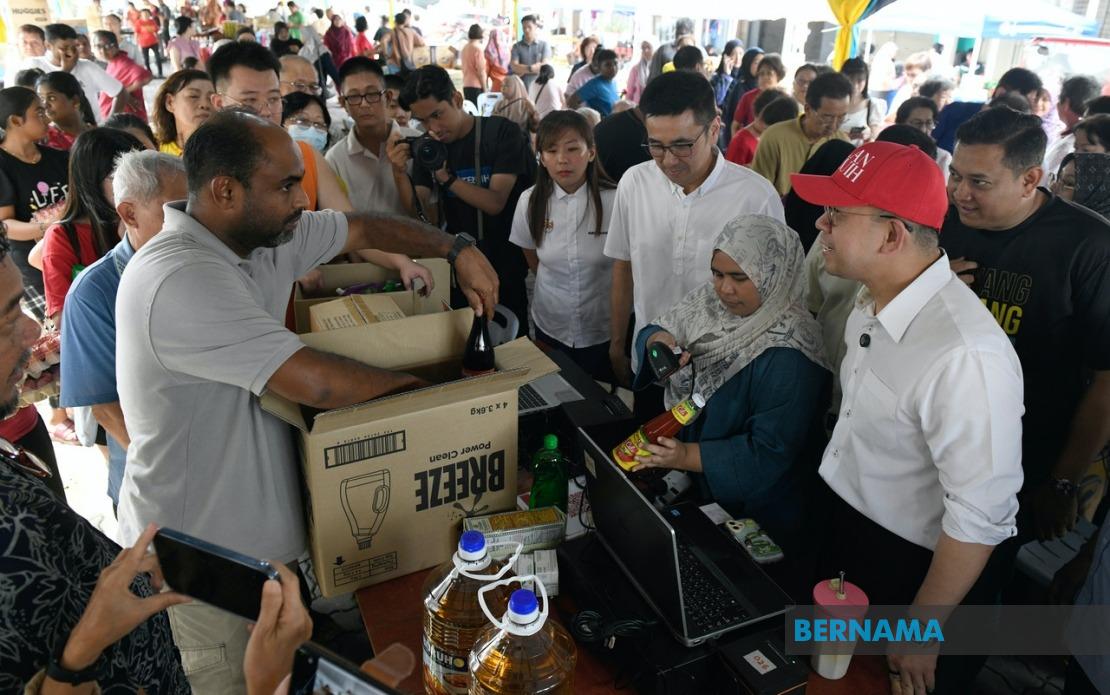
The Jualan MADANI KUSKOP programme, launched during the Jawi state constituency event, exemplifies this community-focused strategy. By bringing government support directly to local areas rather than concentrating resources in federal centres, KUSKOP aims to ensure that small entrepreneurs understand available assistance and can access it without navigating complex bureaucratic pathways. This ground-level engagement model recognises that many MSMEs lack sophisticated market intelligence or government liaison capacity, and therefore benefit from direct outreach.
Malaysia's position as an open economy exposes domestic businesses to international headwinds. Global trade tensions, protectionist tariff regimes, and geopolitical instability create uncertainty that ripples through supply chains and consumer markets worldwide. Despite these external pressures, Malaysia has maintained economic growth momentum, a testament to diversified trading relationships and domestic demand resilience. However, this favourable position cannot be taken for granted—smaller businesses in particular face vulnerability to exchange rate fluctuations, imported input cost volatility, and shifts in regional trade flows.
The strategic imperative driving KUSKOP's expanded activity reflects recognition that MSMEs and cooperatives constitute the backbone of Malaysia's grassroots economy. These enterprises generate employment, circulate spending through local communities, and maintain economic activity in regions beyond major metropolitan centres. When small businesses thrive, multiplier effects distribute economic benefits throughout supply chains and consumer networks. Conversely, when MSMEs struggle, the impact extends far beyond individual business failures, affecting workers, suppliers, and local communities dependent on their spending.
Cooperative structures offer particular advantages for small-scale operators seeking to pool resources, share infrastructure costs, and negotiate collectively with suppliers. By strengthening cooperative frameworks and providing technical assistance, KUSKOP enables entrepreneurs to achieve economies of scale that would be unattainable individually. This approach aligns with successful models elsewhere in Southeast Asia, where cooperative networks have lifted entire sectors and communities.
The government's stated commitment to ensuring that economic growth benefits reach local entrepreneurs represents a deliberate policy choice to distribute prosperity more broadly rather than concentrating gains among large corporations. This populist-tinged approach serves both equity and stability objectives: widely-shared growth reduces social tension and political discontent, while concentrated wealth accumulation can foster grievance and undermine social cohesion. For policymakers, supporting MSME expansion addresses these concerns simultaneously.
The retail and wholesale sector's expansion creates concrete opportunities for entrepreneurs willing to invest effort in market development. Growth provides openings for new entrants, margin improvement for existing operators, and expansion prospects for those ready to scale. The challenge for government programmes lies in translating sectoral opportunity into individual business success. This requires not merely capital provision but also training, mentorship, market intelligence, supply chain connectivity, and access to technology platforms that modern retail increasingly demands.
Government support must therefore extend beyond simple financing schemes. Businesses operating in modern retail face competition from e-commerce platforms, changing consumer preferences, and increasingly sophisticated logistics demands. KUSKOP programmes addressing these dimensions—digital literacy, omnichannel sales capabilities, logistics optimisation—will prove more impactful than traditional grant or loan schemes alone. The ministry's engagement with cooperatives and local entrepreneurs suggests awareness of these complexities, though programme execution details remain important for assessing genuine impact.
Regional context adds urgency to Malaysia's MSME support agenda. Neighbouring economies are similarly expanding retail and wholesale infrastructure, potentially drawing Malaysian consumers and entrepreneurs toward cross-border opportunities. Simultaneously, regional supply chain integration means Malaysian small businesses can access larger markets by building competitive export capabilities. Government support programmes that enhance competitiveness and facilitate regional integration will position Malaysian entrepreneurs advantageously within Southeast Asia's expanding economic integration.
As Malaysia navigates the balance between open economy exposure and domestic enterprise protection, KUSKOP's grassroots initiatives represent a pragmatic middle path. Rather than imposing protectionist barriers that invite retaliation and efficiency losses, the government is equipping domestic businesses with capacity to compete effectively. This approach acknowledges that long-term prosperity depends on Malaysian enterprises being productive and competitive, not sheltered from challenge.

