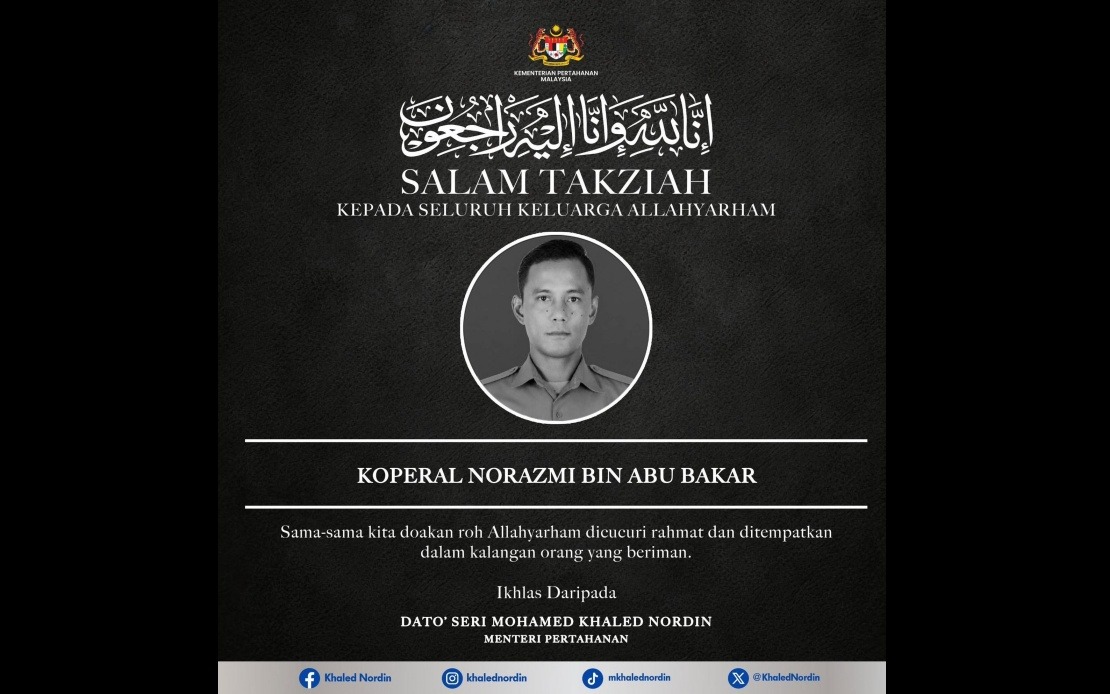
The Malaysian government and Defence Ministry have extended their sympathies to the relatives of Corporal Norazmi Abu Bakar and Private Siti Khadijah Sungip following their deaths in a training incident at Hobart Camp firing range in Gurun, Kedah on June 16. Both servicemembers were fatally injured during a grenade-throwing exercise and succumbed to their injuries while being transported to medical facilities.
Defence Minister Datuk Seri Mohamed Khaled Nordin released a statement expressing profound grief over the loss of the two military personnel. The minister conveyed the government's deepest condolences to the bereaved families, requesting that they be granted courage and fortitude during this difficult period. In his public remarks, Nordin emphasised the shared sense of loss felt across the defence establishment and the broader Malaysian administration.
According to official confirmation from the Malaysian Army, the tragic incident occurred at approximately 10.57 am during a routine training activity. Corporal Norazmi was attached to the 6th Battalion, Royal Malay Regiment, while Private Siti Khadijah served with the 1st Squadron, Royal Army Engineers Regiment. Both personnel sustained critical injuries from the blast and were immediately evacuated for emergency medical treatment.
Despite rapid response efforts, the two servicemembers died during transit to Sultan Abdul Halim Hospital in Sungai Petani, a major regional medical centre. The loss represents a significant tragedy within Malaysia's armed forces and underscores the inherent risks associated with military training operations, particularly those involving explosive devices and munitions.
Army Chief General Tan Sri Azhan Md Othman has mandated a comprehensive investigation into the circumstances surrounding the blast. This examination will aim to identify the specific factors that led to the explosion and determine whether procedural, equipment, or operational issues contributed to the incident. Such investigations are standard protocol following fatal training accidents in military organisations, serving both to honour the deceased and to prevent similar tragedies.
Grenade-throwing exercises are fundamental components of infantry training programmes across armed forces worldwide, designed to equip soldiers with essential combat skills. However, these activities inherently involve substantial risk, as servicemembers handle live explosives under controlled conditions. The incident at Hobart Camp highlights the challenging balance military institutions must maintain between operational readiness and personnel safety.
Defence Minister Nordin's statement included religious prayers for the deceased, reflecting Malaysia's Muslim-majority cultural context. He invoked Islamic teachings, requesting divine mercy upon the souls of both Corporal Norazmi and Private Siti Khadijah and expressing hope for their acceptance as faithful servants. This spiritual dimension of the official response resonates deeply within Malaysian society and demonstrates respect for the sacrifices made by military personnel.
The deaths of these two service members carry particular significance as they represent the frontline risks inherent in military service. Families of military personnel accept considerable emotional and psychological burden in supporting their loved ones' careers, and such tragedies underscore the profound costs of defending the nation. The government's formal expression of condolences acknowledges both the personal loss experienced by the families and the broader impact on military morale and institutional culture.
Gurun in Kedah hosts significant military training facilities, including the Hobart Camp firing range, which serves as a crucial venue for munitions training and weapons qualification across Malaysia's defence force. The presence of such facilities in the region reflects the strategic importance of northern Peninsular Malaysia in the country's overall defence infrastructure. The incident may prompt reviews of safety protocols and training procedures at this and other similar installations across the armed forces.
The Malaysian Army's immediate confirmation of the victims' identities and circumstances reflects the military's commitment to transparency during crises. Prompt official communication helps prevent speculation and misinformation while demonstrating institutional responsibility. This approach supports public confidence in the armed forces' ability to manage serious incidents professionally and with appropriate gravity.
As investigations proceed, the broader defence community will likely examine whether current safety measures, supervision ratios, and emergency response procedures at training ranges are adequate. Grenade training accidents, while statistically uncommon given the volume of exercises conducted annually, require thorough analysis to identify preventive measures. Findings may result in revised protocols, enhanced safety equipment, or modified training approaches intended to further reduce risks without compromising training effectiveness.
The incident serves as a sobering reminder of the genuine hazards military personnel face during their service. Beyond the immediate loss experienced by the families of Corporal Norazmi and Private Siti Khadijah, the tragedy affects their comrades, unit cohesion, and the morale of the broader military establishment. In expressing condolences, government and Defence Ministry officials acknowledged not only individual loss but also the collective sacrifice that characterises military service in Malaysia.

%22%2F%3E%3C%2Fpattern%3E%3C%2Fdefs%3E%3Crect%20width%3D%22100%25%22%20height%3D%22100%25%22%20fill%3D%22url(%23ph40buhg)%22%2F%3E%3Crect%20width%3D%22100%25%22%20height%3D%22100%25%22%20fill%3D%22url(%23ph40buhp)%22%2F%3E%3Ctext%20x%3D%2250%25%22%20y%3D%2250%25%22%20text-anchor%3D%22middle%22%20dominant-baseline%3D%22central%22%20fill%3D%22rgba(255%2C255%2C255%2C0.95)%22%20font-family%3D%22Georgia%2C%20'Times%20New%20Roman'%2C%20serif%22%20font-weight%3D%22700%22%20font-size%3D%22320%22%20letter-spacing%3D%22-0.02em%22%3EGRS%3C%2Ftext%3E%3C%2Fsvg%3E)