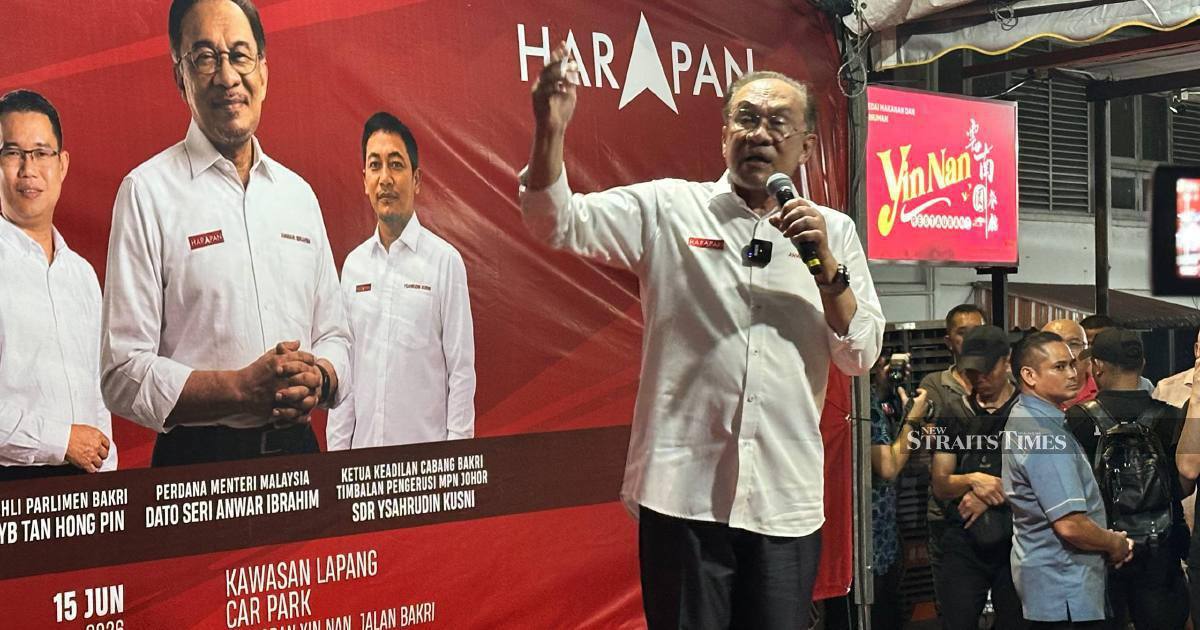
Prime Minister Datuk Seri Anwar Ibrahim has reaffirmed Malaysia's capacity to build and sustain productive relationships with global superpowers while simultaneously defending its core principles in international affairs. Speaking in Muar, Anwar rejected the notion that strengthening diplomatic and economic ties with influential nations such as China and the United States necessitates compromising Malaysia's independent voice on matters of regional and global importance. His statement underscores the delicate balancing act that Malaysia—positioned as a middle power in Southeast Asia—must navigate amid great-power competition.
The Prime Minister's remarks address a persistent concern among observers of Malaysian foreign policy: whether pragmatic economic engagement with the United States and China comes at the cost of Malaysia's autonomy in international diplomacy. This tension has become increasingly acute as both Washington and Beijing compete for influence across Southeast Asia, with smaller nations often caught between competing strategic interests. Anwar's position suggests that Malaysia intends to benefit from relationships with both powers without being coerced into choosing sides in broader geopolitical rivalries. The assertion reflects Malaysia's traditional non-aligned foreign policy doctrine, which has guided the nation since independence.
Malaysia's economy depends heavily on trade relationships spanning multiple regions and ideological blocs. China remains among Malaysia's largest trading partners and investors, particularly in infrastructure and manufacturing sectors. Simultaneously, the United States represents a critical security partner and source of technological innovation for Malaysian businesses. Rather than viewing these relationships as mutually exclusive, Anwar's comments frame them as complementary interests that can be pursued without sacrificing Malaysia's independent judgment on geopolitical issues. This approach allows Malaysia to tap economic opportunities from both directions whilst maintaining room for manoeuvre in its foreign policy decisions.
The statement also carries significance for regional stability in Southeast Asia. Malaysia's role as a founding member of the Association of Southeast Asian Nations (ASEAN) and a nation with territorial interests in disputed waters gives it particular stakes in maintaining strategic autonomy. Issues including maritime disputes in the South China Sea and ASEAN's centrality in regional architecture require Malaysia to speak with consistency and credibility. If major powers perceived Malaysia as subordinate to their interests, the nation's influence within ASEAN and broader diplomatic circles would diminish considerably. Anwar's reassurance that Malaysia preserves independent judgment thus reinforces the country's standing within regional institutions.
Recent developments have intensified scrutiny of Malaysian foreign policy alignment. The previous government under Datuk Seri Ismail Sabri received criticism from some quarters for perceived tilt towards China, whilst others questioned whether sufficient attention was paid to strategic partnerships with Western nations and allies. Anwar's emphasis on balanced relationships suggests the current administration seeks to reset expectations: Malaysia will engage pragmatically with all major powers whilst maintaining principled positions on issues such as human rights, sovereignty, and international law. This recalibration may appeal to constituencies within Malaysia concerned about dependence on any single power bloc.
The Malaysian business community particularly benefits from Anwar's framing of multi-directional engagement. Companies operating across geographies need predictability and consistency in Malaysia's foreign policy environment. If Malaysia were perceived as simply gravitating toward one power's orbit, businesses might face complicated compliance or reputational challenges in their international operations. A nation that explicitly preserves independent judgment whilst maintaining strong ties across regions provides a more stable foundation for commerce and investment.
International observers—particularly in Washington and Beijing—will note Anwar's insistence on principle-based independence. The language serves diplomatic purposes for multiple audiences: reassuring ASEAN neighbours of Malaysia's commitment to regional solidarity, signalling to powerful nations that whilst Malaysia welcomes partnership, it cannot be taken for granted or instrumentalised, and domestrating to the Malaysian public that their government safeguards national sovereignty. This multi-layered messaging is characteristic of sophisticated middle-power diplomacy.
The timing of Anwar's remarks reflects Malaysia's broader efforts to strengthen diplomatic credentials following a period of considerable domestic political turbulence. After years of contested elections and coalition transitions, the government seeks to project stability and strategic clarity. Affirming commitment to principled foreign policy whilst maintaining functional relationships with major powers constitutes part of this stabilisation effort. It demonstrates to both domestic and international audiences that Malaysian leadership possesses the strategic acumen to navigate complex geopolitical terrain.
Looking forward, Malaysia's actual adherence to these principles will determine their credibility. Future votes in international forums, statements on sensitive geopolitical issues, and decisions about regional partnerships will reveal whether Anwar's assertion of independence translates into consistent practice. Southeast Asian nations, having watched how various governments in the region balance external pressures, will scrutinise whether Malaysia demonstrates genuine autonomy or whether rhetorical commitments to principle eventually subordinate to other pressures. For Malaysia to sustain its stated position, the government must demonstrate willingness to occasionally take positions that inconvenience major powers when national interests or regional solidarity require it.

%22%2F%3E%3C%2Fpattern%3E%3C%2Fdefs%3E%3Crect%20width%3D%22100%25%22%20height%3D%22100%25%22%20fill%3D%22url(%23ph40buhg)%22%2F%3E%3Crect%20width%3D%22100%25%22%20height%3D%22100%25%22%20fill%3D%22url(%23ph40buhp)%22%2F%3E%3Ctext%20x%3D%2250%25%22%20y%3D%2250%25%22%20text-anchor%3D%22middle%22%20dominant-baseline%3D%22central%22%20fill%3D%22rgba(255%2C255%2C255%2C0.95)%22%20font-family%3D%22Georgia%2C%20'Times%20New%20Roman'%2C%20serif%22%20font-weight%3D%22700%22%20font-size%3D%22320%22%20letter-spacing%3D%22-0.02em%22%3EGRS%3C%2Ftext%3E%3C%2Fsvg%3E)