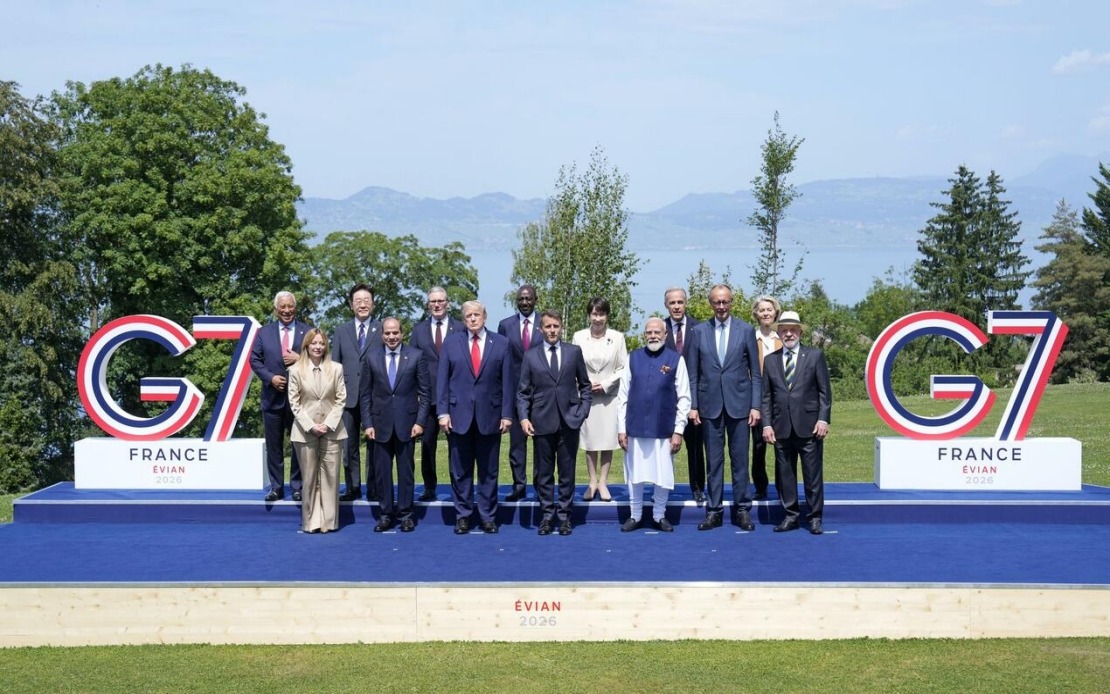
The world's leading industrial democracies have reaffirmed their commitment to Ukraine's defence and reconstruction during their annual gathering in the French Alpine resort of Evian-les-Bains, signalling that geopolitical divisions have not fundamentally fractured their response to Russia's ongoing aggression. At the lakeside summit near the Swiss border, leaders from Britain, Canada, France, Germany, Italy, Japan, and the United States, alongside representatives from the European Union, endorsed a collaborative approach to achieving what they termed a "just and lasting peace" while maintaining diplomatic and economic pressure on Moscow. The consensus emerged despite well-documented tensions between the Trump administration and its European counterparts on matters ranging from trade arrangements and NATO funding obligations to territorial ambitions regarding Greenland and broader Middle Eastern conflicts.
President Trump distinguished his diplomatic approach by publicly urging Russia to negotiate an end to the conflict that has now stretched across more than two years since Moscow's full-scale invasion commenced in February 2022. In remarks to journalists, Trump acknowledged the staggering human cost borne by both Russia and Ukraine, framing negotiation not as weakness but as pragmatic recognition of military realities on the ground. The American president suggested that a settlement would provide the foundation for reconsidering the sanctions relief measures that Washington had previously implemented in response to developments in the Middle East, particularly following what Trump characterized as a completed military engagement with Iran. This conditional approach to sanctions implied that the Trump administration views economic leverage as a tool that could incentivize Russian movement toward the negotiating table.
The diplomatic focus on Ukraine occurred against the backdrop of Trump's broader claim that his administration had resolved the Iranian conflict and secured the reopening of the Strait of Hormuz, a critical maritime chokepoint through which roughly one-third of globally traded oil transits. Trump suggested that with oil now flowing and immediate regional tensions seemingly diminished, his government could pivot toward resolving the Ukrainian situation with comparable energy and urgency. This framing of sequential diplomatic victories reflects the Trump administration's strategy of presenting its foreign policy interventions as problem-solving exercises amenable to rapid resolution through direct negotiation and the threat or removal of economic penalties.
Ukrainian President Volodymyr Zelenskyy participated directly in the summit's discussions, providing first-hand perspective on his country's current defence requirements and strategic objectives. In public statements through social media, Zelenskyy underscored the dual focus of his engagement with G7 members: strengthening Ukraine's air defence capabilities against relentless Russian missile and drone attacks, while simultaneously advancing diplomatic channels that might convince Russia to cease hostilities. His emphasis on air defence reflects the intensifying Russian strategy of targeting Ukraine's electrical infrastructure and civilian populations through aerial bombardment, making anti-aircraft systems among the most urgently needed military supplies from Western sources.
Japanese Prime Minister Sanae Takaichi emerged as a particularly vocal advocate for maintaining G7 unity on Ukraine, warning against any unilateral attempts to alter existing borders through military force. Her statements carried particular significance given Japan's own concerns about territorial integrity in relation to Chinese expansionism in the Pacific region. Takaichi specifically highlighted the deepening military cooperation between Russia and China as well as the reported military alignment between Russia and North Korea, suggesting that Western responses to Russian aggression must account for these broader geopolitical alignments that threaten multiple regions simultaneously. Her framing presented the Ukrainian conflict not as an isolated European concern but as part of a larger pattern of authoritarian powers challenging the international order that underpins regional stability across Asia and beyond.
The inclusion of non-G7 nations at this year's summit reflected France's rotating presidency and its strategic decision to broaden the conversation beyond traditional industrial democracies. Leaders from Brazil, Egypt, India, Qatar, South Korea, and the United Arab Emirates participated in selected sessions, particularly those addressing development finance and Middle Eastern stability. This expansion of the discussion forum acknowledged the reality that contemporary geopolitical challenges require input from rising powers and nations with significant regional influence, while also attempting to build broader coalitions supporting the G7's preferred approaches to international order.
A substantive session focused specifically on the Middle East included delegations from Egypt, Qatar, and the UAE alongside the G7 membership, reflecting heightened international engagement with the Iranian conflict that Trump had referenced. The group welcomed preliminary agreements to cease hostilities and restore navigation rights through the Strait of Hormuz, viewing these developments as steps toward the broader stability that would benefit all maritime trading nations. The emphasis on securing free navigation reflected concerns that regional conflicts could disrupt global energy supplies and maritime commerce, threatening economic interests that extended far beyond the immediately involved parties.
Beyond security matters, the G7 addressed what France had positioned as a fundamental reform of international development cooperation. France's presidency emphasized that traditional development assistance programmes, while valuable, had proven insufficient for meeting the evolving needs of lower-income nations, particularly given the scale of infrastructure requirements and climate transition challenges facing developing economies. The group outlined a commitment to establishing mutually beneficial partnerships that incorporated private sector capital mobilization alongside traditional governmental assistance, reflecting a recognition that public resources alone could not finance the long-term development and infrastructure projects necessary for inclusive global growth.
The joint declaration released by the G7 emphasized the principle of win-win partnerships that would serve both the strategic interests of developed nations and the genuine development needs of partner countries, attempting to frame development finance as a matter of reciprocal benefit rather than unidirectional charity. This framing acknowledged growing scrutiny of development assistance programmes from both donor and recipient perspectives, with concerns that traditional aid sometimes perpetuated dependency relationships or served donor interests rather than recipient development priorities. The G7's commitment to mobilizing private capital and creating partnerships predicated on mutual advantage represented an attempt to evolve development cooperation models for a more multipolar world where recipient nations possessed greater bargaining power and had alternative sources of capital and partnership.
For Southeast Asian nations observing these proceedings, the summit outcomes carried several implications. The continued Western commitment to supporting Ukraine against Russian aggression offered a template for how developed democracies respond to territorial invasion, with potential relevance to regional concerns about Chinese military expansion. The emphasis on maintaining unity among democratic powers while integrating voices from rising economies suggested that future international governance might increasingly require consensus-building among a broader array of stakeholders. Additionally, the focus on reforming development finance to create more mutually beneficial arrangements held direct consequences for Southeast Asian countries that sought to attract development capital and partnership, as the G7 framework would likely influence how major developed economies approached engagement in the region.
The three-day summit demonstrated that despite genuine disagreements between the Trump administration and European governments on numerous issues, foundational commitments to Ukraine's sovereignty and the principle of territorial integrity remained sufficiently robust to generate continued consensus. This suggests that the disagreements, while real and consequential, had not extended to fundamental principles regarding international order, even as the means of advancing those principles—and the pace at which various powers prioritized different challenges—continued to diverge across the G7 membership.

%22%2F%3E%3C%2Fpattern%3E%3C%2Fdefs%3E%3Crect%20width%3D%22100%25%22%20height%3D%22100%25%22%20fill%3D%22url(%23ph40buhg)%22%2F%3E%3Crect%20width%3D%22100%25%22%20height%3D%22100%25%22%20fill%3D%22url(%23ph40buhp)%22%2F%3E%3Ctext%20x%3D%2250%25%22%20y%3D%2250%25%22%20text-anchor%3D%22middle%22%20dominant-baseline%3D%22central%22%20fill%3D%22rgba(255%2C255%2C255%2C0.95)%22%20font-family%3D%22Georgia%2C%20'Times%20New%20Roman'%2C%20serif%22%20font-weight%3D%22700%22%20font-size%3D%22320%22%20letter-spacing%3D%22-0.02em%22%3EGRS%3C%2Ftext%3E%3C%2Fsvg%3E)