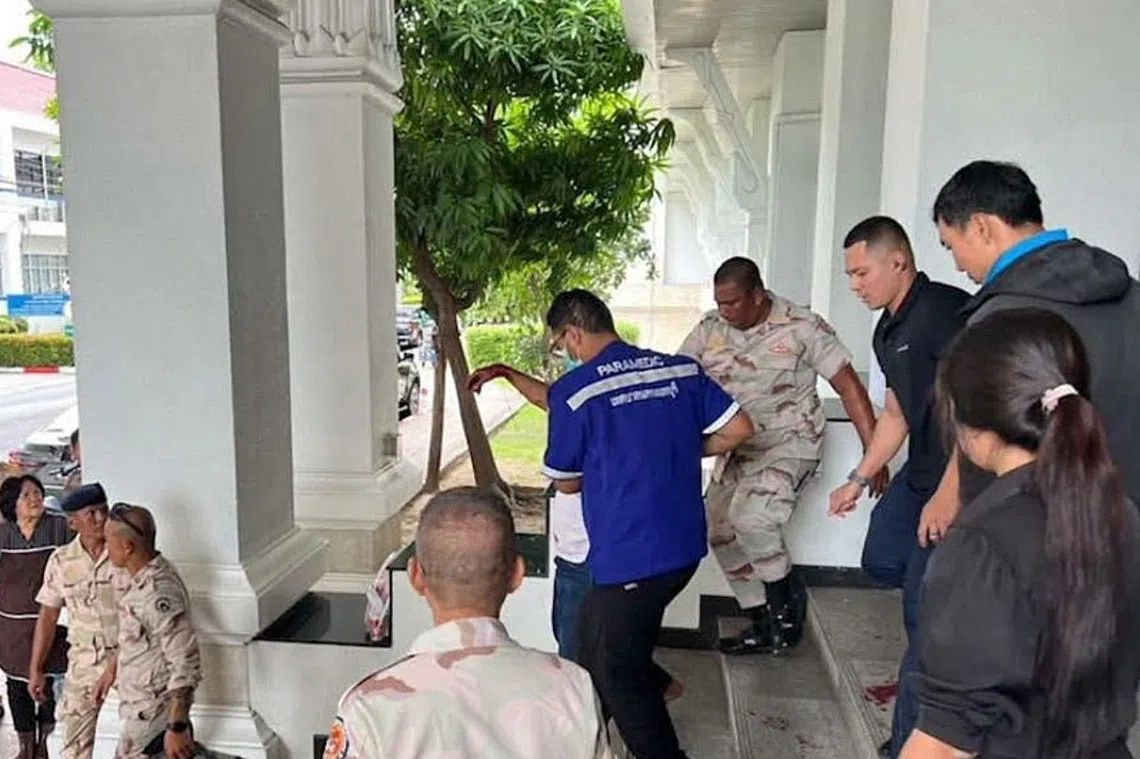
Thailand's fragile attempt to process one of its worst mass shooting tragedies in recent memory was disrupted Monday when gunfire erupted inside a government office on Bangkok's periphery, underscoring the persistence of armed violence in the Southeast Asian nation. Police swiftly apprehended the suspected shooter, identified as a former lawmaker, who had discharged his weapon at a senior provincial administrator and the official's driver at the local government facility. The incident left two people wounded and hospitalized, according to Major General Dejrapee Kongdee, the provincial police commander who provided initial details to international media outlets.
This fresh outbreak of gun violence arrives just 72 hours after Thailand witnessed what officials have characterised as the country's deadliest mass shooting incident in nearly four years. On Friday, a 14-year-old boy allegedly murdered his grandparents before proceeding to Debsirin Nonthaburi School, where he engaged in an indiscriminate killing spree that claimed nine lives and wounded more than twenty others. The teenager subsequently turned the weapon on himself, ending the rampage at the educational facility located within the same province where Monday's shooting took place. The proximity of these two violent incidents—both geographically and temporally—has intensified national focus on Thailand's approach to firearm accessibility and regulation.
The back-to-back shootings have thrust gun control into the centre of public and political discourse at a critical juncture. Prime Minister Anutin Charnvirakul has reiterated his government's commitment to implementing stricter regulations governing firearm ownership and use, signalling that the administration views these incidents as symptomatic of deeper systemic failures in weapons management. The stated intention to tighten controls reflects growing public anxiety about the apparent ease with which weapons have been deployed in recent violence, raising questions about how previous screening mechanisms and safeguards functioned in the cases of both shooters.
The immediate aftermath of Friday's school shooting saw Thai educational institutions implement enhanced security protocols aimed at preventing similar incidents. On Monday, as students returned to classrooms, numerous schools deployed metal detectors at entrances and conducted additional security checks, demonstrating the extent to which the nation's schools have been forced to recalibrate their operational procedures in response to the threat of armed attack. These security measures represent a significant shift in the daily reality of Thai education, introducing visible signs of defensive infrastructure into environments traditionally associated with learning and relative safety.
The shooting at Debsirin Nonthaburi School has prompted serious examination of how a young teenager obtained access to firearms and ammunition capable of causing such devastating casualties. Thailand's existing gun regulations require licensing and background checks, yet both the juvenile perpetrator of Friday's attack and the adult suspected in Monday's incident apparently circumvented or failed such screening processes. This discrepancy between regulatory requirements and operational reality has prompted security analysts to question whether implementation of existing laws has been inadequate or whether the legislative framework itself contains sufficient loopholes to enable dangerous individuals to acquire weapons.
International observers have noted that mass shooting incidents in Thailand occur within a context of broader regional challenges related to firearms regulation and enforcement. Unlike several neighbouring nations with more stringent weapons restrictions, Thailand maintains a licensing system that permits civilian gun ownership under defined circumstances. The two consecutive incidents suggest that authorities must undertake comprehensive examination of how licensing decisions are made, whether proper enforcement mechanisms exist to prevent misuse, and whether psychological evaluations or other safeguards adequately screen out potentially dangerous individuals before firearms are issued.
The involvement of a former lawmaker in Monday's shooting adds a dimension of political sensitivity to the unfolding situation. Former legislators often maintain networks and social standing that may facilitate access to firearms through legal or semi-legal channels, and the fact that an individual with apparent political background engaged in armed violence may amplify public concern about whether privileged individuals face less rigorous scrutiny during firearm licensing processes. This element introduces questions about equitable application of gun control measures across different socioeconomic and political strata of Thai society.
For Malaysia and other Southeast Asian nations observing Thailand's situation, these incidents serve as cautionary examples regarding the potential consequences of insufficiently regulated firearm markets. Malaysia's own strict gun control framework has contributed to relatively low rates of gun violence compared to international norms, and Thai authorities may find that studying Malaysia's licensing requirements, background check procedures, and enforcement mechanisms offers valuable lessons. The contrast between Malaysia's restrictive approach and Thailand's more permissive system illustrates how policy choices in one nation can create demonstrably different public safety outcomes across the region.
The Prime Minister's public commitment to tightening gun controls suggests that Thailand's government recognises the urgency of legislative action rather than incremental administrative adjustments. However, translating political commitment into effective policy requires navigating potential resistance from firearm owners, gun clubs, and hunting advocates who may argue that civilian access to weapons should not be severely curtailed. The government will likely face pressure to design regulations that address genuine public safety concerns while respecting legitimate uses of firearms, a balancing act that has proven difficult in many nations attempting to reform gun policies.
Looking forward, the twin shooting incidents of recent days will almost certainly catalyse broader national conversation about Thailand's relationship with armed violence and civilian weapons ownership. Security experts will likely recommend comprehensive review of how background checks are conducted, what psychological or behavioural factors should disqualify individuals from firearm ownership, and whether certain categories of weapons—particularly those designed for high-volume ammunition discharge—should be restricted or prohibited entirely. Educational institutions will continue implementing security measures while advocates and policymakers debate whether such defensive measures represent an appropriate long-term solution or merely symptomatic treatment of deeper regulatory failures.

