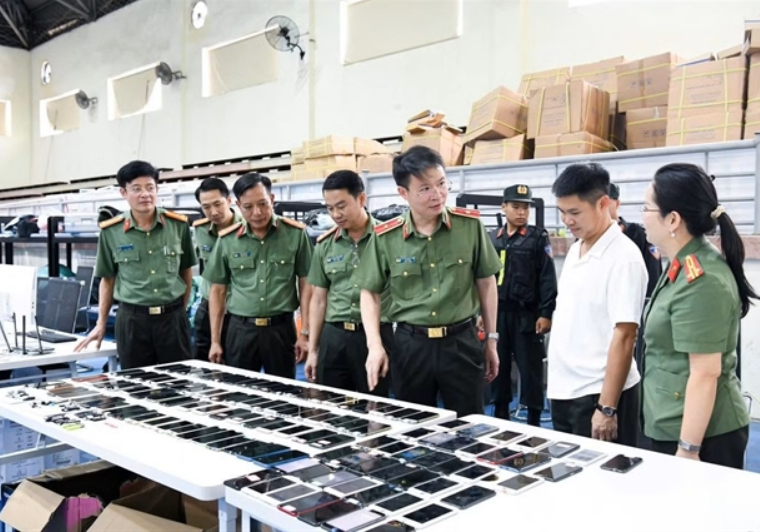
Police in Vietnam's northern Phu Tho province have charged four individuals in connection with an alleged conspiracy to transplant a Cambodia-based online fraud enterprise into Vietnamese territory, marking another escalation in the region's fight against transnational cybercrime rings. The investigation revealed a sophisticated attempt by foreign-operated scam syndicates to circumvent intensifying enforcement actions by exploiting the porous borders and logistical advantages of mainland Southeast Asia.
The operation came to light after investigators detected a coordinated group with documented links to Chinese-run fraudulent call centres operating across the Cambodian border. Intelligence suggested the network was actively preparing to shift its entire infrastructure and personnel into Vietnam to escape heightened regulatory pressure and police operations in Cambodia. This relocation strategy reflects a broader trend among organised crime groups that target vulnerable populations across Asia through voice-call impersonation schemes, romantic deception scams, and investment frauds conducted from fortified compounds.
At the centre of the conspiracy stood Zhao Wei Zhong, a 37-year-old Chinese national tasked with establishing the logistical groundwork for the operation's northern Vietnamese foothold. According to police, Zhao entered Vietnam under explicit instructions from an offshore associate, with his mission being to secure residential properties and arrange infrastructure capable of accommodating the anticipated arrival of foreign personnel from Cambodia. His prior experience managing similar criminal enterprises in Cambodia had equipped him with the operational knowledge necessary to replicate such schemes elsewhere.
Having previously worked within Chinese-controlled scam networks in Cambodia, Zhao leveraged existing relationships to recruit local assistance. He engaged two Vietnamese collaborators: Tran Thi Thu Huong, 24, and Đinh Nam, 27, both from Bac Ninh province in the north. Their role was decidedly practical—providing translation services, securing transportation, and identifying suitable locations across the Vietnamese landscape where foreign operatives could be housed and concealed from authorities while they conducted their illicit activities.
The conspiracy extended beyond Zhao's immediate network. Investigators identified Nguyen Thanh Long, a 43-year-old Hanoi resident, as having supplied essential logistical support, likely coordinating accommodation arrangements, financial transfers, and other operational necessities that would enable the scam centre to function seamlessly upon activation. The interconnected roles demonstrate how modern transnational crime operates through compartmentalised networks where individuals specialise in particular functions—recruitment, logistics, financial management, and operational security.
Vietnamese police moved with deliberation before the plot could mature into operational reality. Officers conducted extensive evidence gathering that ultimately revealed the scope and sophistication of the transfer scheme. The investigation successfully identified all key participants and their respective contributions before the influx of foreign workers from Cambodia could begin, effectively strangling the operation in its nascent stage before it could cause substantial harm to Vietnamese citizens and regional populations.
Charges were formally filed on June 17 against three of the four suspects. Zhao Wei Zhong, Tran Thi Thu Huong, and Nguyen Thanh Long were prosecuted for organising the illegal residence of foreign nationals within Vietnam—a charge that carries significant penalties for immigration violations and complicity in criminal enterprise. All three were remanded into pretrial custody, a measure indicating authorities' assessment of flight risk and the severity of the alleged offences.
Dinh Nam received comparable charges but was subjected to a less restrictive measure: a movement restriction order that confines him to his residential location pending legal proceedings. This graduated enforcement approach suggests police may view his role as subordinate to others in the conspiracy, or that his cooperation with authorities warranted consideration during the charging decision. Nevertheless, the restriction prevents him from absconding or further participating in criminal activity.
The material seized from properties linked to the suspects underscores the technological sophistication required to operate modern scam call centres. Police confiscated 73 computers, 134 mobile phones, 34 USB drives, and 20 Wi-Fi routers—equipment specifically configured to facilitate mass-scale fraudulent communications. These devices would have enabled the operation to simultaneously conduct dozens of fraudulent calls targeting victims across multiple countries, generating substantial criminal proceeds before law enforcement intervention.
The case illuminates the vulnerability of Southeast Asian nations to criminal migration, whereby organised groups relocate from jurisdictions experiencing enforcement pressure to neighbouring countries with perceived weaker capacity or less coordinated responses. Cambodia has become particularly notorious as a hub for such operations, with reports suggesting thousands of foreign nationals operate within virtual call centres serving criminal syndicates. Vietnam's successful preemption of this relocation scheme demonstrates the value of vigilant border intelligence and cross-border law enforcement cooperation, though the ease with which perpetrators reportedly moved between countries indicates ongoing institutional challenges.
For Malaysian audiences, the implications are significant. These transnational scam networks frequently target Southeast Asian populations indiscriminately, with Malaysian citizens representing substantial victim cohorts. The exposed operation reflects sophisticated criminal infrastructure that, had it succeeded in establishing a Vietnamese foothold, would have expanded its predatory reach across the region. The relocation pattern also suggests that Malaysian authorities must remain alert to similar infiltration attempts, particularly given Malaysia's status as an economic hub attractive to international organised crime seeking access to affluent populations.
The successful disruption represents a collaborative regional security outcome, though questions persist regarding how comprehensively such operations can be interdicted when fundamental structural vulnerabilities—porous borders, limited coordination, and the virtual nature of the criminal activity—remain largely unaddressed at the systemic level. Continued vigilance and intelligence sharing among Southeast Asian law enforcement agencies will be essential to disrupting the broader scam ecosystem operating throughout the region.
%22%2F%3E%3C%2Fpattern%3E%3C%2Fdefs%3E%3Crect%20width%3D%22100%25%22%20height%3D%22100%25%22%20fill%3D%22url(%23ph2fjo2g)%22%2F%3E%3Crect%20width%3D%22100%25%22%20height%3D%22100%25%22%20fill%3D%22url(%23ph2fjo2p)%22%2F%3E%3Ctext%20x%3D%2250%25%22%20y%3D%2250%25%22%20text-anchor%3D%22middle%22%20dominant-baseline%3D%22central%22%20fill%3D%22rgba(255%2C255%2C255%2C0.95)%22%20font-family%3D%22Georgia%2C%20'Times%20New%20Roman'%2C%20serif%22%20font-weight%3D%22700%22%20font-size%3D%22194%22%20letter-spacing%3D%22-0.02em%22%3ETeacher%3C%2Ftext%3E%3C%2Fsvg%3E)
%22%2F%3E%3C%2Fpattern%3E%3C%2Fdefs%3E%3Crect%20width%3D%22100%25%22%20height%3D%22100%25%22%20fill%3D%22url(%23ph13n9kg)%22%2F%3E%3Crect%20width%3D%22100%25%22%20height%3D%22100%25%22%20fill%3D%22url(%23ph13n9kp)%22%2F%3E%3Ctext%20x%3D%2250%25%22%20y%3D%2250%25%22%20text-anchor%3D%22middle%22%20dominant-baseline%3D%22central%22%20fill%3D%22rgba(255%2C255%2C255%2C0.95)%22%20font-family%3D%22Georgia%2C%20'Times%20New%20Roman'%2C%20serif%22%20font-weight%3D%22700%22%20font-size%3D%22136%22%20letter-spacing%3D%22-0.02em%22%3EProsecuti%E2%80%A6%3C%2Ftext%3E%3C%2Fsvg%3E)