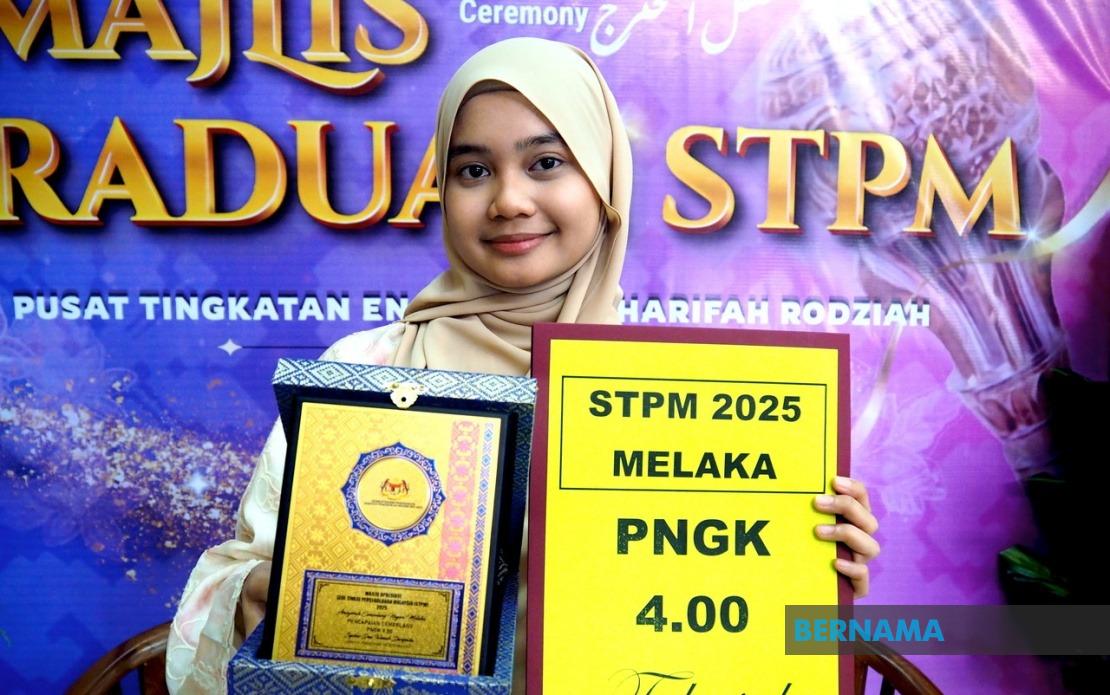
Nurfariesya Nasywa Hamedee's journey to academic excellence reads like a testament to resilience in the face of profound loss. The 21-year-old student from Sekolah Menengah Kebangsaan Agama Sharifah Rodziah in Melaka achieved a perfect Cumulative Grade Point Average of 4.00 in the 2025 Sijil Tinggi Persekolahan Malaysia examination, announced this week, but her accomplishment carries deeper significance than the grades themselves. Her late father, Hamedee Asri, died of a heart attack just a week before she sat for her Sijil Pelajaran Malaysia trial examination several years ago, leaving behind words of encouragement that would sustain her through years of academic pursuit.
The shock of her father's sudden death threatened to derail her education entirely. Confronted with grief and financial uncertainty as her family's circumstances shifted dramatically, Nurfariesya considered abandoning her schooling to enter the workforce and contribute to household expenses. The emotional weight of losing a parent during the formative years of secondary education is a burden few teenagers are equipped to bear, and her impulse to withdraw from studies was entirely understandable. Yet her father had left one final instruction, conveyed through her mother Yusnita Ruslan: that she should study hard and not squander her potential. This counsel, simple yet profound, became the anchor that prevented her from capsizing in her grief.
What makes Nurfariesya's achievement particularly striking is that she had not anticipated such a flawless result. Based on her trial examination performance and preliminary calculations, she had reasonably projected a CGPA of around 3.92, which would have been an exceptional outcome by any standard. The additional points that lifted her to a perfect 4.00 suggest not merely competent studying but a level of consistency and mastery across all her subjects that few students attain. She maintained excellence across a demanding array of subjects including General Studies, Arabic, Usuluddin, History, and Shariah, demonstrating intellectual breadth as well as depth in her chosen field of focus.
Her motivation extended beyond filial devotion to her father's memory. Nurfariesya has harbored a genuine passion for Shariah law since her school days, a scholarly ambition that provided intrinsic motivation beyond external pressures. Her selection of subjects reflected this focused trajectory, each course building towards her aspiration of becoming a Shariah lawyer. This thematic coherence in her academic choices likely contributed to her engagement with the material, transforming what might have been obligatory studying into purposeful intellectual preparation for a career path that genuinely appeals to her. She has already begun the process of applying to Universiti Malaya, where she recently completed an interview for the university's Bachelor's Degree programme in her field of interest.
Nurfariesya's choice to pursue STPM rather than other post-secondary pathways reveals pragmatic educational thinking. She reasoned that STPM offered a more efficient route to university entry compared to alternative qualifications, while simultaneously unlocking broader opportunities for admission into Malaysian and potentially international higher learning institutions. Her decision proved sound, as her stellar results now position her competitively for admission to one of Malaysia's premier universities. This calculation of educational pathways reflects a maturity in academic planning that, combined with her emotional resilience, paints a picture of a young woman thinking strategically about her future.
When asked about her formula for academic success, Nurfariesya declined to claim any mysterious methodology or special technique. Instead, she attributed her achievement to the fundamentals: dedicated studying, unwillingness to abandon her goals despite obstacles, and faith in Allah. This grounded perspective on achievement—rejecting the notion that success requires secret shortcuts or extraordinary talent—carries an important message for other Malaysian students navigating their own educational journeys. Her emphasis on consistency and perseverance as the true drivers of excellence contrasts with narratives that sometimes elevate innate genius above diligent effort.
The backdrop to her success story is the broader context of Melaka's STPM results announcement, which was officiated by Datuk Rosli Abdullah, the State Deputy Exco for Education, Higher Education, and Religious Affairs. This official recognition of excellent student performance underscores the importance that the state education system places on celebrating achievement at the advanced secondary level. Nurfariesya's perfect score represents not only personal triumph but also reflects positively on her school's educational standards and teaching quality.
Paralleling Nurfariesya's achievement within the same examination cycle is Ng Zhen Hong from Kolej Tingkatan Enam Tun Fatimah, who earned the National-Level Best Student Award for the Science Stream in the 2025 STPM. The 20-year-old secured an impressive ten As during his SPM examination and similarly attributes his success to parental support, teacher guidance, and genuine passion for scientific subjects. His approach of spending one to two hours daily reviewing lessons and viewing scientific challenges as opportunities for growth demonstrates a mindset that parallels Nurfariesya's philosophy, suggesting that across different fields of study, high-achieving students share common traits of disciplined habits and positive framing of difficulty.
The contrast between Nurfariesya's path through social sciences and humanities subjects and Ng's performance in the science stream reflects the diversity of excellence within Malaysia's education system. Both students achieved national distinction through different subject combinations, indicating that opportunities for outstanding accomplishment exist across the entire academic spectrum. For Malaysian secondary school students contemplating their STPM subject choices, these examples suggest that excellence is attainable regardless of whether one pursues sciences, social sciences, or humanities—provided the requisite dedication and interest are present.
Nurfariesya's story also speaks to the particular challenges facing students who experience bereavement during critical examination periods. Malaysia's education system, like many worldwide, lacks robust formal mechanisms for supporting students navigating major personal loss while managing significant academic pressure. Her recovery from the trauma of her father's death and her subsequent academic success occurred largely through family support and personal resilience rather than through specialized institutional assistance. The broader question for educators and policymakers is how better to support students in similar circumstances, recognizing that academic potential and personal tragedy can coincide.
Looking forward, Nurfariesya's ambition to become a Shariah lawyer positions her within a growing field of Malaysian women pursuing legal careers in Islamic jurisprudence. Her perfect CGPA provides a strong foundation for specialized legal education, and her interdisciplinary preparation across Arabic, Islamic theology, history, and Shariah subjects suggests she brings cultural and linguistic depth to her field. Her trajectory exemplifies how excellence in secondary education can translate into positioning for meaningful professional contribution.
The narratives of both Nurfariesya and Ng offer Malaysian families and educators valuable reminders about what drives exceptional academic performance. Neither student credits their success to expensive tuition, exclusive schools, or unusual circumstances. Rather, both emphasize the importance of parental encouragement, teacher support, consistent personal effort, and genuine intellectual engagement with their subjects. For families concerned about their children's academic futures, these examples suggest that the most reliable path to excellence remains the traditional one: sustained effort, clear goals, and emotional resilience when facing obstacles.
%22%2F%3E%3C%2Fpattern%3E%3C%2Fdefs%3E%3Crect%20width%3D%22100%25%22%20height%3D%22100%25%22%20fill%3D%22url(%23ph55801g)%22%2F%3E%3Crect%20width%3D%22100%25%22%20height%3D%22100%25%22%20fill%3D%22url(%23ph55801p)%22%2F%3E%3Ctext%20x%3D%2250%25%22%20y%3D%2250%25%22%20text-anchor%3D%22middle%22%20dominant-baseline%3D%22central%22%20fill%3D%22rgba(255%2C255%2C255%2C0.95)%22%20font-family%3D%22Georgia%2C%20'Times%20New%20Roman'%2C%20serif%22%20font-weight%3D%22700%22%20font-size%3D%22272%22%20letter-spacing%3D%22-0.02em%22%3EAnwar%3C%2Ftext%3E%3C%2Fsvg%3E)