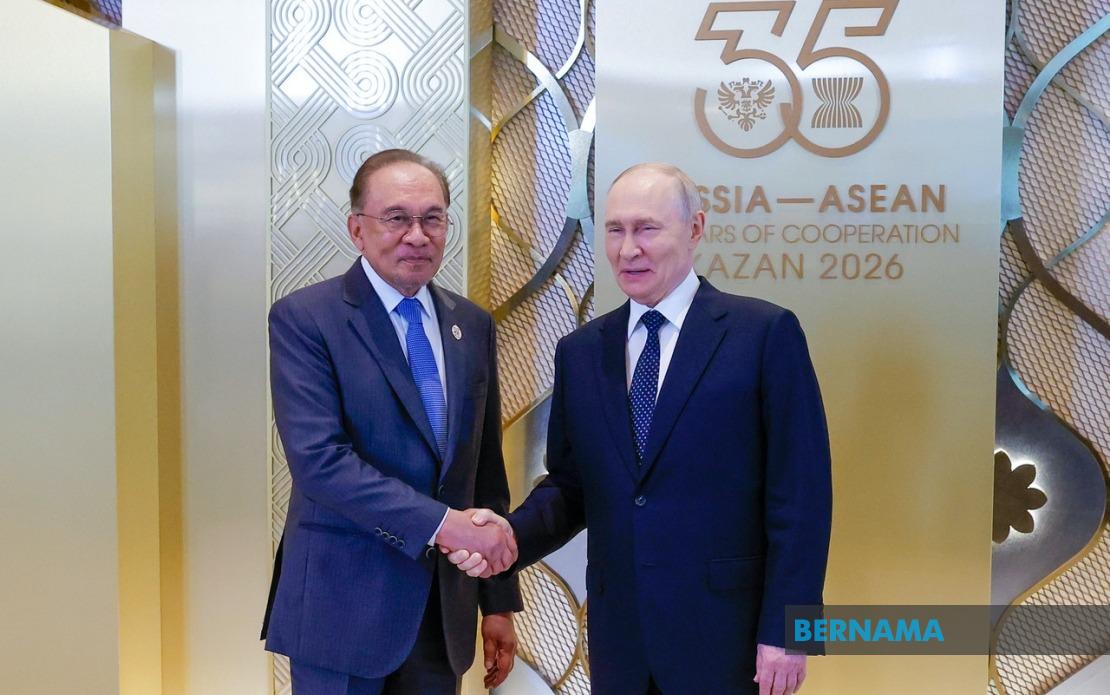
Prime Minister Datuk Seri Anwar Ibrahim has stressed that in an increasingly complex global landscape, structured engagement platforms represent essential mechanisms for deepening diplomatic relations and building confidence between nations. His remarks came after he attended a formal gala dinner hosted by President Vladimir Putin during the ASEAN-Russia Commemorative Summit in Kazan, the capital city of Tatarstan, held from June 17 to 18.
The premier's comments reflect a broader recognition that bilateral and multilateral summits serve purposes extending far beyond ceremonial protocol. These gatherings create deliberate spaces where national leaders can interact directly, away from the rigid constraints of formal negotiations, allowing for the cultivation of personal rapport and informal dialogue. Such interactions frequently generate pathways for addressing contentious issues and identifying shared interests that might otherwise remain obscured by official positions.
According to Anwar, the Kazan summit specifically functioned as an important venue for reinforcing bonds of friendship and enabling substantive exchanges of perspective among participating leaders. The event demonstrated how cultural and historical dimensions of host nations—in this case, Russia's rich cultural tapestry and heritage—can be leveraged to create more conducive environments for diplomatic engagement. By providing a context that celebrates shared human experience and cultural appreciation, such summits transcend transactional diplomacy and touch upon deeper foundations of international relations.
For Southeast Asian nations, engagement with Russia through ASEAN-coordinated frameworks carries particular significance. The ASEAN-Russia Commemorative Summit represents a formal institutionalization of relations between the 10-member bloc and Moscow, providing structured opportunities for dialogue on matters ranging from security cooperation to economic collaboration. This is especially pertinent given the geopolitical complexities of the Indo-Pacific region and the importance of maintaining balanced relationships with major powers.
Anwar, who also serves as Malaysia's Finance Minister, emphasized that such summits are instrumental for identifying and exploring areas where mutual cooperation can generate benefits for all participating states. This framing suggests that engagement is not merely about diplomatic niceties but about identifying concrete opportunities for partnership that can address shared challenges. Whether in technology transfer, trade facilitation, regional stability, or security concerns, structured platforms enable nations to align interests and coordinate responses more effectively.
The trust-building function of such summits cannot be overstated, particularly in a period marked by strategic competition among major powers and persistent global uncertainties. When leaders interact regularly within established frameworks, they develop improved understanding of each other's red lines, strategic priorities, and domestic constraints. This enhanced comprehension reduces the likelihood of miscalculation and creates space for creative problem-solving. The predictability and regularity of engagement also signal commitment to long-term relationships rather than transactional, issue-specific interactions.
For Malaysia and other ASEAN members, participation in such high-level summits serves multiple functions beyond bilateral relations with Russia. These events reinforce ASEAN's collective voice on the regional stage and demonstrate the bloc's commitment to maintaining relationships with diverse partners. In an era where regional architecture increasingly shapes geopolitical outcomes, Malaysia's presence and active participation in ASEAN-Russia forums contributes to ensuring that Southeast Asian perspectives are represented in discussions affecting regional security and prosperity.
The gathering in Kazan also reflects evolving patterns in international diplomacy where engagement is increasingly recognized as a stabilizing force. Rather than allowing relationships to deteriorate through lack of communication, nations are investing in sustained dialogue mechanisms that create habituation and familiarity. This approach has proven particularly valuable when relations are complicated by competing interests or historical tensions, as regular engagement prevents misunderstandings from calcifying into outright hostility.
Anwar's emphasis on mutual understanding as a precondition for cooperation aligns with Malaysia's broader diplomatic philosophy of constructive engagement and pragmatic partnership. The country has historically sought to maintain friendly relations across the ideological and geopolitical spectrum, viewing this approach as protective of national interests in a multipolar environment. By prioritizing dialogue platforms, Malaysia positions itself as a responsible actor committed to rules-based international order while maintaining flexibility in bilateral relationships.
Looking forward, the significance of such engagement platforms may only increase. As nations grapple with transnational challenges including climate change, pandemic preparedness, and economic instability, the need for regular communication channels and established cooperation frameworks becomes more urgent. The ASEAN-Russia Commemorative Summit exemplifies how regional organizations can serve as vehicles for maintaining great power engagement even amid strategic competition, potentially preventing escalation while creating space for collaborative responses to common challenges.

%22%2F%3E%3C%2Fpattern%3E%3C%2Fdefs%3E%3Crect%20width%3D%22100%25%22%20height%3D%22100%25%22%20fill%3D%22url(%23ph40buhg)%22%2F%3E%3Crect%20width%3D%22100%25%22%20height%3D%22100%25%22%20fill%3D%22url(%23ph40buhp)%22%2F%3E%3Ctext%20x%3D%2250%25%22%20y%3D%2250%25%22%20text-anchor%3D%22middle%22%20dominant-baseline%3D%22central%22%20fill%3D%22rgba(255%2C255%2C255%2C0.95)%22%20font-family%3D%22Georgia%2C%20'Times%20New%20Roman'%2C%20serif%22%20font-weight%3D%22700%22%20font-size%3D%22320%22%20letter-spacing%3D%22-0.02em%22%3EGRS%3C%2Ftext%3E%3C%2Fsvg%3E)